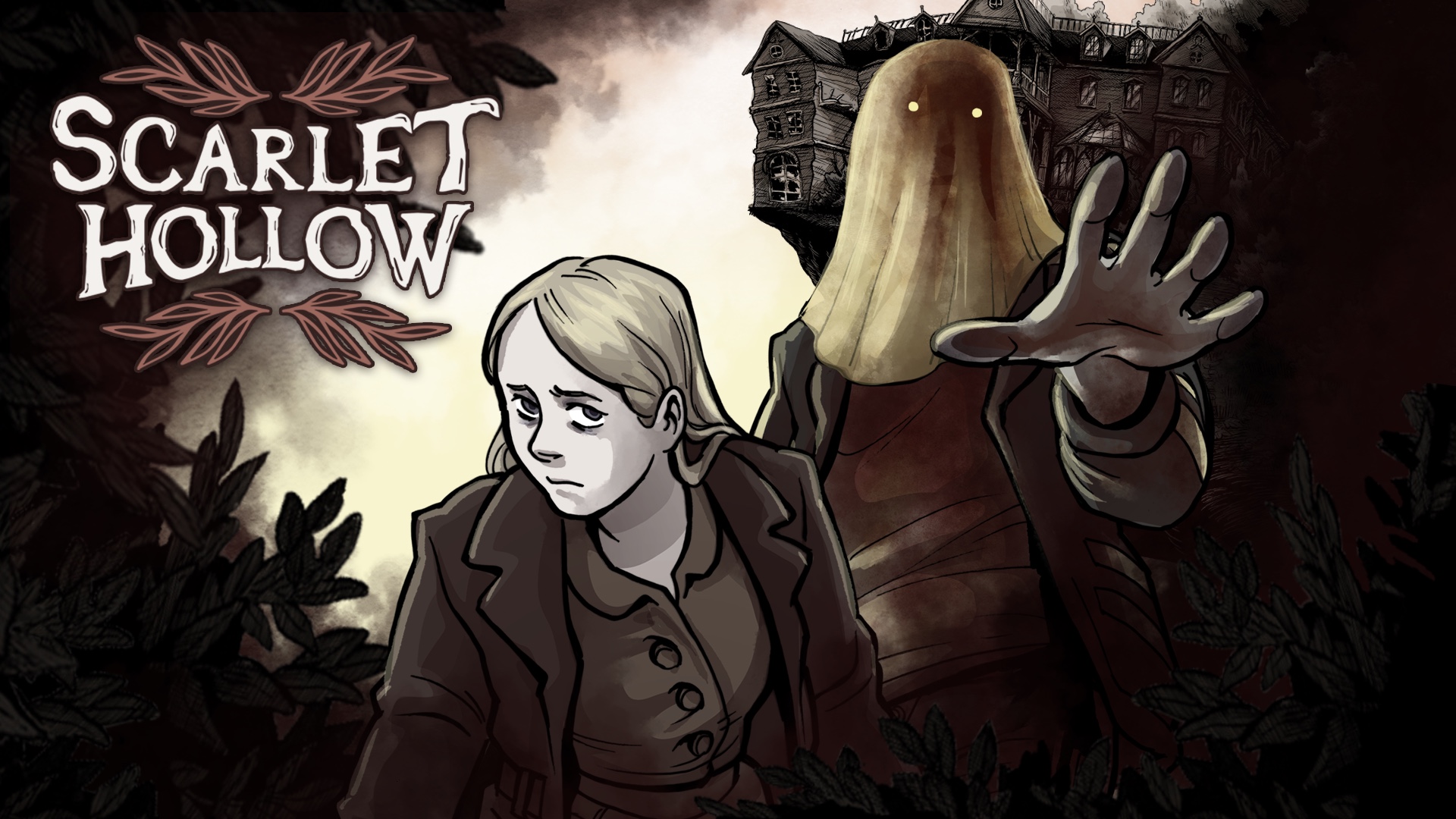
Gaming Editor Hanna Rumowska discovers what awaits in the eerie and mysterious town of Scarlet Hollow
Scarlet Hollow was provided to the author for free for the purpose of review.
Free will in a prewritten narrative
As a massive fan of Slay the Princess, I was overjoyed when Black Tabby Games provided us the opportunity to preview Episode Five of their new game, Scarlet Hollow. Finally, an excuse to sink my teeth into a project I was meaning to pick up for over a year.
My expectations were very high, as I worried that Scarlet Hollow may remain in the shadow of Slay the Princess. Both explore the possibility of free will in a prewritten narrative in a choice-based visual novel format, after all. After playing through Scarlet Hollow a few times, however, I found that this won’t be the case.

An atmospherically rich experience
Scarlet Hollow is an atmospherically rich experience, despite how hard it can be to pull off visual novel horror. Typically, such games lack direct interaction with the space that players should immerse themselves into.
But the second you wake up on the bus, you get the unsettling impression that something is off. You are travelling to the small town that your mum comes from to visit your cousin for her mother’s funeral. Be it the bizarrely forthright stranger on the bus, the decaying estate, or your mysterious, abrasive cousin — things are not right in Scarlet Hollow.

The perfect marriage of writing, art, and sound design forms the game’s unsettling nature. Danger hangs above your neck like a guillotine, particularly if you picked the ‘mystical’ trait like I did.
The town of Scarlet Hollow is doomed. However, between gruesome magic, a mysterious stalker, and incompetent police, it’s hard to say what will come first.
Mundane twisted into the uncanny
Abby Howard’s artwork brings the horror to life; her creature designs are second in scare factor only to her backgrounds. Using cross-hatching, crooked shapes, and ominous forced perspective, Scarlet Hollow thrives on the mundane twisted into the uncanny.
The art style can change dramatically depending on what you’re experiencing. A ghost haunting can be a collage of real life images, a memory can appear stark and discoloured. These effects provide a unique and artistic beauty to the horror.

Episode Five has perhaps the best instance of a stylistic shift yet, in my opinion. To attempt to describe it would be doing it a disservice: you just have to play and see for yourself.
Combined with the sound design and music, which successfully induces panic during the tenser moments of the story, you have an experience unlike any other.

Uniquely detailed relationship system
Scarlet Hollow draws you in, and no matter how deep it goes, you never once think of looking back. This is not even mentioning the portrayals of romance, absurdist sense of humour, or even the game’s engagement with philosophy.
One thing to note is the game’s uniquely detailed relationship system. Rather than merely liking or disliking your character, characters perceive you in terms of ten hidden variables. This leads to unique dialogue and behaviour from multiple characters, important or otherwise.
For example, your cousin, Tabitha, will treat you differently depending on if she thinks you are a closed-off genius, a suck-up, or a brash idiot. Each character also has complex preferences for traits and behaviours built-in, leading to more thoughtful relationships than most dating sims.

A labour of extreme love and passion
This story is currently not finished, but steadily inching towards completion. Black Tabby Games refuse to sacrifice quality for the sake of speed — as such, the final two episodes currently do not have a release date.
Scarlet Hollow is evidently a labour of extreme love and passion, so I deem the wait well worth it. Today, with the release of the latter half of Episode Five, the game has become bigger than ever before. I, for one, am planning to find its every secret, as daunting as the task may be.
Also, I would die for Dustin the opossum — but honestly, wouldn’t we all.

Your choices matter: which review will you read next?
Comments