Film & TV Writer Ariel Lask celebrates the 20th anniversary of the first Twilight novel, exploring the franchise’s lasting cultural impact
This year marks the 20th anniversary of Twilight Stephanie Meyer’s 2005 novel, which generated a multi-billion-dollar blockbuster series, transforming young adult fiction and cinema. Regardless of whether you love it or hate it, it is impossible to dispute its legacy and status as a (dare I say) iconic franchise. However, why is it so ‘iconic’, why does it spawn so many polarising opinions and could it be considered a genuinely good series despite its controversy, backlash, and cringe factor?
Twilight’s legacy is a confusing one. Remembered by some as a quintessential part of their childhood experience; a gloriously corny yet romantic piece of art. Whilst to others, often those who are only familiar with its online reputation, deride and defame it. It’s easy to see how its reputation has arisen, the comically bad CGI, the overuse of green screens, and a constant green filter. Not to mention some of the more questionable lines such as, ‘this is the skin of a killer, Bella’, ‘you better hold on tight spider monkey’, and ‘Bella, where the hell have you been, Loca?’ makes itself, surprisingly enough, vulnerable to mockery.
Twilight’s legacy is a confusing one.
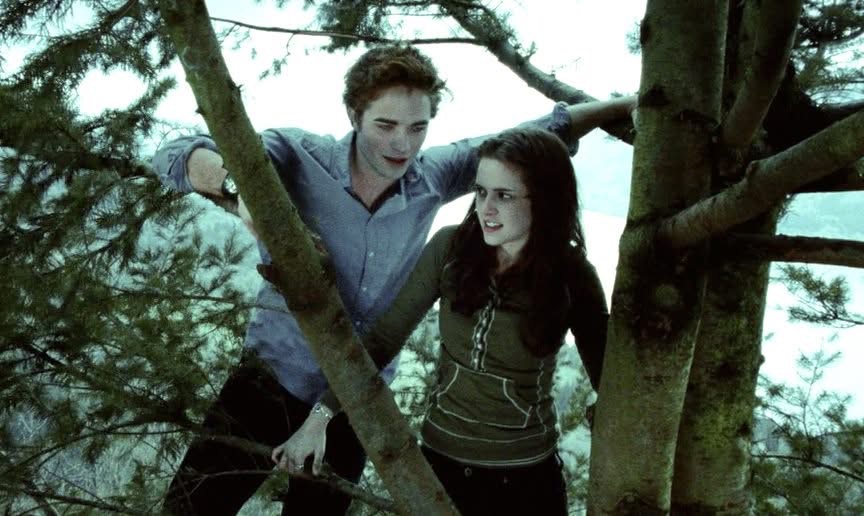
Criticism of the franchise emerges from all sides too; many feminists have criticised Bella Swan’s (Kristen Stewart) ostensibly helpless depiction. However, behind its facade of poor production and often questionable writing is, perhaps, a harshly treated feminist story which should be celebrated for its impact in opening the door for media directed by women made for pre-teen and teenage girls specifically.
Feminist critics often see Bella as a bland, weak character, arguing she solely relies on men such as her dependence on Jacob (Taylor Lautner) when Edward (Robert Pattinson) is absent and her reliance on Edward to turn her into a vampire. However, is this reading entirely fair? Could Edward, perhaps, fill the trope of the damsel in distress more than Bella? In New Moon she travels all the way from Italy and stops Edward committing ‘vampire suicide’. Moreover, when Alice sees a vision of Bella as a vampire, she says she will turn Bella if Edward doesn’t. This, additionally to Bella being immune to vampire mind reading, perhaps gives rise to a theory that she was destined to be part of the supernatural world, her agency therefore extending beyond the men around her. While the feminism in the franchise may not be overt, and despite Stephanie Meyer’s Mormon-influenced worldview bleeding into the novels, there is nonetheless a nuanced and often overlooked argument for Twilight being a feminist story.
…I believe it is safe to infer Twilight’s pivotal role in influencing the ‘romantasy’ genre.
Furthermore, its legacy and cultural impact is undeniable, not solely due to its ‘cringe-worthy’ factor as many may assume, but for its influence on media. Subsequently to its release in 2008, there was a boom in the selling of the supernatural/paranormal romance genre within young adult fiction. In 2007, only two percent of all YA novels sold in the U.S. were classifiable as supernatural/paranormal romance which increased to seventeen percent in 2009 (Keyser S, 2010). Although correlation doesn’t necessarily equal causation, I believe it is safe to infer Twilight’s pivotal role in influencing the ‘romantasy’ genre.
Additionally, Twilight’s influence in pioneering a wave of female-led young adult movies due to its success at the box office is clear; namely The Hunger Games. Which was another female written movie franchise portraying a female main character who is clearly independent despite the presence of Twilight’s love triangle formula. These tropes have bled into our culture and influenced many other forms of media such as The Hunger Games to the newest Star Wars franchise and maybe, even, The Summer I Turned Pretty. This far-reaching claim for Twilight’s influence may seem outlandish – however, due to its commercial success and widespread influence on media, it may not be too absurd to pinpoint Twilight as the progenitor.
Until Twilight, blockbusters almost solely centred around men with a male audience in mind.
From a feminist standpoint, its legacy extends beyond inspiring the creation of the aforementioned successful media centering women and I would argue the release of Twilight is inherently feminist in its own right. Written and directed by women, its unprecedented success subverted the assumption by Hollywood that women were a niche audience. Until Twilight, blockbusters almost solely centred around men with a male audience in mind. Through its popularity in captivating the new demographic of pre-teen and teenage girls (as well as, albeit, middle aged mums), it can be seen as a rightly feminist landmark in media.
More from Redbrick Film & TV:
Comments