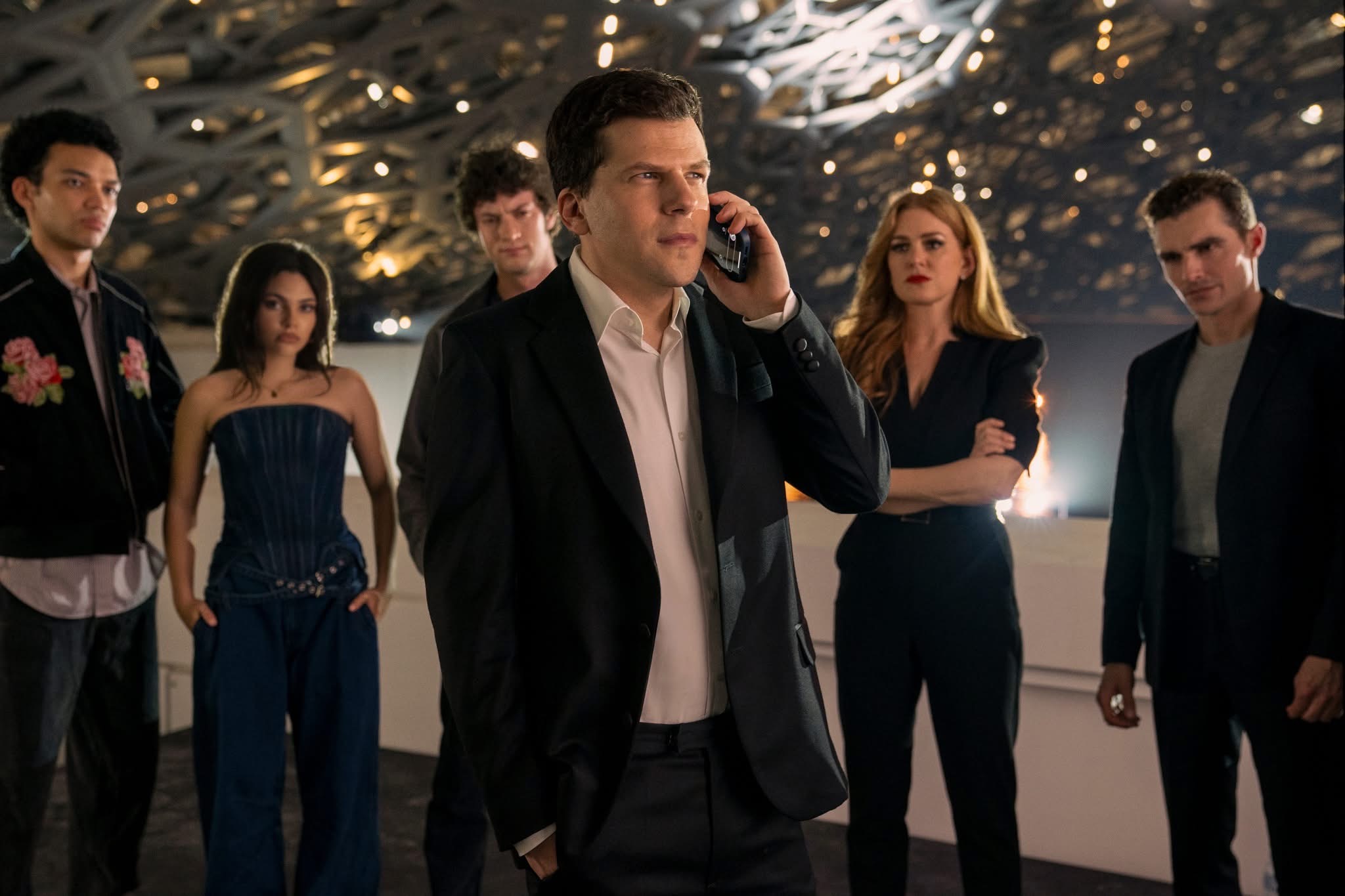
Film & TV Writer Roxana Sherahmad reviews the third instalment in the Now You See Me franchise, finding that it fails to capture the same charm of its predecessors
Nearly 10 years after its last instalment, Now You See Me: Now You Don’t – the third movie in its self-contained magic franchise – was released this November with mixed reviews. The film brings back its previous ensemble cast, as well as some fresh new faces – Ariana Greenblatt, Dominic Sessa, and Justice Smith, all rising stars from recent box-office hits.
It’s safe to say no amount of nostalgia could have made this film memorable.
As someone who grew up loving the unique heist and magic combo that the movies had to offer, I was intrigued to see how this one would fit into the recent conveyor belt of movie sequels being desperately pumped out by Hollywood to varying degrees of success. It’s safe to say no amount of nostalgia could have made this film memorable.
In this film, we follow The Four horsemen as they are reluctantly forced together by what appears to be ‘the eye’ (an ancient magical organisation we still pretty much know nothing about 3 movies in). We learn they have been separated for the 10 years that have passed, and this is explained to us through the perspective of the three rough-around-the-edges Gen Z magicians they are forced to work with.
In case you haven’t watched the first two Now You See Me movies, you will be in luck as the third tells you everything you need to know a few times for good measure; for a movie about complexity and illusions, the writing guarantees that all the subtleties in the horsemen’s relationships are flattened out. What have the horsemen been up to all these years? Let them explain that in a 10-minute-long expository scene. Can’t seem to work out the dynamics between the young magicians and why they have banded together? Well as they will explain, ‘We’re family’.
This film’s use of exposition is very difficult to ignore, seeming as it dominates almost every non action scene, and it makes me wonder if any of the writers had thought of the concept of a flashback or direction. Instead of seeing the reunion of the dynamic between The Four Horsemen, that is so electrifying to watch in the first and second instalments, we are instead briefly told how they feel about each other at that present moment.
A key tension between characters falls in the relationship between the talented and easy-going Bosco Leroy (Dominic Sessa) and Atlas (Jesse Eisenberg), meant to make light of the intergenerational divide between the seasoned millennial magicians and their fresh-faced Gen Z counterparts. The sense of everything being dumbed down for us especially comes through in their interactions, as Atlas explains that Leroy is arrogant and too laid back at every opportunity that presents itself to the point where it just gets hilarious. We often feel as frustrated as Leroy is made to feel as we are continually fed with half-baked Gen Z criticism: at one point Leroy’s name is mocked for sounding like it was generated by ChatGPT. Through all this Atlas becomes a caricature of himself, as do many of the other characters, and we end up feeling like The Four Horsemen are an extended cameo in their own movie. It’s alright though, because Rosamund Pike’s (who plays Veronica Vanderberg) South African accent is the real star of the show.
…we end up feeling like The Four Horsemen are an extended cameo in their own movie.
None of the characters feel fleshed out, though this seems to be the fault of a bad script as the actors do their best to achieve moments of depth in a film which tries to juggle way too many characters. A casualty of this being that the self-aware humour that the film employs also singes all the emotional beats, leading to even a major character death paling in the fast and shallow pace and sardonic tone.
Despite all this, the film does succeed in delivering the absurd spectacles that The Four Horsemen promise you. If you don’t take the film seriously it’s entertaining and hits a certain comedic threshold. It does however set a bleak tone for these perpetual sequels once you realise they have nothing else new to offer you bar a glimpse at a familiar beloved character, or was that just another illusion?
More from Redbrick Film & TV:
Doctor Who: The War Between the Land and the Sea… or Between the Fans and the Writers?
Earth’s Infestation: Yorgos Lanthimos’ Uncomfortable Truth for Teddy in Bugonia
Comments