Film & TV Writer Amelia Long explores Harris Dickinson’s directional debut, Urchin, finding that it respectfully handles themes of homelessness and addiction
Spoilers for Urchin (2025). Content warning: brief mentions of addiction and homelessness
Harris Dickinson’s feature-length directorial debut Urchin was released in cinemas on October 3rd, and I had the chance to watch it about a month later. Drawing from the history of British social realism, with clear influences from Agnès Varda to Mike Leigh, Urchin follows Mike (Frank Dillane), a young man desperate to be understood and seen.
Dickinson deals with the complicated subject matter of homelessness and addiction with the respect it deserves, never indulging the audience in dramatic or sensational scenes of life on the streets.
Dickinson deals with the complicated subject matter of homelessness and addiction with the respect it deserves, never indulging the audience in dramatic or sensational scenes of life on the streets. Instead, he focuses on the quiet mundanity of Mike’s day-to-day. My focus in this article will be on the portrayal of vulnerability, how Dickinson expresses it through everything but dialogue, primarily, Dillane’s physical performance and the surrealist elements. All of which put the audience in Mike’s head as he moves through the film.
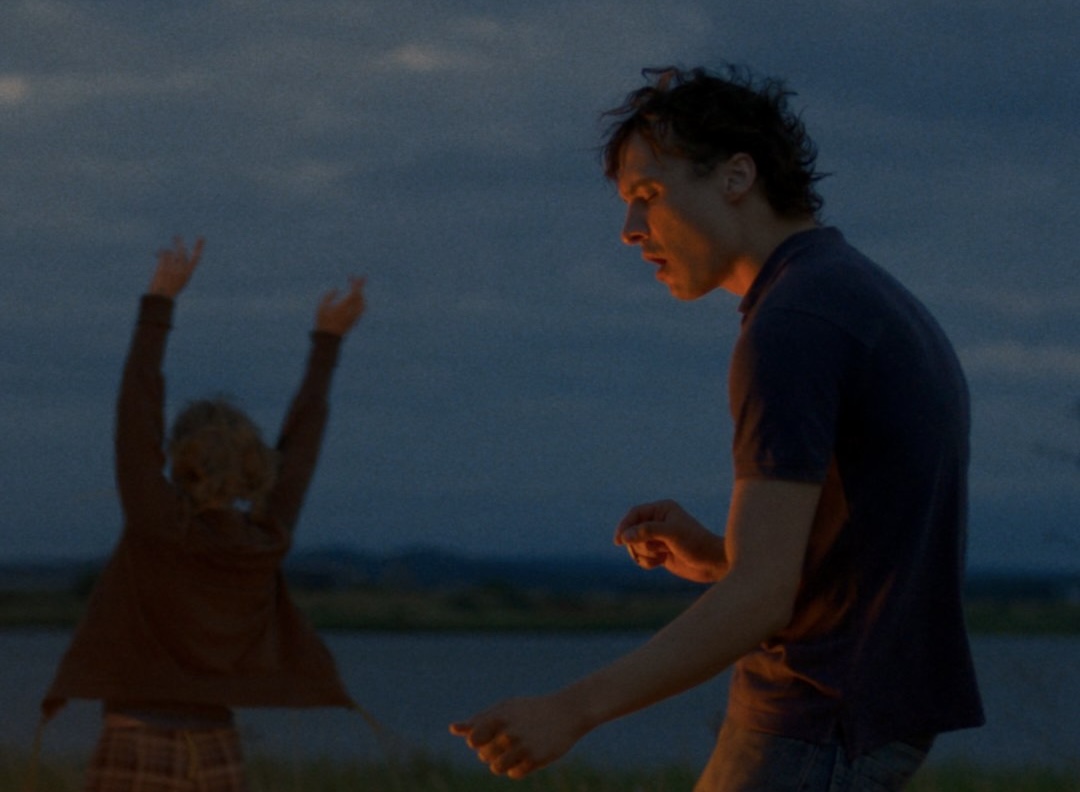
Dillane’s physical performance stands above all else in Urchin, the audience learn about Mike through his physicality, giving insight into his personality. Mike’s body is a site of vulnerability, signified by the way his movement dictates his emotions. Dillane contorts himself into an image of pain, stress, joy, and pleasure at important moments of the film. Most of all, Mike is rash, making split second decisions, the best example is when he steals a man’s watch, who had offered to get him some food. Dillane conveys the change in Mike through body language, right before he punches the man, Mike’s pace falters, he quickly looks around, then attacks, grabs the watch, and sprints off. From here, the pace is frenetic, all hinged on Dillane’s performance.
Dillane also uses his body to convey how Mike’s attitude changes with his current situation. Only twenty minutes into Urchin, his life is improving, having been released from prison with a job lined up and a room at a hostel, Dillane expresses happiness through the way he now moves. Mike bounces out of the charity shop after buying new clothes, grinning to passersby – visibly lighter, signifying vulnerability. This lightness quickly diminishes as Mike has to apologise to his victim as part of his parole. As the scene progresses, Mike grows increasingly agitated, looking around nervously and tapping his leg almost uncontrollably. Here, he loses his vulnerability, despite the camera’s steady zoom into a close-up, the scene cuts away, stunting the emotional climax. The audience is no longer privy to him speaking his emotions. Now he hunches as he walks, looking at the ground and zipping his jacket all the way, shutting himself off from us and the world around him.
The most stylistic choice of Urchin is the use of surrealism, these diversions out of the realist narrative happen in bathrooms, a place which symbolises physical vulnerability. As Mike showers after entering prison, the camera pans down into the drain which opens into an abyss. The camera glides through this pitch black world filled with colourful shapes emblematic of cellular and synaptic structures. Dickinson does not dwell here, now the camera is fixed, zooming out to reveal a forest scene, panning up and through a cave where Frank is alone, almost camouflaged against the grey, staring into the sky. This moment is never explained or returned too, instead the scene smash cuts to Mike coming out of a stupor as if zoned out, and the film returns to the banality of the parole office. So many questions arise from this deviation of narrative.
Another time the surrealism returns is near the end, again it starts in a bathroom, bathed in electric blue light, Mike opens a cubicle door and finds an elderly woman standing still, staring. Again, the audience is not given an explanation, though the same woman returns in the ending. Silence swallows the scene, and Mike reaches out to her, as if for comfort. He begins to follow her through a church corridor into the nave of the church, where Nathan is standing in priest-like robes. Nathan hugs Mike, whose body collapses into the affection, exemplifying his desire for comfort, when he suddenly pushes Mike through a door into an endless void. This void is starkly similar to one mentioned above, now Mike falls the air, body splayed and flailing as Niccolò Paganini’s 24th Caprice plays, highlighting the chaos of the scene.
Dickinson’s use of surrealism, especially in the ending, highlights Mike’s descent into vulnerability, as we have watched his life fall apart again.
Finally, Mike becomes still, face at peace and moves into a foetal position as if sleeping. The camera no longer follows him, instead we are forced to watch him fall further and further until he disappears, and the screen fades to black. Dickinson’s use of surrealism, especially in the ending, highlights Mike’s descent into vulnerability, as we have watched his life fall apart again. This last moment of peace is both cathartic and harrowing, leaving us to wonder his fate as the credits roll.
Verdict:
Urchin is a masterclass of physical performance and genre; the world is developed and realistic – thanks to on location filming – rendering Mike’s inner life as complex and confounding in contrast. Watching Urchin for the first time is an intense emotional experience and requires active watching from the audience, which I also appreciate.
Rating: 4.5/5
More from Redbrick Film & TV:
Are We Making Too Many Biopics?
Character Spotlight – More than a Kingslayer: A review of Jaime Lannister
Comments