Film & TV Writer Emily Walmsley finds Emerald Fennell’s adaptation of Wuthering Heights to be cinematically powerful, despite its historical inaccuracies
Since before its Valentine’s Day release, Emerald Fennell’s “Wuthering Heights” has sparked intrigue and controversy across social media and the press. “Wuthering Heights” is an adaptation of Emily Brontë’s novel of the same name, a cornerstone of gothic literature since its publication in 1847; however, the 2026 film has not been true to the original. Although, of course, an adaptation is just that: an adaptation.
…the film is undoubtedly a model for the power of cinematography.
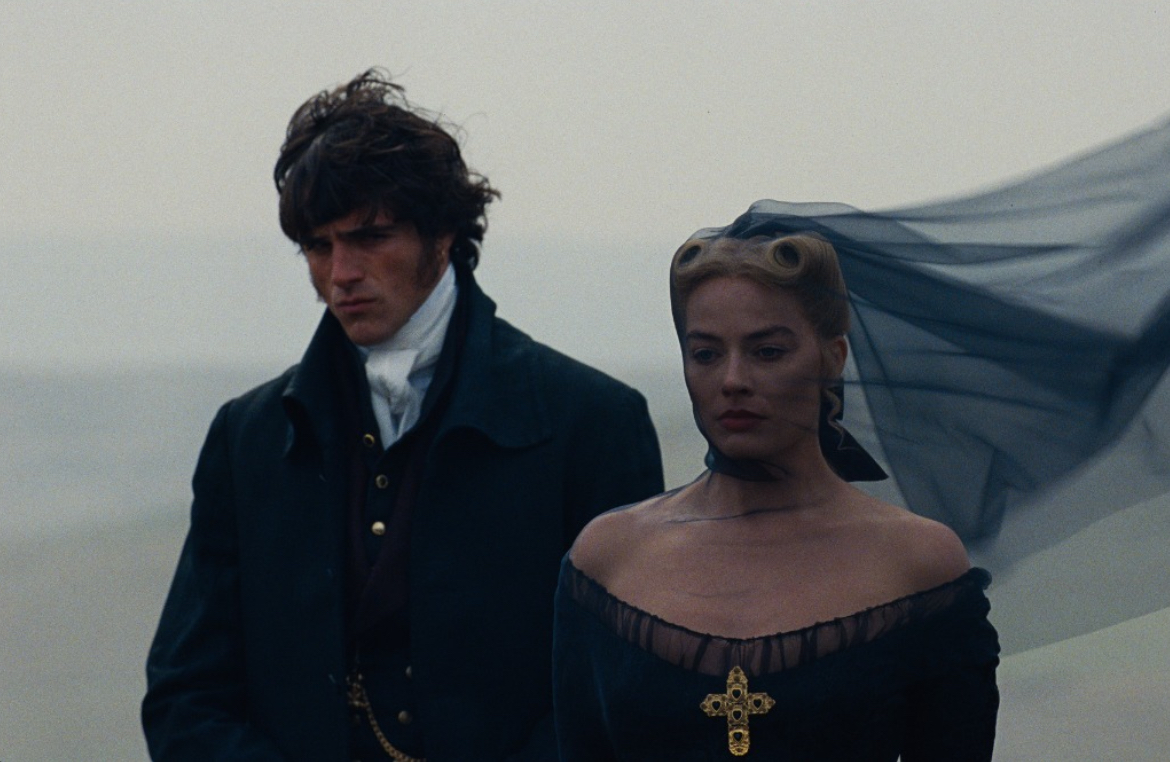
Though artistic choices such as casting, costuming, and plot deviations have sparked dispute amongst fans of both Brontë’s novel and Fennell’s adaptation, the film is undoubtedly a model for the power of cinematography. Cinematographer Linus Sandgren created an intoxicating atmosphere, creating a claustrophobic feel amidst the vast landscapes of Yorkshire. Colours are used throughout the film to highlight emotion, with striking shots of red skies, and red dresses, acting as a gothic motif of passion, destruction, and tragedy. The dark, moody moors are at once contrasted with the vibrant yet flat-feeling Thrushcross Grange.
While some argue that an adaptation should portray a story in a fresh, creative way, it feels as though the original plot is somewhat lost. The most contended aspect of Fennell’s adaptation is the casting of Jacob Elordi as Heathcliff. Described in the novel as ‘dark-skinned’, we never know Heathcliff’s true origin (with Nelly speculating ‘who knows but your father was emperor of China, and your mother an Indian Queen’); but we know for certain that he is not white. Typically, I believe that whoever is the best actor, despite outward appearances, should be awarded a role; however, in this instance it is integral to the narrative that we see Heathcliff as he was intended by Brontë. It is rare that a period drama originating from England includes characters that are anything but white, and the removal of Heathcliff’s authentic appearance from “Wuthering Heights” is damaging.
While some argue that an adaptation should portray a story in a fresh, creative way, it feels as though the original plot is somewhat lost.
Besides the multitude of historical inaccuracies, Margot Robbie, brilliant actor as she is in the plethora of films she has starred in (for example, Greta Gerwig’s Barbie, 2023), does not give a compelling performance of the powerhouse of emotion that is Catherine Earnshaw. First of all, the choice to ditch the Yorkshire accent makes the character seem detached from the story. The Yorkshire accent is supposed to reflect the socially untamed aspect of Catherine’s personality, but Robbie’s Received Pronunciation turns Catherine into a character disconnected from the untamed nature of the moors surrounding her.
The costume designer for “Wuthering Heights”, Jacqueline Duran, is undoubtedly talented, with her design featuring in many esteemed book-to-film adaptations: Pride and Prejudice (2005), Anna Karenina (2012), and Little Women (2019). British Vogue labels the costumes of “Wuthering Heights” as ‘wild and wonderful’, and whilst I agree with the former description, I cannot say the same for the latter. The extravagance of some of the costumes, particularly on the female characters of Catherine Earnshaw (Margot Robbie) and Isabella Linton (Alison Oliver), are certainly pieces of art that are at once intricate and interesting; however, the use of some textures, such as latex, makes the film lose its Victorian grounding. Yet, Duran’s creativity is certainly a high point in some scenes, featuring some striking, historically accurate pieces,
Despite this, even as a lover of Emily Brontë’s novel, as an entity that is separate from its inspiration, “Wuthering Heights” was undoubtedly an enjoyable watch, with completely sold out shows across the country to attest to this. While the plot is significantly different from the original narrative, Heathcliff and Cathy’s enduring, destructive love can be felt throughout – a testament to the story’s powerful emotive presence.
Rating: 3/5
More from Redbrick Film & TV:
Comments