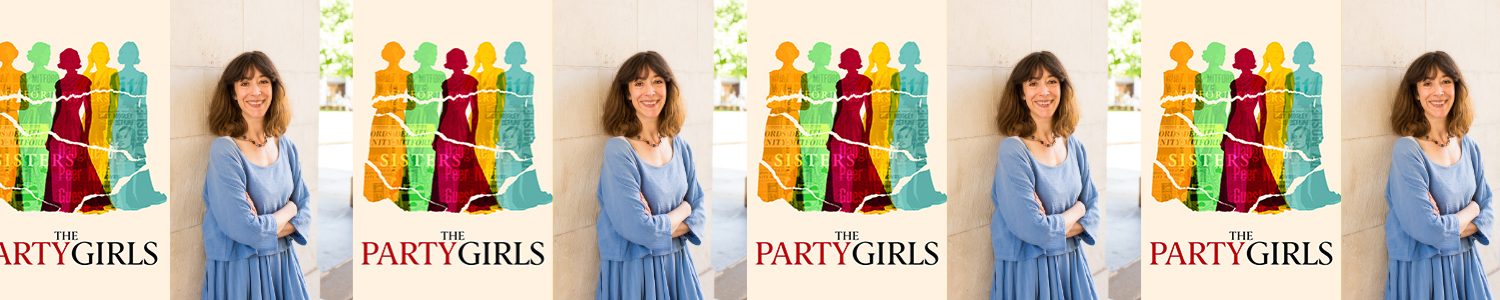
Editor-in-chief Vidhi Bhanushali interviews UoB alumni Amy Rosenthal, playwright of The Party Girls, which is soon to play at The Rep.
Politics and ideologies are a crucial part of people’s personalities. But what’s more crucial is the way these beliefs sprout in our heads as children, and how much of that changes as we grow up. The Party Girls by Amy Rosenthal explores this idea of extremist political beliefs that the Mitford sisters develop in contrasting ways. We see Decca Mitford pursue love, while the other sisters stay firmly obsessed with the political stance they chose as children.
Amy Rosenthal’s passion for this story is reflected in her description of the play and her interest in the influence of politics on shaping personalities. I interviewed her on video call about her process and her thoughts on the themes in the play.
A family of aristocratic sisters torn apart by political convictions
If you were to describe your play in one line, how would you do it?
I would say it is a story of a family of aristocratic sisters torn apart by political convictions. I think that’s the best description that fits on a superficial level. It covers the life of the sisters over a huge period of time, talking about love and prejudice. I hope it is also funny at times to break the seriousness of the political situations.
While talking about families and siblings, what role does plain influence play in the light of these children acquiring personal beliefs on politics?
Children often grow up forming their opinions in direct opposition to each other
Children often grow up forming their opinions in direct opposition to each other. In the case of these sisters, what interested me was their childishness and antagonistic approach in the beginning. A sister would say she’s a communist just because the other claims to be a fascist, a clear example of youthful rivalry. Considering the time in which they lived, these beliefs hardened into something dangerous. They were intelligent women who were not allowed to be educated because their eccentric father believed that if women went to school, they would get thick ankles from playing hockey! As a result, they self-educated and fell in love with the extreme politicians of the time. I was interested in the firm political stances that these women developed while growing up in restrictive conditions.
It sounds intriguing to think about the difference between a childish understanding and an adult obsession of an important aspect like politics.
Yes, these sisters in the past, and to some extent in my play as well, were shrieking, babbling aristocrats who have their own private language and nicknames for each. That being said, I wanted my play to hold the complicated bit alongside the sister whose views were least sympathised with, to try to have moments of humanity. Some of the conflicts between the sisters were so intense that they did not speak to each other for thirty years. The play covers several timelines to show their relationship.
What was your inspiration behind this play?
Initially, it was a commissioned piece, and I knew very little about the sisters. I had read the novels written by Nancy, the eldest sister, and knew briefly about what the others had done. But because I am a writer who gets blocked sometimes, it is very welcoming for me if someone approaches me with an idea. And so, I jumped into it and researched it, to find a story in it. But what I didn’t anticipate was how much I would fall in love with it as a subject matter itself.
As we speak about political differences and beliefs held by the youth, how close do you think the parallels are between the current generation and the sisters?
That’s an interesting point. I have been asked before that if social media had existed, what would the sisters be doing with it. It was a terrifying thought because two of the sisters were in close contact with Hitler and became personal friends with him. They were a danger to Britain during the war because they were passing on secrets. It is indeed mind-blowing to think about the possibilities of their actions if they had access to social media platforms given what they did anyway. But they would have probably also been be cancelled for their beliefs.
I want them to talk about the play when they leave the theatre
What category of audiences are you expecting to relate to your story, and why? Who do you think should definitely watch this play?
I would like everyone to watch it. There is a tendency for older audiences to be drawn towards this, as they would imagine it to be rooted in history. People of that age would be familiar with the prominent figures that the play talks about. I also hope that it is a play for our times as it is about political difference. All that aside, it is also a love story! I like leaving the audience to feel hopeful about the world so I’ve tried to get a happy ending out of this serious tale that might not have had one. My aim is to give all types of audiences, of any age, a good experience and I want them to talk about the play when they leave the theatre, even if they didn’t like it. I want people to laugh, even though a lot of this is quite dark. I want them to feel excited about the possibilities of theatre and its magical means to time travel!
You’re a University of Birmingham alumni! What did you study here, and what aspect of your university played a part in your career while becoming a playwright?
I did an MA in Playwriting from the University of Birmingham. I had done an undergraduate degree in drama in Manchester. I didn’t know what direction I wanted to go in then, but my dad was a television writer, and my mom was an actress. I am a terrible actor, and I knew that as soon as I began my drama degree. But at the end of it, I did a little bit of playwriting as an option. I really liked writing plays because that way, you get to play all the parts without having to do it in front of anyone. At that time of the late 90’s, it was the only playwriting course in the country as far as I knew. David Edgar, a brilliant playwright, was an amazing teacher and ran a wonderful course through which we had a lot of access to other industry professionals. I really loved Birmingham as well, more than I expected to. And I’m really looking forward to coming back when the show goes on.
Watch The Party Girls at The Rep from Monday, 6th October to Saturday, 11th October. You can buy tickets here.
Comments