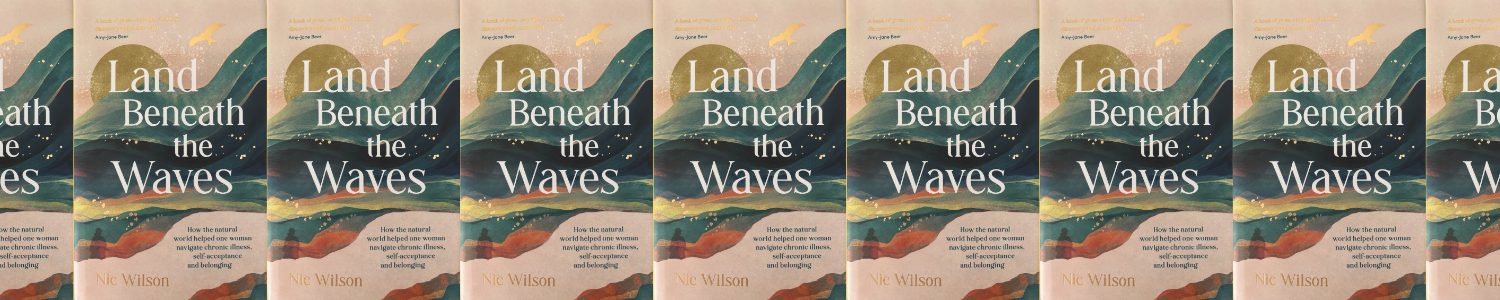
Culture Writer Emily Walmsley writes about author Nic Wilson’s talk on her new book Land Beneath the Waves, which explores nature as a mirror and a companion to human struggles through the lens of her own chronic illness
Content warning: mental illness, chronic physical illness, trauma, grief, environmental distress
You can find nature anywhere, it’s just a case of looking
Humanity is inextricably entwined with nature; it is intrinsic to our understanding of the world around us and to our connections with others, but more importantly, to our connection with ourselves. In her debut novel Land Beneath the Waves, author Nic Wilson explores her own relationship with nature whilst navigating life with a chronic illness.
During her talk with Dr. Susanne Boerner (Assistant Professor of Human Geography at the University of Birmingham), Wilson shares her authorial journey, from working on the Country Diary series in The Guardian to contributing to various anthologies. What started as a collection of nature stories, Land Beneath the Waves quickly became autobiographical as Wilson discovered that her own experiences with women’s health, mental health, and chronic illness are not separate from her experiences with nature.
The title of the novel lends itself to the chalk-lands of the Chilterns, which were formed during the cretaceous period and act as a habitat to various wildflowers, harbouring a wide range of biodiversity. The title presents the ‘fluidity’ of a landscape that is significant to Wilson, indicating the ‘parallels between a chronically ill body and the landscape,’ both of which are highly unpredictable. In this way, nature can act as a mirror for our experiences.
The plethora of healing effects that spending time in nature can bring
Dr Boerner shared that telling stories often acts as a medicine; in times of ‘hopelessness,’ both nature and writing become our ‘companions.’ It is the constant in everyone’s life that can have a healing presence, aligning with the ‘nature cure narrative’ that explores the plethora of healing effects that spending time in nature can bring. Through the restrictions of living with a chronic illness, Wilson was able to open her perspective to the world in a way that allowed for the appreciation of the landscape and natural life immediately surrounding her, stating that if you simply notice the birdsong, ‘you will never be alone.’
Dr Boerner also voiced that ‘we are one’ with the land; that the natural life surrounding us holds a wisdom that is often dismissed in the colonial understanding of knowledge and the natural world. This opposes indigenous beliefs of balance: to conserve our environment, we must see ‘the beauty and the wonder’ as well as ‘the crises and the issues’ that harbour our complex relationships with the natural world. Wilson feels that it is her duty as a naturalist to speak of the climate crisis in her work, for our relationship with nature is both symbiotic and sacred.
The natural life surrounding us holds a wisdom that is often dismissed
Our relationship with nature changes throughout our lives – what was once predictable and grounding in childhood (such as the changing seasons), can become unpredictable in adulthood: as we become more complex and nuanced, we lose the ability to see the simple structures that once constructed our world views. Wilson is aware that in our fast-paced society, people often lose touch with nature and the peace that it brings. Wilson resonates with Terry Pratchett’s idea that you must ‘open your eyes, and then open your eyes again,’ because even in bustling city centres, you can find comfort in the natural world.
In Wilson’s writing, she follows a practice of ‘heeding’ – being present in her surroundings to create a sensory atmosphere for the reader. This immersive experience can serve as a tool for navigating our own experiences with the world, as Wilson explains that ‘nature has a lot to teach us.’ Land Beneath the Waves redefines nature as inclusive of the human experience – humanity is innately connected to nature.
As Wilson once found her solace through the stability of nature, she also learnt to appreciate the beauty of its unpredictability and ubiquity. The earth is connected to all aspects of humanity; Land Beneath the Waves opens with a quote from Shakespeare’s Hamlet – ‘there’s rosemary, that’s for remembrance; pray, love, remember’. Perhaps creating a relationship with the natural world relies on changing our perspective – it will be there for us in any way we wish to let it into our lives (whether that be within literature, art, or science), thus affirming Wilson’s belief that ‘you can find nature anywhere, it’s just a case of looking.’
Comments