Comment Writer Joseph Helsby reflects on his experience at the highly anticipated Radiohead reunion tour.
Following an almost 8-year hiatus, Radiohead returned last month, performing five shows at the O2 Arena in London. With the capacity of the venue being only 20,000 and the band receiving 45 million monthly listens on Spotify alone, tickets were astronomically hard to get hold of. Many fans questioned why the band hadn’t chosen a stadium tour, which would have done more to accommodate the fan demand. I myself only managed to get hold of tickets through a bizarre long-term favour, having previously given up Taylor Swift tickets for a friend in 2024.
Upon arriving at the O2, the intergenerational nature of the band was apparent. Obviously, lots of the younger fans needed to be accompanied, as per the venue’s rules. However, it didn’t seem as though parents had been dragged to the gig in a way that might be true for other artists. Arguably, they were more excited than their children. For example, I saw one father next to me dancing like Thom Yorke, moving in a way that seemed impossible given our limited space.
I saw one father next to me dancing like Thom Yorke, moving in a way that seemed impossible given our limited space.
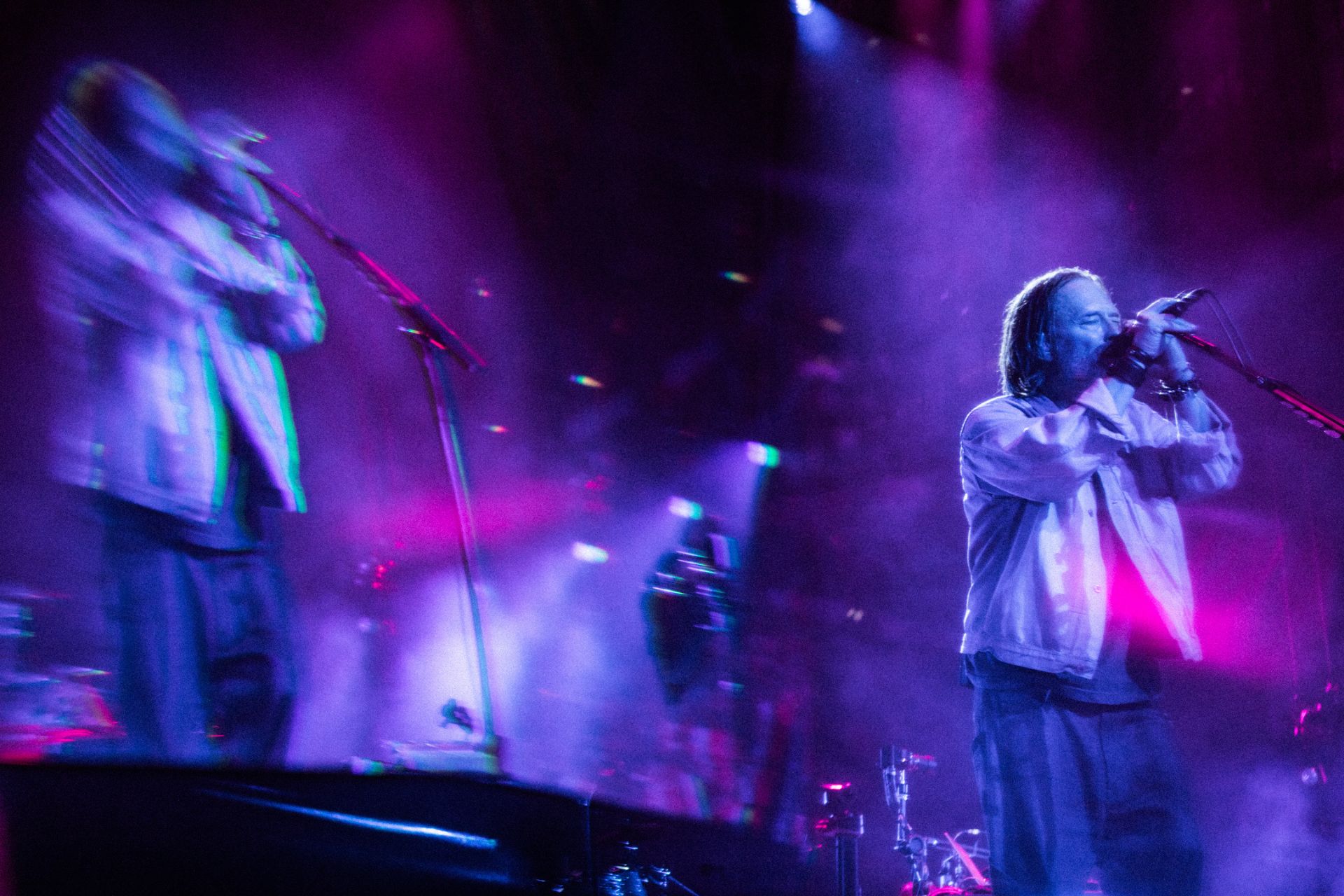
The production of the concert was second to none. Firstly, the stage was situated in the middle of the arena and was circle shaped. This allowed the audience to see each member of the band performing a couple of times, regardless of where they were situated. My dad and I were sitting in the back row of the upper section, but could still enjoy Thom’s erratic stage presence and Johnny’s unique, hunch-backed guitar playing. Secondly, the big video screens perfectly encapsulated the band’s artsy, alternative, almost psychedelic vibe. The screens were a composition of distorted light and colours, reflecting the album the band were playing from. Personally, I think this accompaniment added a lot to the audience experience, especially for those sitting in the nosebleeds.
Unlike other major stadium tours, like those of Oasis and Taylor Swift, Radiohead’s set lists aren’t the same every night. While the band play hits such as ‘Paranoid Android’, ‘You and Whose Army’, and ‘Weird Fishes’ every night, there is no guarantee of hearing any other song on a given night. The changing set list builds anticipation for every song and allows the band to play deeper into their repertoire, spreading it over multiple nights. However, if you arrive at the venue expecting to hear a certain popular song, there is a chance you will be disappointed. I personally enjoyed the changing set list because it meant that the gig couldn’t be ‘spoiled’ for me through recordings of previous gigs on social media, as my concert would be unique to those I scrolled through online. Furthermore, due to the number of great songs in their back catalogue, the chance of a bad set list is low.
On our night, 25th November, the set was heavy on songs from In Rainbows and Ok Computer, including songs such as ‘Lucky’, ‘Bodysnatchers’, and ‘Karma Police’. On the 25th, they also played ‘Climbing Up the Walls’ for the first time on this tour, a song which hasn’t been played since at the time of writing. The set list was an ode to Radiohead’s heavier and more rhythmically challenging work. As someone used to the beautifully polished albums, the live editions were noticeably raw and there were occasions where Thom and Johnny struggled with playing their complex rhythms live. However, live renditions should never sound identical to studio versions. It’s the spontaneous interpretations and raw delivery you can only experience in person, arguably the purpose of live music.
It’s the spontaneous interpretations and raw delivery you can only experience in person, arguably the purpose of live music.
The tour itself pays tribute to the timelessness nature of Radiohead’s sound and the talent of its musicians. Even after 8 years pursuing individual projects, the band’s chemistry and commitment remains unmistakable. The changing set list feels refreshingly human in an age of predictable and heavily choreographed performances, while the music continues to resonate with audiences regardless of age. This tour has also prompted fans to question whether this reunion will bring new music, something that remains uncertain at this stage but exciting nonetheless.
Looking for more? Check out:
Book Review: How To Disappear: A Portrait of Radiohead
Comments