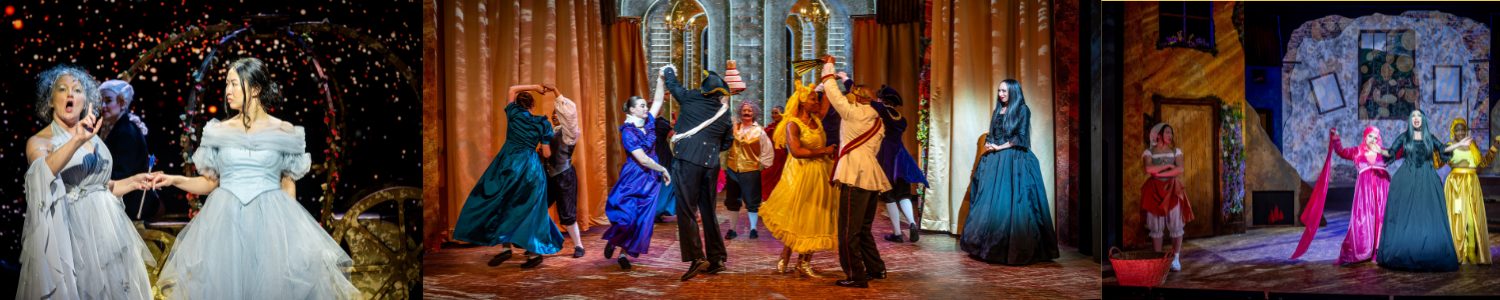
Culture writer Maya Arif praises Lorna Laidlaw’s Cinderella, emphasising the importance of balancing political references with slapstick comedy for family audiences
Step inside a world of magic, friendship, and fantasy with Lorna Laidlaw’s production of Cinderella – performed in The Old Rep Theatre.
Cultural, social, and political references….make the tale feel grounded and relatable
This modern rendition of Cinderella holds onto the familiar idea of a happily ever after while weaving in cultural, social, and political references that makes the tale feel grounded and relatable. Cinderella and Prince Charming connect through their shared love of dance and their desire to escape the pressures around them. Every aspect of her life is controlled by her stepmother and stepsisters, while he longs for a sense of normality away from royalty. The show opens with the Fairy Godmother (Therese Collins) introducing Cinderella’s life under pink sparkling lights, whilst two actors use their shadows to re-enact the scene. The houses covering the stage are decorated with flowers and vines which gives the production a small-town charm. The pace of the production is fast and energetic, keeping younger audiences engaged from start to end.
The witty and clever writing ensures the production stays relatable for adults and entertaining for children without feeling forced
Diverse casting is one of the standout features, with both Cinderella (Jaiden Tsang) and the Prince (Stefan Davis) played by performers of colour. This choice emphasises the importance of inclusivity on stage, as talent was the basis of the casting process – not race. Political references appear throughout the script. The performance jokes about bin strikes, zero-hour contracts, and job references, as the stepmother (Julie Ann Baker) dramatically fires Cinderella along with the rest of the staff. Cinderella is typically set in a fantasy space, but these references make the story feel current by pointing out the abuse of authority and power inequalities in society.
Social commentary is also woven in through humour, with the stepsisters (Sam Yetunde and Victoria Tew) representing modern beauty standards. They storm on stage with shopping bags, take constant selfies, and rely on external validation. Whilst they are a comedic device for the audience, they also are a tool to criticise societal expectations of beauty. A machine called The Babie appears on stage to get them ready for the ball, taking care of their makeup, hair and parodies cosmetic procedures such as liposuction. The witty and clever writing ensures the production stays relatable for adults and entertaining for children without feeling forced. Dandini, played by Jordan Laidley is a particular highlight with consistently humorous timing
Comedy runs confidently through the entire show. Adults are treated to references to Birmingham’s culture and subtle innuendos while children enjoy the slapstick mentions of viral social media memes. Audience participation plays a big role. Booing, catching sweets thrown into the crowd and dance performances helps keep the atmosphere lively.
Children also responded well to the use of ‘Golden’ from the film Kpop Demon Hunters which is popular amongst younger crowds. Dandini, played by Jordan Laidley is a particular highlight with consistently humorous timing. Some musical numbers are playful reworkings of familiar songs. ‘Good Morning Baltimore’ becomes ‘Good Morning Birmingham’, which creates an easy laugh. The fairy tale elements are heightened through strong visuals; Cinderella’s shimmering blue gown lowers onto the stage and a bronze carriage covered in flowers arrives for her journey to the ball. Her entrance down the stairs through the audience is magical and easily one of the most memorable moments of the pantomime.
The final section of the panto introduces a modern twist. Cinderella leaves behind a Converse instead of a glass slipper. Despite the stepmother’s attempts to hide her, Cinderella succeeds and the shoe fits. When the Prince proposes, she rejects his gesture and instead asks him to be her prince, placing their relationship on more equal ground. This role reversal challenges traditional fairy tale plots and provides Cinderella with agency, after her submissive and passive life under her stepmother’s cruel orders. The production then ends with a joyful group performance, encouraging audience participation through a sing-a-long, completing the production’s promise of a happily ever after.
Rating: 4/5
If you are interesting in seeing the Old Rep’s production of Cinderella, you can buy tickets here!
Enjoyed this review? Read more from Redbrick Culture below:
Musical Review: Elf the Musical
Theatre Review: Sherlock Holmes and the 12 Days of Christmas
Comments