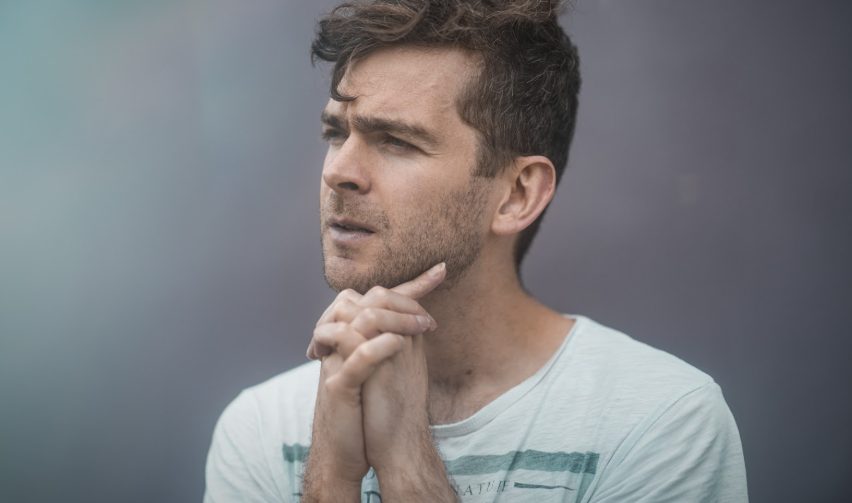
Music Critic Carly Cannarozzo sits down with dream-folk songwriter Chris Cleverley
FATEA Magazine’s 2023 ‘Male Artist of the Year,’ Chris Cleverley, is a dream-folk songwriter carving a fresh path through the UK acoustic scene. Drawing inspiration from artists like Sufjan Stevens and Leonard Cohen, Chris crafts a sound that’s uniquely his: a blend of Christmas melancholy and ethereal folk. Ahead of the release of his new Christmas EP, God of All Things, I had the chance to speak with Chris about everything from his beginnings as a young musician in Birmingham to the distinctly human themes that linger throughout his warm, intimate sound.
So you grew up in Birmingham in the 80s and 90s, and it was really a city known for punk and heavy metal—bands like Black Sabbath and Ozzy Osbourne. However, you came out of this city with a different sound, leaning into what I saw described on your press release as dream folk. Would you say that growing up in Birmingham affected your style as a musician? And were there any other factors that led you to folk music in a city that’s pretty rock-focused?
It’s interesting you mentioned heavy metal, because when I was a teenager, I had long hair, wore metal t-shirts, and played in metal bands at all the iconic Birmingham rock clubs. That’s what I wanted to do. I wanted to be a rock star. But there’s also this undercurrent of great acoustic music in the city—the Moseley Folk Festival and brilliant venues like the Town Hall, the Hare and Hounds, the Kitchen Garden Cafe. And when I studied at Warwick, there was a massive folk scene, probably less rock-focused, so that directed me down that route a little more.
I started playing folk clubs, but even when I’m writing acoustic music, I have a strong affinity with heavy metal. I try to bring some of those influences into the acoustic style. I think that’s massively because of growing up in a city where metal is such a big thing. Like you said—Black Sabbath, Ozzy Osbourne, Led Zeppelin. When you’re a kid in Birmingham, you feel a very strong connection with that culture.
I started playing folk clubs, but even when I’m writing acoustic music, I have a strong affinity with heavy metal.
You mentioned in the initial email for the interview that Birmingham audiences have played a massive part in your career. What is it about Birmingham audiences that you think has contributed to your art?
I think the support I’ve had from people in Birmingham has been integral to where I am today. When I started out doing shows on a more professional basis, I’d never done a gig outside Birmingham. I was playing all the really cool acoustic venues and felt this following and buzz around what I was doing. People were buying these really basic DIY records—I was printing covers in Microsoft Word.
I wanted to play music, but I never really believed anyone would be interested. Playing around the Birmingham scene, getting this following, meeting all these people—it got the ball rolling. It gave me confidence and self-belief to take it outside the city and around the UK. I owe everything to those people. A lot of them still come to shows. They’ve come to every gig over the years, and it blows my mind that people are that loyal and supportive.
Compared to when you were doing heavy metal in the beginning, how did you find the audience shifted when you moved to folk? Is there a big scene for folk in Birmingham?
I think it’s got a great scene—partly because of the Birmingham Conservatoire, which has a folk contingent. Some of the best musicians in the country come to study and then stick around, playing in sessions and venues. So compared to other cities, Birmingham has a large proportion of the UK’s best folk musicians. And you’ve got events like the Moseley Folk Festival, where artists from all over the world travel to play. It’s a massive hub for that part of the scene, including the underground national scene.
About the change in audiences—there’s definitely been a demographic shift. When I was playing metal gigs as a teenager, the crowd was mostly people my age—we were 16 with fake IDs trying to get into venues. Now people stick with you and follow you, so it’s probably the same people, but now they’re in their 30s. It’s always great when younger people come to folk gigs, because it tends to be a slightly older audience—30s, 40s. So it’s awesome to see people in their early 20s discovering folk music.
Before I ask about the new album, I wanted to bring it back to the one you released in 2024, In the Shadow of John the Divine. It seems like it has a similar vibe to God of All Things. They’re both Christmas records. Is there something about Christmas music that inspires you, or that you enjoy creating?
Last year I’d never done anything like it before, and I wanted to give it a try because I had a few ideas with a wintry, Christmas theme. But that kind of music is so saturated—there’s so much of it—so there’s no point unless you’re trying to do something different. I didn’t want to make it all happy, jolly, party-Christmas stuff. I love that music, but I didn’t think there was anything new I could add to that. So I wanted to explore it from a more introspective perspective, maybe a more melancholic one.
Christmas is a curious time. We think of it as happy and festive, but lots of people don’t experience it that way. It can be ambivalent. People rest for the first time in ages, and they connect with things they’ve been carrying—loneliness, grief. I wanted to give people having those different experiences a voice. I wouldn’t call them anti-Christmas records, but they explore those ideas. People connected with it last year, so I felt there was potential to keep exploring it on God of All Things.
Christmas is a curious time. We think of it as happy and festive, but lots of people don’t experience it that way.
Speaking of the EP—on Instagram, you talked about the messaging behind the first single, “Lord of Chaos.” While your music often takes on a divine aspect—God of All Things, John the Divine—your description of this single feels more spiritual than religious. You bring up the psychological over the religious. Is there a religious aspect to the EP? And if not, what does God of All Things mean to you?
It’s interesting—there’s a lot of religious imagery, which I find fascinating, but I’m not religious myself. I don’t have a faith, but I’m captivated by the imagery, language, and ideas. Leonard Cohen is a good comparison—he uses a lot of theological, biblical themes but wasn’t, as far as I understand, religious. You hit the nail on the head: the God of All Things concept is more spiritual and human. It’s about exploring ideas of the self.
For people who don’t have a faith, when you’re feeling desperate and want to appeal to something that might direct your life, you don’t have a deity to look toward. So maybe you look to the beauty in the natural world, or emotional forces that guide our lives. I like the metaphor of framing those things as gods—the gods of oceans, ice, seasonal shifts, things tied to the Christmas period. In “Lord of Chaos,” there’s a hymnal, prayer-like quality, but it’s more like appealing to the universe than any deity.
So—you’re on tour for the new EP and returning to Birmingham. How has touring with this EP been so far? Can you share the song you enjoy playing live the most?
It’s been great so far. I’ve had a couple of dates playing the new songs for the first time, and they’ve connected with people. Musically, some songs are differently arranged. A few are piano-led, and I’m predominantly a guitarist. So for this tour, I learned to play piano and have been performing on a keyboard for the first time. It’s diversified my live sound—bringing in synth sounds and different textures. It helps keep people engaged. If you’re on one instrument for an hour doing broadly the same thing, it’s harder to hold attention. Introducing new instruments opens up what you can achieve. It’s been a steep learning curve, but it’s reinvigorated my approach to touring. It feels fresh and exciting.
In your press release for your return to the Hare and Hounds, it’s mentioned that your performances occupy the space between concert, yoga, and meditation. What is your creative process like for creating that warm, inviting atmosphere, both in the songs and on stage?
I think the sonic world you create plays a big part. I’ve done a lot of yoga and meditation over the years, both alone and in classes. In classes, there’s often warm ambient music—some of the times in my life when I’ve felt most calm. Connecting with those sounds, I wanted to understand how to make them myself and put them into the production of my music. A lot of that ambient atmosphere is on the record, and I like to think some songs could fit in relaxation spaces because they’re made similarly.
Live, it’s about bringing in as many of those sounds as possible and recreating them on stage. Since the pandemic, people go out less. Concerts can feel less habitual and a little tense. So I try to communicate with people and build rapport—acknowledge that everyone might be a bit nervous, that it’s a strange thing to be in a room with strangers trying to connect. Encouraging people to relax and embrace that together helps. It’s about removing the separation between artist and audience. We’re all just people probably feeling the same things.
Encouraging people to relax and embrace that together helps. It’s about removing the separation between artist and audience.
At the time of this interview, the full EP hasn’t dropped yet. Is there anything you’d like to say about the record before its release—any insight into what the album will look like and how it compares to previous releases?
The single ‘Lord of Chaos’ is out already, and the second single, ‘Frost Giant,’ is out next Friday, the 21st of November. It features a collaboration with an incredible Leeds-based artist, Molly Rymer, who has an astonishing voice. I’m excited for people to hear us harmonising—she co-wrote the song, so it goes in a different direction for me. Compared to last year’s release, this one leans slightly more into festive musical aspects. There are three traditional carols that have been rearranged, influenced by Sufjan Stevens. I tried to bring in more traditional Christmas elements and present them in a way people maybe haven’t heard before. I can’t wait to release it on Friday the 5th of December—physical CDs on Bandcamp, and streaming everywhere.
Enjoyed reading this? You might also like:
Comments