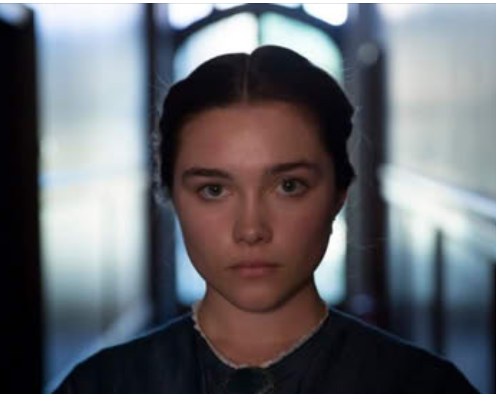
Film Writer Cassandra Fong revisits Lady Macbeth, finding it to be a quiet masterwork with a gripping central performance from Florence Pugh

Lady Macbeth is better than ever a decade later. No, I’m not talking about the play (which is certainly older than a single decade), but rather the tragically little-discussed film.
It dropped back in 2016 with barely a ripple outside of critics’ circles, and I remember thinking, Well now, this one’s a sleeper. Not in the boring sense—far from it. More like a wolf in a starched bonnet and laced-up corset. One of those rare little beasts that doesn’t roar so much as purr in the dark, and then, when you’re leaning in, slits your throat.
Lady Macbeth is not a horror film. Not on paper. There are no ghosts, no blood-flecked axes, no creaking floorboards announcing the return of some long-dead spirit. But it is horrifying, in the way that real human nature is horrifying. In the way that silence can be louder than screams. In the way that you can watch someone do something terrible and still feel—God help you—a flicker of understanding.
Now that we’ve got ten years of hindsight, and now that Florence Pugh has become the kind of name you see lit up in every awards-season trailer, it feels safe to say this: Lady Macbeth is one of the best debut features of its era. Not only because it introduced us to Pugh’s volcanic talent, but because it knew what so many stories forget—that evil doesn’t always wear a mask. Sometimes it wears a powder-blue dress and sits very, very still.
Let’s talk about that stillness.
William Oldroyd, the director, comes from the theatre, and you can feel it—but he doesn’t stage the film like a play. No blocking-for-the-back-row nonsense here. His camera is steady. Static, even. But don’t confuse that with passive. He uses stillness the way a spider uses silk: to wrap you up. Every shot lingers a little too long, every silence stretches just enough to make your stomach twist. You wait for the scream. The outburst. The big sweeping moment. But it doesn’t come, and that’s the point. The dread accumulates like dust in an empty room. It’s unbearable. And then it gets worse.
Florence Pugh gives the kind of performance people write doctoral theses about
And in the middle of all that is Florence Pugh, in what I still think is the kind of performance people write doctoral theses about. When we meet her, she’s little more than a shadow of a person. A young bride bought and sold like a cow, married off to a man who doesn’t touch her, speak to her, or even see her. There’s something unformed in her, something shut down. But not dead. Not quite. You can see it in her eyes, if you’re watching closely: that flicker. A live coal in a bed of ash.
Most films would use that setup as the launchpad for some noble journey of female empowerment. Cue the rising music, the supportive best friend, the moment where our heroine finds her voice and tells off the villain. But Lady Macbeth is after something far murkier. Katherine—Pugh’s character—isn’t interested in being admirable. She’s interested in being free. And that desire, once unleashed, doesn’t stop at the boundaries of morality. It doesn’t even glance at them.
What happens in this movie—I won’t spoil it—is shocking, but not in the way we usually mean that word. It doesn’t rely on plot twists or cheap reversals. The shocks come from watching someone slowly, methodically shed everything that once made them sympathetic, and doing it with such calm certainty that you can’t quite look away. You want to. God knows you want to. But you can’t.
There’s something deeply uncanny about watching someone move through the world like that—with a calm so total it feels inhuman. And Pugh pulls it off with terrifying ease. She doesn’t act her way through this part. She inhabits it. Every breath feels calculated. Every blink timed. It’s a performance so precise you could cut glass with it.
And yet it’s not cold. That’s the magic trick. She doesn’t play Katherine as a monster—at least not at first. You see the desperation. The loneliness. The desire to feel something, anything. The early moments where she’s locked in that old, creaking house—spoken to like a servant, denied air and light and even the most basic human decency—those moments are suffocating. And they make what comes next almost understandable. That’s the rub. That’s the brilliance. Almost.
The movie plays you like a violin. You start off rooting for Katherine. How could you not? She’s trapped, discarded, forgotten. You want her to break free. You cheer for her. And then, without realizing it, you’re somewhere else entirely. You’re watching her do things that would make Lady Macbeth herself take a step back, and you think: Wait. When did this happen?
The moral terrain of this film is a minefield. Every step you take, you wonder if you’re complicit. That’s why it haunts you. Not because it tells you evil exists, but because it reminds you how easy it is to walk toward it with open arms when it’s dressed as justice. Or love. Or revenge.
Oldroyd and screenwriter Alice Birch never overplay their hand. They don’t need to. The dialogue is spare—knife-thin, sharpened to a point. Whole scenes go by without a word, and yet they say volumes. The script trusts the audience. It assumes you’re smart enough to fill in the blanks. And if you’re not, well, the film doesn’t much care. That confidence is rare. It’s what makes the movie feel so bracing.
And the way it looks—well. This is not your lush, Merchant-Ivory period piece. The rooms are bare. The wallpaper peels. The moors are muddy and gray and unforgiving. It’s gorgeous in the way a skull can be gorgeous—clean lines, unflinching angles, not a scrap of fat. Ari Wegner’s cinematography (she later shot The Power of the Dog, which makes perfect sense) is clinical but never sterile. Every frame feels designed to trap the characters, to push them against invisible walls. Even when the camera doesn’t move, it presses in.
It served as a quiet, bloody blueprint for a new kind of storytelling
Silence plays a starring role, too. There’s almost no score. Just the wind, the fire, the soft hiss of fabric. And when the silence breaks—when someone screams or sobs or slams a door—it hits like a hammer. That’s horror, folks. Not the jump. The quiet before it. The waiting. Lady Macbeth understands that deeply.
And then there’s the ending. Again, I won’t spoil it. But I will say this: it’s perfect. Chilling. Not because of what happens, but because of what it means. Because of how far you’ve come—and how far the film is willing to go to finish what it started. You don’t leave Lady Macbeth feeling uplifted. You leave it hollowed out. Dazed. Like you just walked out of a particularly cruel dream.
I don’t know if I’d call it a masterpiece, exactly. That word gets thrown around too easily. But I’ll say this: Lady Macbeth is a controlled burn of a film. Tight. Unsparing. Beautiful in its cruelty. And in the ten years since its release, I haven’t seen many others do what it does with half as much discipline. It didn’t just announce the arrival of Florence Pugh—it served as a quiet, bloody blueprint for a new kind of storytelling. One that doesn’t beg for your sympathy, but dares you to look away.
And if you do look away? That’s fine.
Just don’t be surprised when it follows you home.
Enjoyed this? Read more from Redbrick Film
Comments