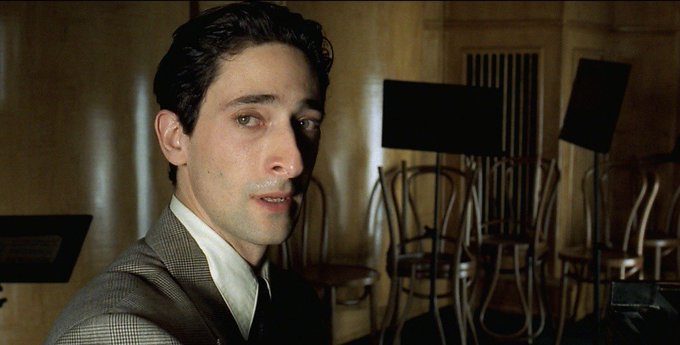
Film & TV Writer Cassandra Fong revisits 2002’s The Pianist, crediting its continued cinematic relevance

Content warning: discussions of the Holocaust
Over two decades after its debut stunned the film world, The Pianist (2002), directed by Roman Polanski and starring Adrien Brody, remains a harrowing masterclass in restraint, survival, and the transcendent power of art. As the world spins back toward the uglier parts of its nature — nationalism bloating in public squares, lines drawn in blood and bureaucracy — The Pianist has clawed its way back into the conversation. And it’s angrier now. Sadder, too. More prophetic than anyone wanted it to be.
Polanski offers a meticulous portrait of one man quietly enduring the unendurable.
Based on the memoir of real-life Polish-Jewish pianist Władysław Szpilman, the film chronicles a gifted musician’s harrowing journey through Nazi-occupied Warsaw. But unlike most war dramas, The Pianist avoids spectacle. It speaks in whispers with silences louder than gunfire, shadows darker than explosions, and produces a tale that feels terrifyingly intimate.
The plot is deceptively simple: Szpilman is terrifyingly fragile — all eyes and bone and twitch, a rising star in 1930s Warsaw when his life is upended by Nazi occupation. But rather than staging a sweeping saga or romanticizing resistance, Polanski offers a meticulous portrait of one man quietly enduring the unendurable.
It is in this quiet that the film finds its power. There are long stretches where no words are spoken, yet volumes are communicated. Star Adrien Brody gives a performance of near-total vulnerability. His eyes carry the story from fear to disbelief to grim determination. Brody lost over 30 pounds for the role and isolated himself for weeks prior to filming. The results are etched into every frame.
That this is a true story, one told by Szpilman himself in his post-war memoir, adds an almost unbearable poignancy. Brody is not inventing this man. He is honouring him. Brody went on to become the youngest actor to win the Academy Award for Best Actor in 2003, a rare feat for such a minimalist performance.
At the emotional core of The Pianist is the idea that art, particularly music, can serve as a form of resistance. Szpilman’s connection to the piano is not just about career or passion. It becomes a symbol of his identity, his culture, and his very humanity in the face of brutal dehumanization.
The film’s relevance is sharper now than perhaps it was when it first released.
Composer Wojciech Kilar’s sparse, haunting score blends seamlessly with classical pieces by Chopin, the music Szpilman performed before the war. These moments, when Szpilman plays, are among the few glimpses of beauty in a world gone to ruin. They are acts of rebellion not through violence, but through grace.
I would be lying if I said watching The Pianist in 2025 felt purely historical. The film’s relevance is sharper now than perhaps it was when it first released. We are, once again, seeing the slow rise of authoritarianism, the erosion of empathy, the way entire communities can be painted as “other” with terrifying ease.
In such a time, The Pianist becomes more than a film. It becomes a warning. A reminder. And, oddly, a hope: not a loud, inspiring hope, but a quiet one, the kind that crouches in rubble and plays music only it can hear.
More from Redbrick Film & TV:
Redbrick Rewind: Kill Your Darlings
Comments