Film critic Cassandra Fong reviews Sofia Coppola’s adaptation of The Virgin Suicides, commending its precise use of lighting, sound, and camera technique
The last time I tried to write about The Virgin Suicides, I was a lonely girl in high school who was about to have a mental breakdown that lasted for months, and quite rapidly made myself a self-aware inconvenience with my own emotions.
Sound familiar? Don’t get me wrong, I was more of a schoolgirl with a flair for melodrama than anything truly tragic. But I am hinting at a deliberate parallel, of course, to the Lisbon sisters: the titular (mostly) virgins, five beautiful blonde girls who captivate a group of boys in their suburban neighbourhood. These amorphous, interchangeable boys grow up to be men that narrate the story, gathering the girls’ possessions and reminiscing on all the times they watched them in their youth. To paraphrase Kerouac, their hearts were stabbed with pain when the girls they loved went the opposite direction. The question that drives the story: to what extent should the audience sympathize with these middle-aged men clinging to their morbid fascination with their prematurely dead crushes?
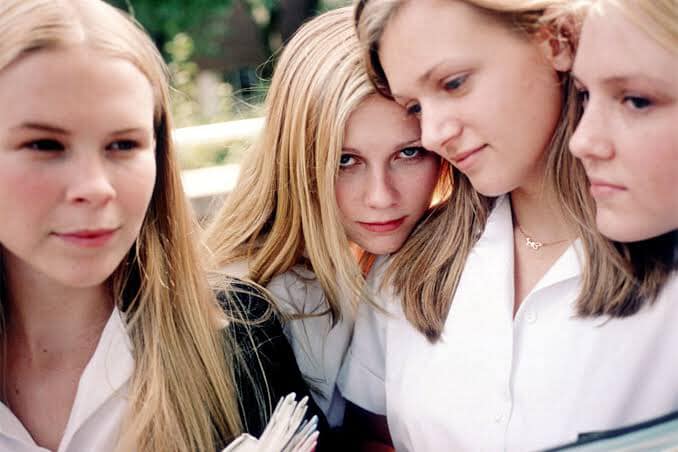
The feminine mystique of the sisters is amplified by soft lighting, delicate and meditative
Sofia Coppola’s hazy adaptation is faithful to the novel, with its elegantly rueful prose and a feverish longing simmering beneath every sentence. When the voiceovers on screen read out lines from the novel, the lush melancholy is almost audible, and a perfect complement to the gauzy visuals. The feminine mystique of the sisters is amplified by soft lighting, delicate and meditative, the symbols of a magic-realist American suburbia. The setting itself is tightly atmospheric: shot in various soft, golden hues, it feels both idealized and sterile, creating an almost surreal, dreamlike quality to the environment. The film’s wide shots of the neighborhood—where the houses look identical and the streets empty—suggest a lack of individuality, a theme that echoes the Lisbon girls’ own lack of autonomy within their confined world. In scenes where the girls are confined to their house, such as when they are kept indoors after Cecilia’s suicide attempt, the lighting shifts to a diffuse softness, often appearing to emanate from a non-specific source. This effect distorts the space and gives it a dissolving quality, as if the walls themselves are collapsing inward, erasing the boundaries of the sisters’ emotional isolation. The house is neither fully internal or external—a physical object but also a psychic container. This movie is the pioneer of the contemporary coquette aesthetic, but here the entire film is saturated with a stately funeral-march feeling.
As theorized by Laura U. Marks, haptic visuality refers to images that privilege texture over depth, inviting the viewer to “feel” with the eyes rather than “see” with them. Coppola’s mise-en-scène cultivates this haptic mode: gauzy curtains, sun-dappled lawns, soft-focus lenses, and the tactile softness of 1970s fashion fabrics render the film a sensorial archive of girlhood textures. The use of close-up shots also contributes to the haptic nature of the film. In scenes where the camera lingers on everyday objects—the pink rose petals, the pressed flowers, the girls’ painted toenails—Coppola creates an intimate atmosphere that encourages the viewer to feel the textures of these objects in the same way one might caress them. The mundane objects of the Lisbon sisters’ lives become vessels of tactile longing, rich with sensory associations (sweetness, fragility, youth) that are felt but never fully explained. These shots give a sense of the objects being alive, wrapped in memory, each material fragment charged with unspoken significance. In this way, Coppola’s film becomes a space where vision and tactility converge, offering the audience a cinematic experience that is as much about the texture of memory as it is about the narrative itself.
In her storytelling, Coppola leans into the elliptical, building a rhythm through omission rather than narrative momentum. This formal choice is not passive or merely atmospheric; it reflects the epistemological core of the story: the unknowability of the girls, and the impossibility of truly accessing another’s interior world. What we see is not them—but the void around them, the boys’ endless circling of an answer that will never come. The use of soft focus and lens diffusion is a formal embodiment of this emotional opacity. The Lisbon sisters are often shot from a distance, through windows, veils, branches—a cloaking device that offers the visual suggestion of femininity without ever disclosing its truth. In this way, femininity in the film functions as a representational limit: always aestheticized, always partial, always just out of reach. In a particularly emblematic scene, Lux lies on the roof smoking a cigarette, isolated and bathed in dim yellow light. The shot is static, wide, and deliberately depersonalizing. The sensuality of this girl who had been introduced to the viewer in a sun-kissed daze is never eroticized for viewer pleasure; it is melancholic, estranged, and ghostly. The shadow cast over her face underscores her alienation, while the stark lighting highlights the vulnerability of her situation. Here, the lighting is not merely decorative—it is emotive and essential to understanding Lux’s fractured emotional landscape.
While the boys speak in a reflective tone, we are left to wonder how much of their narrative is shaped by their desires and memories rather than the reality of the girls’ experiences
The synergy between Eugenides’ literary voice and Coppola’s visual language becomes a central aesthetic strategy. In both versions, what is technically suburban America is not realist geography; it’s a psycho-emotional landscape—a map of loss and longing. For instance, the iconic image of the sisters in the living room in their white dresses under the glow of warm lighting evokes a sense of innocence, yet the film’s mise-en-scène subtly hints at the tragic end that is to come. These lighting choices—combined with soft focus and slow-motion sequences—create a visually otherworldly effect, making the Lisbon girls seem both elusive and transcendent, as though they exist somewhere between reality and the realm of memory. The voiceover—a potentially clunky device in less deft hands—is wielded with exquisite restraint. Delivered in the cool, almost affectless tone of an older man recalling youth, it is tempered nostalgia, not overt sentimentality. It serves as a clever way to externalize the girls’ internal lives. While the boys speak in a reflective tone, we are left to wonder how much of their narrative is shaped by their desires and memories rather than the reality of the girls’ experiences. The Lisbon sisters are remembered not as full people, but as a series of fragments: Lux’s hair in the sunlight, Cecilia’s hospital gown, Bonnie’s silent glances. These fragments act as emotional puncta, impossible to explain but impossible to forget. The camera work here is crucial: it frequently frames the girls in long, wide shots, distorting their figures and heightening the sense that they are icons rather than subjects. Their beauty, in this context, becomes a form of narrative detachment, something that both captivates and ultimately disavows any deeper engagement with them.
This is further complicated by Coppola’s deliberate invocation of the feminine sublime—a type of emotional or aesthetic excess historically excluded from the masculine-coded category of the “sublime.” The sublime in The Virgin Suicides exists in a dual tension: it is simultaneously a transcendence of the mundane, an idealization of girlhood and feminine beauty, but it is also a tragic erasure of the girls’ full subjectivity and agency. The film’s excessive beauty—the overexposed lighting, the syrupy soundtrack, the stillness of the mise-en-scène—borders on indulgence, and in that indulgence it stages a counter-aesthetic to patriarchal clarity. It’s not just that the Lisbon sisters are mysterious, it’s that the world doesn’t deserve to know them. Their opacity becomes a political aesthetic. In doing so, she reveals the impossibility of reducing femininity to a commodity to be consumed, loved, or explained. The girls are beyond reach, and their beauty becomes a counter-aesthetic to the controlled, rationalized beauty often associated with patriarchal cinema. The use of soft-focus filters heightens this calculated ethereal quality of the girls, rendering them as half-imagined figures whose presence is fleeting. Their very death—which is never explicitly shown, only hinted at through visual cues (a lock of hair, a shot of a girl’s reflection in a mirror, the quiet finality of a distant figure on the rooftop)—is emblematic of this sublime. Death itself, as it relates to the Lisbon sisters, cannot be fully understood. It remains, as the girls do, both terrifying and beautiful. Coppola’s refusal to reveal their deaths (whether in a symbolic or literal sense) creates a space where meaning cannot be fully contained or controlled. By leaving their deaths and lives open to interpretation, Coppola transforms the sublime from a visual spectacle into an emotional and intellectual void—a gap where the audience’s gaze must struggle to make sense of the tragedy.
In keeping with this, sound design in The Virgin Suicides also plays a subtle but integral role in sustaining emotional indeterminacy. Air’s original score—synth-heavy and nostalgic—creates a sonic texture that never fully resolves into melody. It drifts, loops, echoes. This is what sound theorist Michel Chion would call acousmatic sound: a kind of disembodied voice or music that heightens mystery rather than grounding it. The score, like the visuals, never tries to tell us what to feel; instead, it hums around the edges of feeling. This is aptly demonstrated in one of the film’s more traditionally structured scenes where the girls attend the homecoming dance. The colour palette shifts to rich, saturated tones: Lux’s modest white dress, the deep greys and blues of the gymnasium décor, the shiny pink schnapps stealthily sipped. Yet despite the visual vibrancy, Coppola maintains an undercurrent of discomfort. The camera frequently isolates Lux in close-up, even amid crowds, while the soundtrack—Heart’s ‘Crazy on You’—blasts with euphoric volume. It’s a moment of ecstatic simulation: the girls finally enter the world, but they remain profoundly alone in it. The sound mixing is particularly clever here. When Lux and Trip slip outside, the music becomes muffled, distant—aural chiaroscuro that separates inner experience from outer presentation. The contrast between the noise of the dance and the silence of the football field that follows is brutal. Lux lying alone on the grass at dawn, her hair glowing in the early light, is one of the film’s most iconic images. Shot from a high angle, she looks diminished, framed by a vast, indifferent field. This is existential mise-en-scène—Lux adrift in the very world that once promised her freedom.
The Lisbon household itself becomes one of Coppola’s most powerful cinematic devices over the course of the film. Initially open and sunlit, it slowly morphs into a visual prison. Windows are boarded up, curtains drawn. Light becomes scarce and angular. By the time of the girls’ confinement, the home is composed of aesthetic claustrophobia: saturated shadows, stillness, and disjointed angles. Coppola stages the house not simply as a set but as a psycho-symbolic actor. Its shifting architecture is a map of interior despair. In one scene, Bonnie sits alone on a sofa beneath a cross, framed symmetrically with harsh key lighting from above—invoking religious iconography. Yet, instead of redemption, the image speaks of ritualized stagnation, a space where salvation has collapsed into routine. As such, the adaptation doesn’t just translate the novel—it embodies its affective architecture. The novel is about memory filtered through time; the film becomes an aesthetic machine for remembering, but one that highlights the failure of memory to resolve anything. This failure is not a flaw, but a condition of Coppola’s feminist poetics: it critiques the cultural imperative to “know” girls, to explain them, to narrate their lives into coherence. The film refuses to exploit the girls for emotional or narrative satisfaction. The girls are not made to be understood, and their deaths are not depicted in ways that invite catharsis. So, what do I find the most impressive about this movie? Coppola’s greatest innovation lies in her radical use of ellipsis as ethics. She refuses explanatory psychology, rejects melodrama, and denies the audience visual access to the girls’ deaths. This is not coyness—it is a direct challenge to the logic of cinematic mastery, which presumes that to show is to know, and to know is to possess.
You may ask why I have so many thoughts about this one story. I don’t know what moved my previous self to respond to these particular words. I won’t know what moved me to respond to these voyeuristically, deceptively brutal images that arose from that specific book. I could try to solve the mystery of whatever was going on in my adolescent mind, if anything was: but I can’t recapture it, and any shrine I build to it will dissipate stranger and more enigmatic than when it was made.

Comments