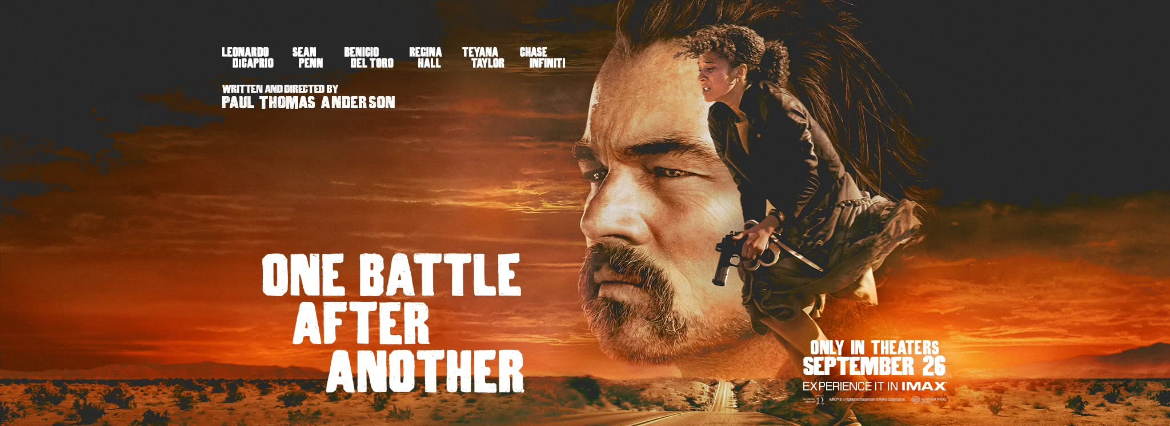
Film & TV Writer Connor Wilson reviews One Battle After Another, a thrilling, fast-paced film set in a horrifyingly fascist state, finding it to be ultimately hopeful with a deeply familial core
For how starkly relevant and important Paul Thomas Anderson’s (PTA) One Battle After Another is today, his newest action-caper-car-chase-thriller also bears a sense of perennial significance. The film begins with political revolutionaries known as the ‘The French 75’ detonating bombs and setting free arrested immigrants (pointing out the allusions to ICE feels redundant), before thrusting the audience forward 16 years after the group dissolves into a present-day America where nothing much has changed. The fascism at the heart of the state persists, although for failed revolutionary – and father-of-one – Bob (Leonardo DiCaprio), the frantic energy of rebellion is now channelled into paranoia and substance abuse. When his daughter goes missing, Bob’s life reignites in a dizzying and oft-comical quest to rescue her.
Johnny Greenwood’s offbeat, frenetic score make the film feel like 40 minutes less, with a pulsating rhythm and energy akin to Punch-Drunk Love.
One Battle After Another boasts a lengthy 2 hour 40 minute runtime, but the edit and long-time PTA collaborator Jonny Greenwood’s offbeat, frenetic score make the film feel like 40 minutes less, with a pulsating rhythm and energy akin to Punch-Drunk Love. The performances effortlessly match the tone of the film, with DiCaprio delivering as a slightly foolish but deeply caring father-figure, paired with Chase Infiniti as his daughter Willa and Benicio Del Toro as Sensei Sergio St. Carlos.
If any star is guaranteed to be up for awards this season though, it’s antagonistic force Sean Penn as Col. Steven J. Lockjaw. The dynamism of his unrestrained performance as an emotionally erratic military man wouldn’t feel out-of-place in a film like Kubrick’s Dr. Strangelove. However, Penn also makes the character a deeply unsettling and grim villain in opposition to the hopeful spirit of revolution.
The performances effortlessly match the tone of the film
As Lockjaw hunts for his enemies, Anderson’s scattered characters are engaged by modern militarised violence which penetrates everyday locations: high school dances, apartment buildings, out on the streets. One of Sensei Carlos’ students yells ‘It’s World War Three out there!’, a timely and foreboding exclamation. Even in moments where characters are safe, there is a lingering sense of anxious dread and threat. PTA’s idiosyncratic camerawork forces you to the edge of your seat, particularly in extended sequences where he finds new methods of shooting cliched scenes. Instead of following a car from above for a chase scene, for example, he tracks up and down the hills like the audience are on a rollercoaster. One Battle After Another is the celebrated director’s first film set in the 21st century since 2002, and he continues to push the medium forward with each entry in his filmography.
He puts faith in the next generation of young people where some directors would choose to be critical.
Rather than a focus solely on the technicalities of a revolution, the film lets the fascist horror of the state speak for itself and places its emphasis on the relationships at its core. Bob’s character is often defined by his foolishness, but his overwhelming love for his daughter is the driving motivation for his actions throughout. PTA has put a lot of desperate and loathsome characters on the screen (and does so again in this movie) but here it is a note of hope he chooses to centre on. He puts faith in the next generation of young people where some directors would choose to be critical.
One Battle After Another occasionally stumbles over its own ambition, with a very-fast paced opening 30 minutes where some character motivations can come across disjointed upon first viewing. However, the longer the film rolls the more excitement and momentum builds, marked by some killer needledrops including Steely Dan and The Jackson 5 songs among others.
Verdict
Paul Thomas Anderson’s latest is a political tale of self-discovery which is as noteworthy for its technical brilliance as it is for the subject matter the esteemed director chooses to tackle. Arguably not his most flawless effort, but one that is so ambitious and exciting that it is sure to endure in the conversation of most significant films this decade.
4.5/5
More from Redbrick Film & TV:
Redbrick Rewind: Kill Your Darlings
Comments