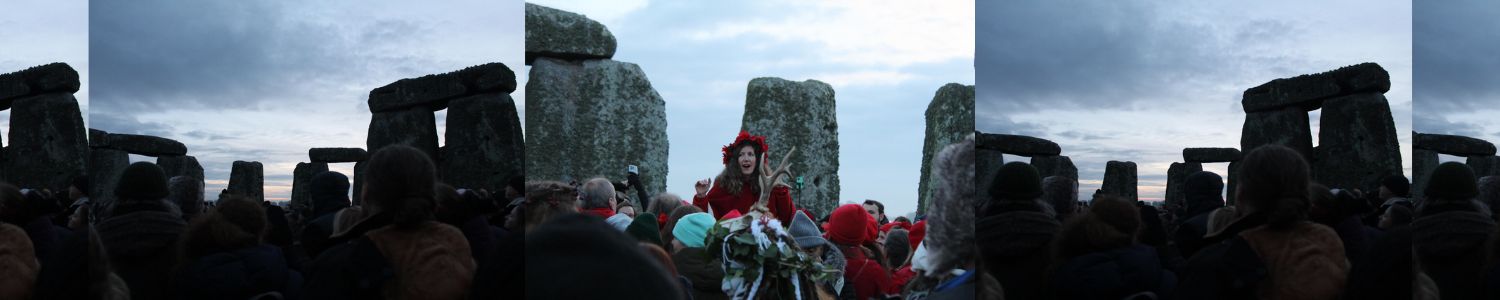
Culture Writer Esme Chen reflects on her experience celebrating the Winter Solstice at Stonehenge, expounding on its connection to Pagan spirituality
A happy belated Winter Solstice to you!
On the 21st of December, many cultures and religions – including Pagans and Wiccans, China’s Dongzhi, the Hopi and Zuni peoples, and India’s Lohri and Makara Sankranti festivals – celebrate the Winter Solstice. I was one of them. But what exactly is the Winter Solstice, and why does it continue to matter?
A festival honouring the rebirth of the sun and the quiet hope of returning light
By definition, the Winter Solstice marks the shortest day and longest night of the year, when the Earth’s poles are tilted at their furthest point away from the sun. It signals both the beginning of astronomical winter and a crucial turning point: from this moment, the days slowly begin to lengthen again. For Pagans, the solstice coincides with Yule, a festival honouring the rebirth of the sun and the quiet hope of returning light. Given Paganism’s reverence for natural cycles and seasonal rhythms, this moment carries particular spiritual weight. Traditions such as decorating with evergreens, burning Yule logs, and lighting candles all symbolise continuity, renewal, and survival through darkness. For me – and around 8,500 others – this year’s celebration also included the annual Winter Solstice gathering at Stonehenge.
So how exactly does the Winter Solstice connect to a place like Stonehenge?
Put simply, Stonehenge was constructed in alignment with the sun’s movements during both the summer and winter solstices. The Heel Stone – a large sarsen stone positioned outside the main circle – aligns with the setting sun on the Winter Solstice, marking the seasonal transition. While this alignment holds deep significance for modern Pagans, it also reflects the monument’s immense historical importance across time periods. During the Neolithic era (c. 10,000–3,000 BCE), sunlight was central to agricultural life, survival, and social organisation. Archaeological discoveries at nearby Durrington Walls, including large quantities of animal bones, suggest that people gathered for vast communal feasts during the solstice, likely accompanied by rituals and ceremonies.
Offering worshippers a tangible connection to both ancient peoples and the land beneath their feet
For modern Pagans, Stonehenge remains a powerful spiritual symbol. Its precise astronomical alignments echo Pagan reverence for the natural world, particularly within earth-centric traditions such as Druidry. Beyond this, the stones themselves carry an ancestral presence, offering worshippers a tangible connection to both ancient peoples and the land beneath their feet.
But why does any of this matter now? Why is it important to keep these traditions alive?
Preserving Pagan traditions matters because they represent a shared cultural past that transcends modern religious, political, and social divisions. The land we stand on belongs to all of us, regardless of race, creed, sexuality, or gender. The Winter Solstice celebration at Stonehenge reflects ancient values centred on community, renewal, and harmony with nature – values that feel increasingly urgent in an era of deepening polarisation.
Modern Paganism continues to face prejudice, often reduced to caricature or dismissed as irrational. This stigma is inseparable from a history in which dominant religious institutions actively delegitimised older belief systems to consolidate authority. Pagan traditions – whether solstice celebrations at Stonehenge or rituals at sites such as Glastonbury Tor – have long been marginalised or suppressed. To participate in and preserve these practices is, in itself, an act of resistance: a challenge to religious fundamentalism and a reclamation of Britain’s spiritual history, one that is rarely acknowledged in formal education.
A reclamation of Britain’s spiritual history
I had wanted to attend the Winter Solstice at Stonehenge for years. As my interest in folklore and ancient traditions deepened, I finally decided to go, waking up in the early hours and, by sheer luck, securing a place within the stone circle itself. The morning unfolded as a communal celebration – music, hymns, choral singing (with an exclusive performance by the Shakti Sings Choir), and even the appearance of a black cat – a lucky omen for 2026, if you ask me.
Experiencing these practices in person, rather than through a screen or in isolation, was profoundly moving. Living in Birmingham, many Pagan gatherings feel distant or inaccessible, often centred in rural communities. At Stonehenge, however, the atmosphere was unmistakably communal. While most attendees were dressed for the cold (thankfully, a mild December), others wore more overtly ritual attire – fairy lights woven into cloaks, deer skulls and antlers, and even Morris dancers. The result was not spectacle, but shared reverence; a reminder that ancient traditions are not relics, but living, breathing practices.
Soft chants of “free the stones” could be heard
However, despite English Heritage overseeing the solstice — and credit where it’s due for the sheer level of organisation at four in the morning — there remains an irony in a large, capital-driven institution maintaining control over a site widely regarded as sacred. This unease was not mine alone. Throughout the ceremony, badges were visible and soft chants of “free the stones” could be heard, underscoring a quiet resistance woven into the celebration itself.
Having visited Stonehenge previously, during Easter 2022, the contrast was striking. Then, the experience had been defined by security barriers and strict time restrictions. At the solstice, however, a rare freedom was granted. I found myself standing among the stones, something that would seem almost unimaginable on any other day. At dawn, Stonehenge felt unearthly and deeply mystical; for me, it was as though the veil between this world and the fae had thinned. There is something profoundly affecting about sharing such a moment with others – people who value the same histories, landscapes, and rituals – a sense of connection that can feel elusive in a city like Birmingham. Conversations flowed easily; strangers felt briefly familiar.
Events like the Winter Solstice at Stonehenge can be overwhelming: history and ritual thudding through the body; chants echoing against stone; drums, gongs, and singing bowls filling the air. Yet it is overwhelming rooted in connection rather than chaos; a connection that binds place, people, and past into a single, resonant experience.
That being said, I wish you a warm and fruitful Winter Solstice: a time for renewal, reflection, and the gentle return of light.
Enjoyed this review? Read more from Redbrick Culture below:
Comments