Culture Writer Lilia Field reviews the Fawlty Towers play, finding it to be a comedy-filled two hours, but perhaps an unnecessary revival
Lay out your white tablecloths and tea cosies, get yourself a Waldorf salad, and look out for falling moose heads fresh from the taxidermy because, fifty years since it was first aired, Fawlty Towers is back.
Britain’s cult comedy classic was in safe hands
Directed by Caroline Jay Ranger (Only Fools and Horses: The Musical) and written by both Connie Booth and John Cleese himself, this adaptation of Britain’s cult comedy classic was in safe hands. But the question that follows all revivals of this kind, a trend in theatre in recent years, is what incentivises audiences to fork out £40 for the ticket and leave the comfort of one’s home rather than just turning on Netflix and binge-watching all the episodes at one’s leisure. The fundamental answer to this is that it must bring something new to the table. It must rest in a delicate balance between being true to the original for the zealous fans who see any subversion of their beloved show as heresy and be different enough to drive audiences to experience it all over again. Does this revival of Fawlty Towers accomplish this?
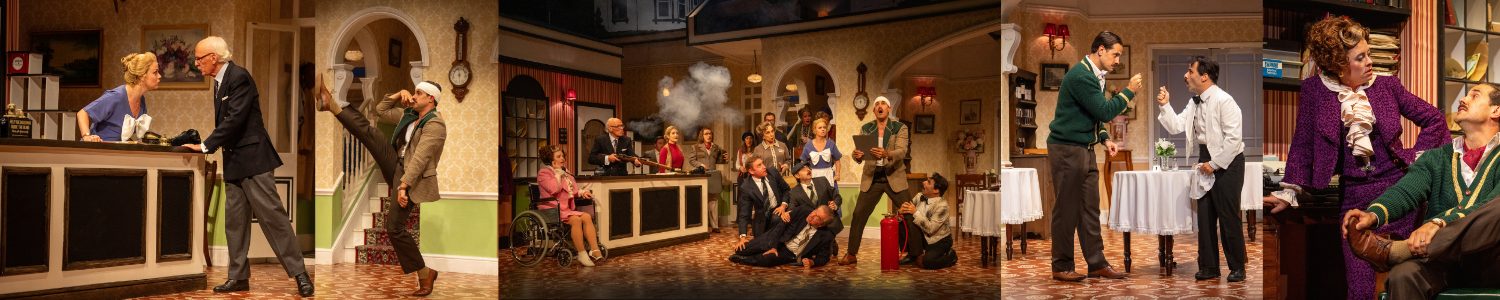
Starring Danny Bayne as beloved Basil Fawlty, Mia Austen as the overbearing matriarch Sybil, Joanne Clifton as Polly and Neil Stewart as The Major, a few from a large cast of fan favourite characters. The cast were asked to perform a difficult feat; they must embody the characters we have come to love. In the art of imitation they rarely disappointed. It was apparent that Austen had judiciously studied Prunella Scales to such an extent that one might have believed that the team had found means to resurrect her onto stage. Clifton too executed Polly’s characteristics with ease and whilst all these made for a convincing performance, Bayne was given the hardest task of all. Asking to fill the shoes of John Cleese is a task of impossibility. Unfortunately, next to Cleese, Bayne appeared stiff, and the comedic timing of Bayne’s delivery was not executed to the same pedigree as Cleese’s original Fawlty. Nevertheless, Bayne must be applauded for trying, and certainly he managed to pull off a convincing Fawlty despite this.
All the charm and tat that accompanies a Torquay hotel
This reveals a fundamental impossibility with revival theatre of this kind. How can one live up to the original? The set was elegantly constructed in the style of the original, built on several layers, with all the charm and tat that accompanies a Torquay hotel. However, the play’s close allegiance to the show’s original plot certainly hindered its success.
The play combines fan favourite scenes amalgamated for the two hour run time. Our favourite hotelier battles prickly old ladies, stolen money, fires, rats, ingrown toenails and mishaps with Claret, or is it Bordeaux? Whilst these episodic incidents were certainly funny, they were funny when the show first aired. A lack of innovation, new plots, scenarios or punchlines means that the play lacked purpose or direction. I found myself frequently questioning what was the point?
Moments felt fragmented, with forgotten punch lines and half-said expressions
What’s more, the show, first aired in 1976, has obviously had to adapt its jokes for current tastes and comedic boundaries. Cleese famously rejected complaints about his more controversial jokes, such as The Major’s speech in ‘The Germans’. Catering to public opinion, such jokes were cut from the new play. However, in cutting some parts and leaving others, many moments felt fragmented, with forgotten punch lines and half-said expressions which the audience, from memory, are forced to fill in in their heads. If certain jokes do not work in the current climate, why have them at all? Why are Cleese and Booth so adverse to writing anything new?
If one visits the theatre wishing for nostalgic charm and familiar favourites, the new Fawlty Towers is certainly for you. With beloved characters, hilarious predicaments and an increasingly absurd medley of wit and slapstick comedy at the play’s conclusion, the show is certainly a very good replica. But I can’t help wondering if British theatre with all of its talent and history can’t do anything more.
Rating – 3/5
Fawlty Towers – The Play shows at the Wolverhampton Grand Theatre till 21st February 2026. Tickets can be purchased here.
Enjoyed this review? Read more from Redbrick Culture below:
Comments