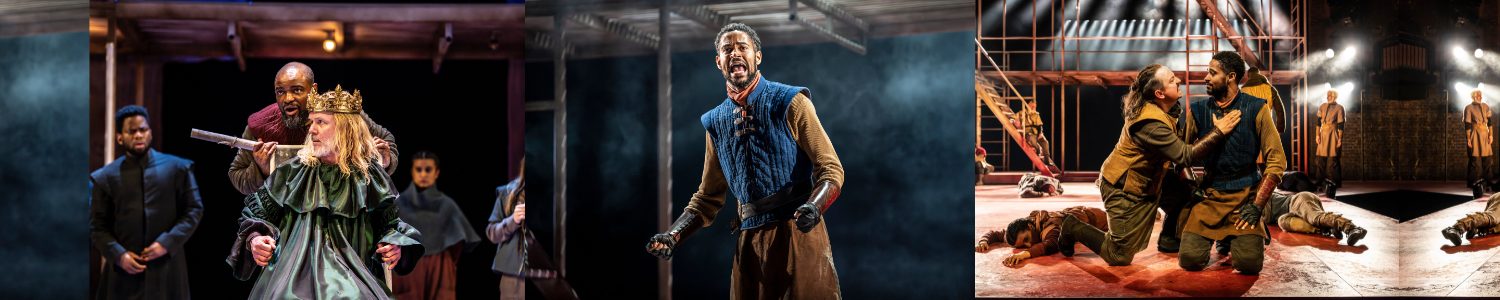
Culture Writer Ben Emmel reviews the RSC’s Henry V, praising the visually striking production driven by Alfred Enoch’s compelling portrayal
Young and old are at odds in Tamara Harvey’s new production of Henry V. Or more specifically, it is an exhausted, flagging world which sits at odds with Alfred Enoch’s youthfully energetic King Henry. We enter at his father’s deathbed, borrowing from Henry IV Part Two – though there is no sense of the juvenile Prince Hal anywhere near Enoch’s focused and mature heir-apparent. This version of Henry is unconventional. Somehow Enoch makes him simultaneously a sympathetic sensitive young man, a powerful and inspiring orator, and also unflinchingly resolute when it comes to the grisly realities of kingship. What we see is effectively a lightning-in-a-bottle leader, who powers his way through the challenges of the play. Enoch’s Henry calmly dispatches the treachery in his court, before shifting his focus to war with France.
A lightning-in-a-bottle leader
Harvey stages Henry’s famous ‘Once more unto the breach’ monologue on a battlefield of scattered bodies – whether they are dead or simply exhausted matters not, as his words rouse them to life, and suddenly they are energised for battle again. Alfred Enoch’s centrality to this production (the poster has him amid an anonymous sea of people) allows him to make the most of Shakespeare’s speeches, as he seemingly has the perfect rallying cry prepared for every moment. Not even a triple hanging on stage can distract the English people from Henry’s captivation, as they turn their backs to listen to him.
The hangings are one example of the brutality which this production does not shy away from. Lucy Osborne’s set features a heavily bloodstained stage floor – a constant reminder of lives already lost. The war scenes themselves are brilliantly staged by Annie-Lunnette Deakin-Foster (movement director) and Kate Waters (fight director) who put aside the weapons and instead leave us to watch the rhythmic
clashing of bodies. This gives the fight scenes a kinetic viscerality, only further emphasised by packing the stage with supernumeraries (an ensemble of local young people) to build the epic scale of the battles, which often end in a sea of bodies.
The impact of war is felt by all in this production, where there is an air of despondency – time seems to be running out for almost everyone. The King of France (Jamie Ballard) in particularly seems to spend every minute of the play in despair, as he presides over a court lit by a solitary incandescent bulb, which has already grown somewhat dim. His son, The Dauphin (Michael Elcock) is in stark contrast and provides a foil to Henry, as he embodies a different kind of youthfulness. A zealous all-coveting young man, Elcock’s Dauphin jumps onto the throne as soon as his father stands up, before immediately being dragged back down by a father who knows how such bellicosity ends. Dauphin and Henry are youthful exceptions among the quiet melancholia of the general population, who can feel inevitable doom on the horizon.
The production struggles to definitively find its tone
Even the subplot has a feeling of existentialism to it. Bardolph and Nym (Emmanuel Olusanya, Ewan Wardrop) enter looking as if they have stepped straight out of a production of Waiting for Godot. There are moments of comedy, but they still have bite to them – Pistol’s (Paul Hunter) choice to pilfer a man’s shoes into his threadbare swag bag, is undercut by the fact he is looting the corpses of a recent battle. As a result, the production struggles to definitively find its tone. This disharmony partly stems from the charm of Enoch’s Henry, whose dedicated statesman-like demeanour becomes increasingly harder to square with his actions as ‘warlike Harry’. Perhaps the character Shakespeare wrote is just a bit too dark for such sympathy.
Having said that, Harvey’s approach has plenty of merit. In our current world of growing polarisation and brutal warfare, it is an unexpected choice to sidestep the militarism of Henry’s warmongering and instead approach him as a charismatic leader of hope and unity. What makes it work is how fleeting it is. The play reminds us that Henry will soon be succeeded by his young son, the disastrous Henry VI, and so all is not as settled as it might be. While Henry has a unique talent for poised leadership, his successes will only last as long as he will – brutality is still on the horizon after all.
Rating – 4/5
Henry V plays at the Royal Shakespeare Theatre in Stratford-upon-Avon until 25th April 2026. Buy tickets here.
Enjoyed this review? Read more from Redbrick Culture below:
Musical Review: Jesus Christ Superstar
Musical Review: The Lightning Thief: The Percy Jackson Musical
Comments