Culture writer Lilia Field reviews the Party Girls, finding it to be a complex exploration of political allegiances and familial bonds
Content warning: discussions of anti-Semitism, the Holocaust, the Israel-Gaza conflict
A play shrouded in the morally grey, Amy Rosenthal’s hauntingly relevant new piece The Party Girls is a semi-biographical exploration of the glamorous aristocratic lives of the Mitford sisters, and the entanglement of privilege, love and familial connection shadowed by the dark political forces of pre-war Europe.
A complex examination of shared morality and human experience
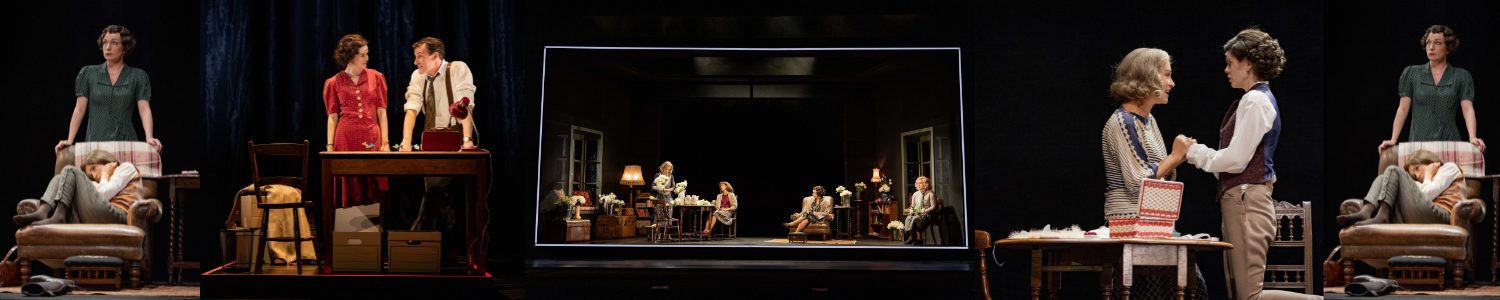
Spanning over 30 years, this ambitious piece is framed within the episodic memories of ‘Ballroom Communist’ Jessica ‘Decca’ Mitford (Emma Noakes) and her complex relationship with her sisters and their political allegiance to the Third Reich. Split between the ancestral home of the Mitfords in Oxfordshire, Washington, San Francisco, Munich and Versailles, the global nature of the play is reflected by incredibly intricate set pieces, boxed by white glowing ‘photo frames’ – which Jessica both longs for in nostalgia and abhors. These illuminated memories are surrounded by a suffocating darkness, oppressive and liminal. They are a visual representation of the black and the white, a reminder of the moral dilemmas at the heart of the production.
Whilst this set design proves a clever machination to allow for the coverage of a vast period of time, these transitions were, at times, not effortless. The contemporary music played between scenes seemed like an overt force of hand for the audience to draw comparisons to the political extremes of the 1930s and our own political climate. This frequently broke the immersion of the play and undermined a far more effective mode of comparison which the play excelled at – the shared humanity and familiar moments which brings to the forefront a complex examination of shared morality and human experience.
The global nature of the play is reflected by incredibly intricate set pieces boxed by white glowing ‘photo frames’
The technical aspects of the play were also not completely polished. On one occasion, a coat rack fell on Joe Coen (playing Bob Treuaft) which – while not a moment that ruined the experience of the play – certainly retracted from the outstanding acting that was onstage beforehand.
The play, however, excels in its characterisation. It centres on the vibrant and complex sisters: novelist and matriarch Nancy (Kirsty Besterman); Diana (Elisabeth Dermont Walsh), both society darling and adoring sister as well as lover of the leader of the British Union of Fascists; giggling debutante Unity (Ell Potter) who, in emulation of her sister, develops a school-girl crush on Adolf Hitler; and Debo (Flora Spencer-Longhurst), the youngest who dreams of marrying a Duke. Jessica, arguably the play’s protagonist, too does not escape moral criticism.
The production’s emotional depth must also be commended. It masterfully dances between moments of abhorrent evil, such as the chilling denial of Holocaust victims by Diane and comforting scenes of domestic intimacy from the sisters. This duality lies within the heart of the play. Moments of bleak comedy are intertwined with the plot such as Hitler not being ‘at all a prude’ and Jessica wanting ‘to do Lenin,’ which are presented as blushing school-girl frivolity wrapped in the privilege that isolates the sisters from the lives these figures will destroy. Little but praise can be said about the acting. Whilst at times accents appear a little caricaturist the accuracy that the cast display in presenting the complex relationships, both love and hatred between a family broken by radical politics, is simply extraordinary.
It masterfully dances between moments of abhorrent evil […] and comforting scenes of domestic intimacy
Dermont Walsh particularly excels as Diana, displaying a captivating, endearing sister whilst also being a zealous upholder of the most grotesque opinions of the Nazi race theory. This humanisation is a stroke of genius. The fact that perpetuators of great evil and abhorrent ideology can also love, grieve, and empathise shifts our perceptions of the villains that have characterised the 20th century.
Naturally, the play is deeply political and its relevance to today’s political landscape is strong. It appears an increasingly important story to tell, and in some elements this is handled with subtlety, such as Unity mirroring the words of Farage and the extreme right by exclaiming one should put ‘Britain First’ and keep ‘Germany for the Germans.’
However, in other instances the play seems to pursue contemporary political issues in a manner that appears one is being lectured rather then debated. In the wake of the Israel-Gaza conflict, Diana’s anti-Semitic rampage coincides with the Israeli state’s justification for the occupation of Gaza and the West Bank. Whilst this is a genuine opinion that of course has a place on the stage, this agenda minimises what grants the play its brilliance – the moral ambiguity and space the play allows its audience to form opinions on subjects of deep moral consequence.
At times, historical events were neglected in favour of this. For example, Jessica a deep supporter of the Soviet Union, would have been deeply disturbed by the deaths of 28 million of its citizens, also as a consequence of the Nazi-Race theory. This goes unmentioned in the play, seemingly to not overshadow the previous view. Despite some technical hitches, the play has the potential to be, perhaps the most divisive and debated piece of theatre in recent years. It brings to the forefront debates over the legacy of the Second World War and how this has shaped not only the political climate today but the way these events shape national consciousness.
Rating: 4/5
Enjoyed this review? Read more from Culture below:
Musical Review: FRIENDS! The Musical Parody
Theatre Review: Measure for Measure
Theatre Review: The Talented Mr. Ripley
Comments