Culture writer Ellen Campbell reviews The Talented Mr. Ripley, finding it suspenseful and intriguing, and praising its accomplished cast and unique directorial choices
Patricia Highsmith’s The Talented Mr. Ripley is a gripping crime classic and Mark Leipacher’s stage adaptation and direction certainly do the novel justice. The play follows the calculated Tom Ripley in his search for wealth, success and belonging. Tom Ripley is played by the accomplished Ed McVey, known for his role as Prince William in Netflix’s The Crown. McVey acutely mastered the characterisation of Tom Ripley, beautifully conveying Ripley’s overwhelming desire and ruthlessness when it comes to his need for status.
Beautifully conveying Ripley’s overwhelming desire…
Richard ‘Dickie’ Greenleaf is an entitled young man spending his days painting and lounging on sunny beaches in Europe, much to his parents’ dismay. Tom is sent to Europe by Dickie’s father to retrieve Dickie. However, Tom becomes mesmerised with Dickie’s seemingly perfect life and infatuated with Dickie himself, eventually murdering Dickie and impersonating him.
Dickie Greenleaf is played by the wonderful Bruce Herbelin-Earle, who gained recognition as Marcus Greenbridge in the Emmy Award-winning Netflix series ‘Free Rein’. Dickie’s love interest, Marge Sherwood, is played by Maisie Smith. Smith is an award-winning actress best known for her 13-year longstanding role as Tiffany Butcher in the BBC’s ‘EastEnders’. The play follows the intertwining lives of these three characters.
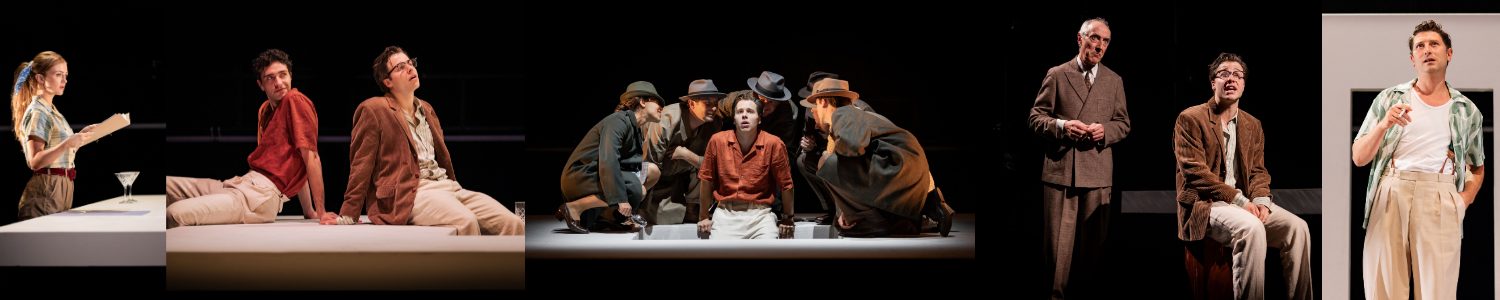
One of the prevalent themes within the production is duality. As Tom impersonates Dickie, he is haunted by the memory of his friend and struggles to escape the guilt. This duality is gracefully depicted by the presence of Dickie behind Tom in the scenes following his death, in which they talk and move as one character. This reminds the audience of Tom’s crime and reveals how Dickie remains at the forefront of his mind. The continual shadowing and mirroring of the two characters reinforces the motif of isolation, prevalent throughout the play.
‘Do you ever feel as though you’re being watched?’
The production opens and closes with the line ‘Do you ever feel as though you’re being watched?’. A haunting question that Tom repeatedly asks the audience at moments of unease. This refrain reveals how despite being physically alone for the majority of his life, Tom constantly feels as though wider forces are at play. Furthermore, this ominous recurring line invites the audience to look inward and question their own feelings of isolation and perhaps even guilt.
A final standout theme within the production is the sense that the narrative is being manipulated by Tom himself. This is implied with moments in which a character shouts ‘cut!’, the lights come on and the actors reset the scene in order to act it out again. An unusual directorial technique which I have never seen in theatre before, the brilliance of it resonated with me significantly. By stopping the scene and redoing it, the audience are reminded that they are witnessing a fictional plot and moments are replayed with different outcomes. Additionally, this sense of a play within a play connotes how Tom is his own playwright and writes his story as he goes along. Thus, this establishes Tom as an unreliable narrator and prompts the audience to question what is real.
The play was wonderfully executed and crafted with precision
Despite only being an ensemble of ten cast members, the play was wonderfully executed and crafted with precision. The set was also creative, with only a large box in the middle acting as a stage upon a stage, in which characters appeared from and disappeared into. The suspense and tension of the production was eminent, and I found myself hanging onto the lines of the characters, waiting on the edge of my seat for the outcome. The only criticism with the play is that it perhaps dragged slightly for the last half an hour, though I understand this pacing was in line with the novel and arguably necessary in order to remain accurate to the original plot. I just felt as though some of the final scenes were drawn out for a little too long. Nonetheless, Mark Leipacher has created a must-see production, and I would highly recommend it.
Rating: 4/5
The Talented Mr. Ripley plays at the Birmingham Rep till Saturday 27th September 2025. Buy tickets here.
Enjoyed this review? Read more from Redbrick Culture below:
Interview: Amy Rosenthal for The Party Girls
Comments