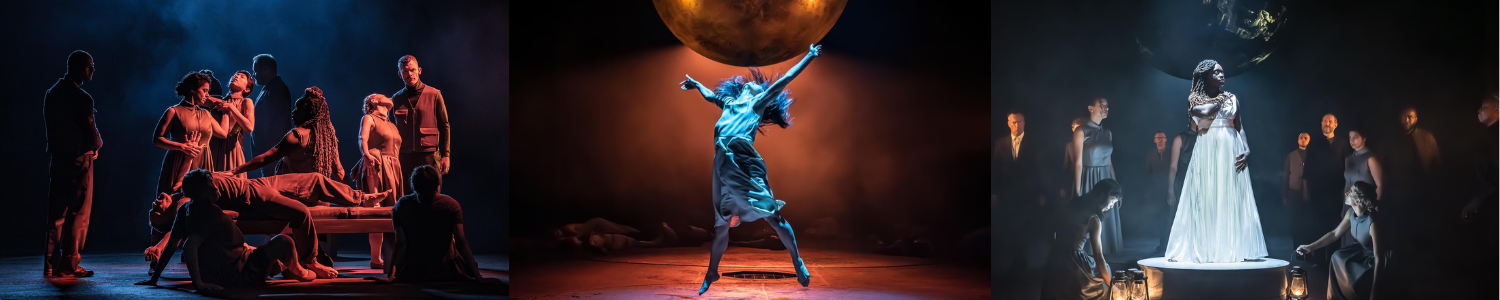
Culture writer Louisa Pickard reviews Shakespeare’s The Winter’s Tale, praising its relevance to the real world, particularly its emphasis on female-focused narratives

A woman is unjustly accused of infidelity, imprisoned whilst pregnant, denied her bodily autonomy, and forced to trial. Is this 1623 or 2025? Is this fantasy, or are we living a dystopian reality? These are only a few of the questions that director Yaël Farber asks the audience, in her compelling and curious production of William Shakespeare’s The Winter’s Tale.
Shakespeare’s late romance play of jealousy and forgiveness is no easy text to interpret and stage. Yet, Farber deftly relies on subtle staging and powerful performance to communicate a story that could not be more relevant to audiences of today. The Winter’s Tale follows the adultery trial of innocent Queen Hermione, before skipping forward sixteen years to learn how her abandoned daughter has grown up in a distant land. Though a magical and fantastical story, this performance pulls out the very contemporality of the text and is grounded in human experience.
This performance pulls out the very contemporality of the text and is grounded in human experience
With the Royal Shakespeare Company’s recent rebranding as an accessible venue for all, this year has seen string of creative interpretations. This has ranged from a Titanic-inspired staging of Hamlet, to a reimagining of Much Ado About Nothing in a world of premiership football. Yet, Farber’s tasteful, simple, and yet powerful directorial choices were a refreshing change of pace for this year’s theatrical programme. Working with movement director Imogen Knight, the staging prioritised the female cast and foregrounded the physicality of human bodies, as well as the text’s messaging of faith, forgiveness, family, and friendship.
One particularly striking moment took place during Hermione’s childbirth scene. Her ladies-in-waiting surrounded the bed, holding hands overhead, as Hermione rose through the circle of bodies, mimicking the journey that the baby was taking in labour. Such emphasis upon female community at birth resonated with early modern practises, where a strictly female group of ‘gossips’ (meaning godparents) were present. This visual conveyed the wider directional female-focused choices of the performance. For instance, the chorus of Bohemia remained female-dominated, despite no such indication in the original text.
Another particularly powerful artistic choice was the stage design, thanks to the creative direction of Soutra Gilmour. The iconic thrust stage held two circular rotating sections, one upstage and one downstage – but subtly set in wooden panelling. It was bordered by a water feature running along three corners, and eye-catchingly framed by a suspended spherical projection. These designs narrated and supported the text, and evolved alongside the storyline. The show opens in Sicilia, a space of darkness, repression, and male tyranny; as such, the colour palette of grey and blue costume design was mirrored by the projected moon which frequently loomed over. Along with smoke rising from the water, and the spiralling stage, these creative choices reflected Leontes’ rapid descent into paranoia. Yet, many Shakespeare’s contemporaries considered women to have typically cold and watery bodies, with their menstrual cycles linked to the moon; therefore, the visual choices became inherently feminine.
The stage spoke to the power of female community and undercut the displays of male dictatorship onstage
Alongside the arresting performances of Madeline Appiah (Hermione) and Aïcha Kossoko (Paulina), the stage spoke to the power of female community and undercut the displays of male dictatorship onstage. Later, the play moved to the free, natural, pagan space of Bohemia. The moon took on the likeness of a radiating sun or a planetary orb, and the colour palette shifted to warmer tones. Though the actors’ movements became more predictable, for instance, the plot necessitating a dance sequence, the musical direction was exciting and innovative. Having previously favoured string instruments, featuring a violinist and cellist upstage, the feast (turned festival) scene transformed into a ritualistic rave. Heavy synths and electronic beats accompanied guttural singing, a blazing fire, and feverish dancing. It was an exciting moment of raw humanity which engaged with another contemporary theme: environmental anxiety.
It was an exciting moment of raw humanity which engaged with another contemporary theme – environmental anxiety
Farber’s casting choices were also refreshing, seen with the multi-casting of Trevor Fox who played both Time and Autolycus, the ballad seller. Though this was necessitated by Kathryn Hunter’s unexpected decision to withdraw from the role of Autolycus, Fox’s insistent presence onstage foregrounded a blanketing anxiety of the passing and temporality of time. Rising to the challenge, Fox’s performance was both comic and compelling, delivering the lines with agility and ease. Meanwhile, some of his younger colleagues such as Leah Haile (Perdita) and Lewis Bowes (Florizel) gave a confident performance, but at times lacked the projection and enunciation needed for the RSC space. This was further hindered by the inconsistent use of microphones and issues with levels. Nevertheless, the two lovers gave a refreshing sense of earnestness to the performance and left the audience relieved to see a fairy tale ending after all.
With a full cast onstage, family and lovers reunited, the actors turned their backs to the audience and set their eyes on the spherical projection. It had transformed into a rotating globe, and broke the fourth wall, relocating viewers from the abstract fantasy to a more grounded reality. Though I am undecided as to whether this was the most tasteful way to do so, Farber’s message was clear. Whilst for the characters this was, ultimately, just a winter’s tale, the realities of white, cis, male tyranny remain. The RSC’s production of The Winter’s Tale was both sobering and stimulating, demonstrating how Shakespeare remains timeless and topical for all.
Rating: 4/5
Note that students and anyone under the age of twenty-five are eligible for £10 tickets to RSC shows. The Winter’s Tale is running until the 30th August, buy your tickets here!
Comments