Film & TV Writer Esme Chen compares Nosferatu and Dracula, analysing how vampiric media reflects contemporary cultural obsessions with thinness
Content warning: discussions of weight loss and disordered eating
The discourse and pressure around weight loss drugs such as Ozempic is a horror genre within itself. It is dystopian: hunger becomes a weakness; consumption becomes unpleasurable; and eating itself is rendered optimal rather than enjoyable. It is no coincidence that this discourse has intensified during a period of fervent economic recession. More interestingly, it mirrors the contemporary rise and fetishisation of cannibalism across social media, literature, and film.
The discourse and pressure around weight loss drugs such as Ozempic is a horror genre within itself.
For me, this convergence sits within the broader romanticisation of the vampire. In this article, I will compare two seminal vampiric texts: Nosferatu (2024, dir. Robert Eggers) and Dracula (1958, dir. Terence Fisher). But first, it is necessary to foreground why – and how – this shift has occurred, and why it matters.
As previously mentioned, the discourse surrounding weight loss drugs such as Ozempic is horrific. Eating becomes optimal, unpleasurable, and disciplined. Cannibalism, by contrast, completely reverses this logic. The desire to eat and consume becomes excessive and uncontrollable, and, depending on the media, not even shameful. In films such as Bones and All (2022, dir. Luca Guadagnino), the eater must hide, apologise, and fervently abstain. Vampires – or at least the stereotypical ones – are unapologetic: aristocratic, pretentious, entitled.
It is this split between acceptable desire (thinness, restraint) and pathological desire (excess, appetite) that becomes crucial. The body is no longer simply consumed, but managed, moralised, and optimised. This distinction is precisely what separates Eggers’ Count Orlok from Fisher’s Dracula.
They are thin, beautiful, eternal – and, crucially, emotionally restrained.
The stereotypical vampire is exactly what biopolitical governance of appetite endorses. They are thin, beautiful, eternal – and, crucially, emotionally restrained. Rather than eating food, they extract. The modern, fetishised vampire embodies restraint, minimalism, cold beauty, and ‘clean’ consumption. This stands in stark contrast to the romantic vampire – the messy cannibal – where extraction becomes survival and need triumphs over elegance. The vampire, as managed desire, mirrors how thinness is presented today through aesthetic discipline and late-capitalist restraint.
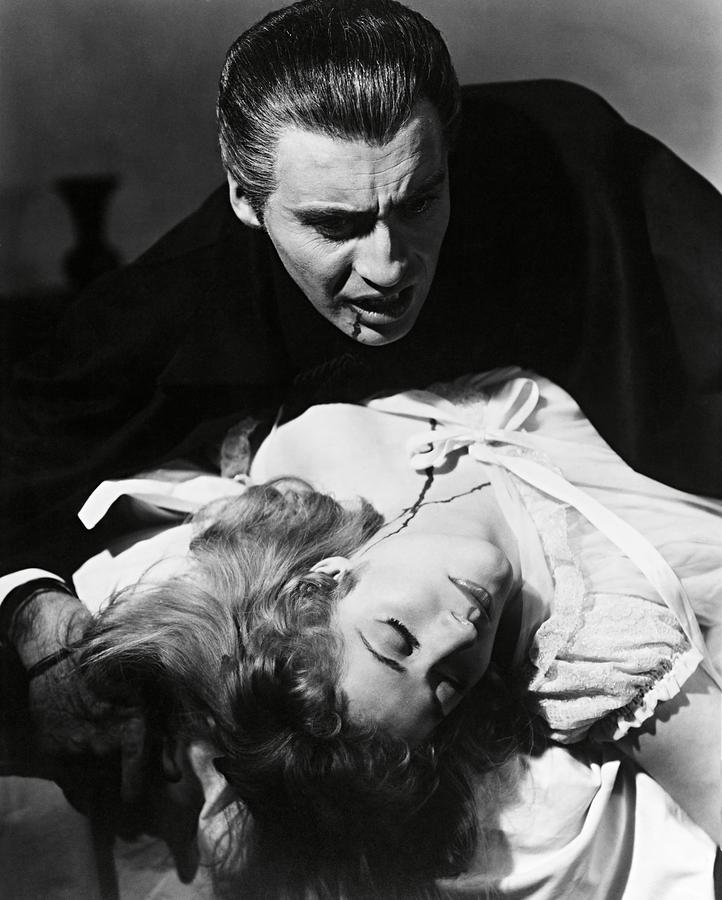
In Dracula (1958), hunger becomes aristocratic control. Christopher Lee’s Count is astute, uncannily elegant, and meticulously composed. Most importantly, his appetite never appears ravenous or desperate; it is selective, ritualised, and controlled. His hunger is never ‘ugly’. This maps cleanly onto contemporary body politics, where, particularly for women, thinness signals discipline, futurity, and control. Hunger becomes a weakness, something to be surveilled and governed. We increasingly see high-visibility celebrity figures embody this valorisation of thinness, and Lee’s Dracula becomes an eerily prescient figure: feeding as elite consumption, desire aestheticised and managed.
This maps cleanly onto contemporary body politics, where, particularly for women, thinness signals discipline, futurity, and control.
Dracula’s rendition of feeding is entirely opposed to Eggers’ Count Orlok. While Lee’s Dracula is purposefully erotic – tall, darkly charismatic, and coded with perverted sex appeal – Orlok is skeletal, animalistic, and visibly dead. Scholars have long noted that 1950s Britain was a period of repressed sexuality, in which vampirism functioned as a coded metaphor for forbidden desire. Orlok offers none of this. His hunger is constant, exposed, and unsated.
Eggers’ Orlok is inseparable from the imagery of rot, infestation, and bodily excess. He cannot brand or aestheticise his hunger, just as the average body cannot aestheticise thinness. While Dracula eats invisibly, Orlok eats visibly. In contemporary culture, visible hunger is always punished. Too many women and girls refuse to eat in public, apologise for eating, or verbally discipline their bodies while consuming food. Since when did basic human need – and basic pleasure – require justification?
In contemporary culture, visible hunger is always punished.
Eggers makes hunger monstrous again, not because it is immoral, but because it is socially uncontainable. Hunger becomes terrifying not because Orlok needs to feed, but because he cannot stop wanting. This is where cannibalism becomes culturally productive: it confronts our denial of appetite, pleasure, and excess. The consequence of that confrontation is monstrosity.
If Dracula’s thinness is controlled, Nosferatu’s thinness is terminal. Dracula’s body reassures; Orlok’s indicts. This dichotomy exposes the dangers of a culture committed to the eradication of hunger. Whether driven by economic recession, misogyny, or late-capitalist discipline, the promise of a future without appetite is a dangerous fantasy. If Ozempic offers a world in which hunger disappears, Eggers’ Nosferatu insists that hunger will return – through decay, disease, or bodies that refuse to behave. That inevitability is where the true horror lies.
More from Redbrick Film & TV:
TV Review: The Secret Lives of Mormon Wives Season Three
Comments