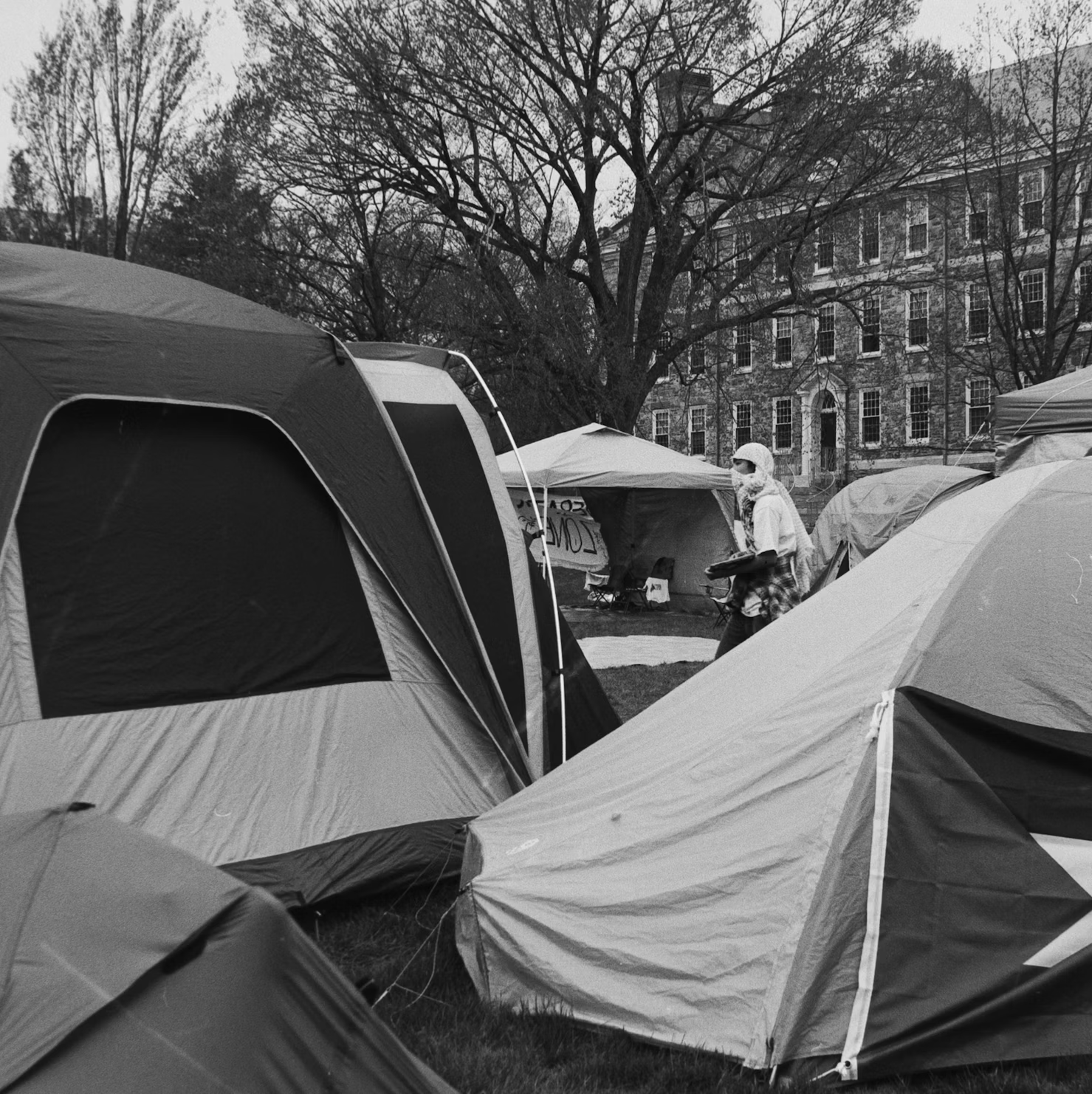
Social Media Manager Toby Jarvis looks behind the scenes of the ‘Gaza Heart’ encampment of 2024, and its less-than-romantic reality

Any readers in their first or second years will not remember the pro-Palestinian encampment from the summer of 2024, which, after sixty-four days, was unceremoniously bailiffed into non-existence that July at the request of the University. But it still hangs over us: one of its leaders is now president of the Guild. With this in mind, how much do we actually know about what was going on there? Most sources are either directly from the camp, or directly from the university, and if you fancy massively insulting your own intelligence for no reason you’re more than welcome to read the latter.
More people were posting about the encampment than actually showed up to it
To really unpack the Liberated Zone / encampment / ‘Gaza Heart’ et. al, you’d need an impartial and removed voice… like Redbrick, for example. Unfortunately, our paper’s coverage was mysteriously quiet at the time — not for lack of trying, by the way — but there’s no time like the present for catching up. Its more trivial details hardly bear repeating so long after the events in question, but the mystery at the centre of the camp was the unified front it succeeded in presenting to outside students. In other words, there was no small amount of infighting it was concealing.
Part of the reason this is not wider knowledge is simply that far more people were posting about the encampment than actually showed up to it. It’s a weary but undeniable truth that slapping something on your Instagram story requires no effort whatsoever, and many students fancied this as an alternative to dogsbodying around the Green Heart. After about a fortnight, almost no newcomers were visiting the Zone. It’s like a recurring nightmare about being mugged by a human incarnation of BBC Four
The romantic (and untrue) narrative at the centre of the camp was that it was a spontaneous coalition of students, organised in perfect union to oppose the Palestinian genocide and this university’s alleged ties to it. In fact, almost every group in the ‘coalition’ had secondary interests that often brought them into conflict with each other. A special mention has to go to the Marxists: one party, whose name I don’t care to remember, used the camp as a pretense to flog their propaganda rag to well-meaning visitors for five pounds a copy. In doing so they raked in about a hundred pounds — none of it meant for Gaza, of course.
That was unsurprisingly unpopular, and the situation was hardly helped by their habit of insinuating any nay-sayers were simply too stupid to understand them. In Sheffield, a very similar disagreement boiled over and resulted in a public expulsion of the Trots (so much for the vanguard). No-one likes being condescended to by a nineteen-year-old who thinks they alone understand the truth behind the world; it’s like a recurring nightmare about being mugged by a human incarnation of BBC Four. Their favoured topics of discussion were not about Palestine but had everything to do with indulgent, feverish blathering about dead German and Russian revolutionaries. This is to say nothing of the occasionally awkward interplay between religious conservatism and social progressivism among some of the factions. At one point a Pride flag inexplicably vanished from sight overnight.
Suffice it to say little of this was apparent to the outside audience. Fundamentally, the camp was more a television set than a living environment; only about ten of its hundred tents were in use by the end. A few electoral no-hopers even used it as a background for their campaigning — one of them was local populist belcher Akhmed Yakoob (I wonder where he is now?). Watching coverage of the Your Party conference I was trying to figure out why one of the pork-jowled functionaries seemed so familiar, and then I remembered he’d proudly yabbered at me about how great it was to be visiting the protesting students at the University of Manchester. The camp was more a television set than a living environment…
But on the topic of pork, what about the rozzers? Occasionally the University would send for a couple PCSOs (cosplayers, basically) to vaguely menacingly watch with its own security from little perches around the camp. It is a miracle anyone survived such an organised display of male pattern baldness. They did even more of sod-all than the campers they were supposed to be intimidating, which was something of an achievement.
The real push against the encampment from the university was its lawsuit against two of its members, for which it forked out for a KC — the case isn’t overly interesting (TL,DR: university won, camp did not) save for the fact it accidentally rechristened the Vice-Chancellor ‘Mr Tickle’ (see point 17 here), which henceforth shall remain his name in perpetuity. Although the case does bring to the forefront the sloppiness of some coverage: this article for The Tab mentions the ‘UoB Two’ defendants while failing to note its author literally is one of them, which is a pretty severe conflict of interest.
It was a cynical, embittering environment dominated by squabbling
Losing in court, combined with the end of term, provided a natural end to the camp, although sporadic protests (as well as a couple underwhelming sequels) have taken place in the years since. To be frank it was a cynical, embittering environment, dominated by squabbling and slowly declining morale. This is not helped by the false history of it that has been allowed to take root, largely by students who could hardly be bothered to visit.
Routinely four-hundred people would like posts promoting an event to which four actually showed up. It was a chance to indulge in the aesthetic pleasures of being a revolutionary, or at least a facsimile of one who would risk nothing and commit no time to their cause. Israeli atrocities in Gaza were enough to warrant outcry, yes, but not enough to venture beyond the Selly Oak mould. The vacuum of clarity resulting from this functionally non-existent base of supporters, and the absence of independent coverage around the Liberated Zone, has given it a completely apocryphal posthumous existence. The version of it in our collective memory will always be more romantic than the real thing.
If you liked this, read more from Redbrick Comment:
In Conversation with FemSoc: Redbrick on Spiking Against Students
Comments