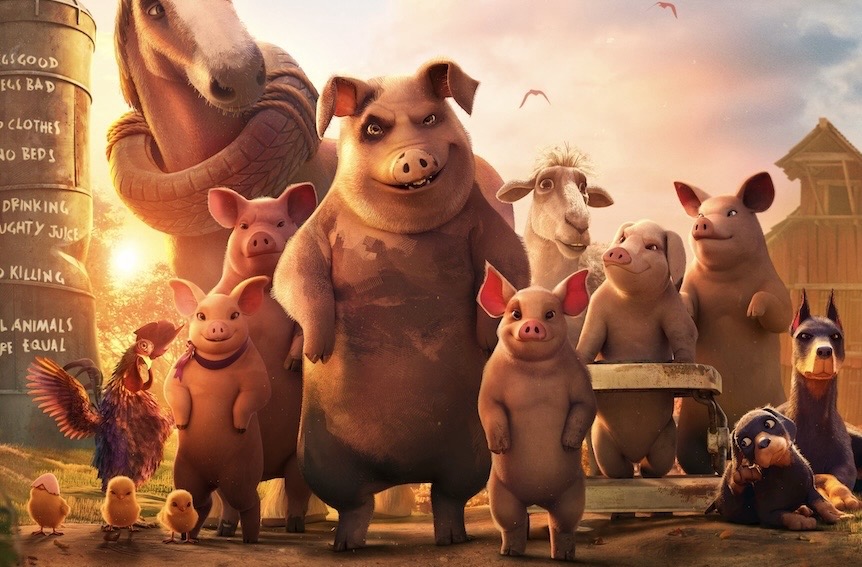
Comment Editor Ed Bettles discusses the trailer for the new animated Animal Farm, criticising its changes from George Orwell’s original novel
On December 12th 2025, Angel released the first official trailer for a new animated version of Animal Farm, directed by Andy Serkis and adapted for the screen by Nick Stoller. This is not the first time that George Orwell’s classic novel (first published in 1945) has made its way onto the big screen, honouring the legacy and solidifying the position of Animal Farm within the English literary canon. Joy Batchelor and John Halas’ 1954 film and John Stephenson’s 1999 live-action remake have both been historically well-received and highly regarded by audiences, setting a high bar for their successor to meet. However, the first glimpses of Serkis and Stoller’s film, scheduled for release in cinemas on May 1st 2026, appear to have fallen short, leaving critics resoundingly underwhelmed and even outraged by their modern reimagination of Orwell’s poignant critique of totalitarianism in Stalinist Russia, despite over a decade spent in development and an all-star cast of voice actors.
However, the first glimpses of Serkis and Stoller’s film, scheduled for release in cinemas on May 1st 2026, appear to have fallen short...
As those of you who, like me, studied Animal Farm in secondary school will know, the novel follows a group of farmyard animals, who revolt against their drunk, negligent and exploitative owner, Mr Jones, in an allegorical reflection of the Communist Revolution against Tsar Nicholas II. Orwell then uses the political framework established by the pigs, Snowball (representing Trotsky) and Napoleon (Stalin), to explore how their collectivist ideology, Animalism (a thinly veiled metaphor for Communism), can give way to corruption and tyranny.
Serkis’ Animal Farm, according to its synopsis on IMDb, and what can be gathered from the official trailer, appears to remain loyal to most of these original plot points. Namely, the animals rebel against Mr Jones (voiced by Serkis himself) and implement the commandments of Animalism, before Napoleon (Seth Rogen) assumes full control of the farm, gradually but unmistakably changing the commandments for his own selfish gain. For example, ‘All animals are equal’ is blatantly and satirically subverted to become ‘Some animals are more equal than others’. Eventually, this effect culminates in the novel’s final, haunting image of Napoleon as a leader indistinguishable from the humans that oppressed them in the beginning. However, there are three key, unmistakable changes that distinguish this new animated version from Orwell’s novel, thus attracting the scorn and scrutiny of critics.
First and foremost, Serkis introduces a new main protagonist, a piglet named Lucky (voiced by Stranger Things star Gaten Matarazzo), who appears to serve as a surrogate audience, embodying and exemplifying the intended reactions we should have to the film’s action through the lens of their youthful naivety. Secondly, and somewhat as a consequence of the first, some critics have commented on Serkis’s attempt to appeal to younger audiences, using crude fart humour and allusions to a potential happy resolution in which the animals regain control from Napoleon and restore the principles of Animalism.
These changes, and forced insertions of levity to appeal to younger audiences, completely undermine Orwell’s intentions and limit the film’s capacity to offer the poignant ideas that we recognise and value in the novel.
To me, this completely misses the point and subverts the intended narrative that Orwell explores in the original text. Despite the appearance of a children’s novel, Animal Farm is not intended to be light and comical. As a political satire, the irony and somewhat tragic ending should be read as solemn and uncomfortable, impressing upon the audience the harsh but very real potential for corruption in power in our society. These changes, and forced insertions of levity to appeal to younger audiences, completely undermine Orwell’s intentions and limit the film’s capacity to offer the poignant ideas that we recognise and value in the novel.
Lastly, in Serkis’ adaptation, the duplicitous, self-serving farmer Mr Pilkington, who becomes involved in trade with Animal Farm, is reimagined as the businesswoman Freida Pilkington (Glenn Close). While they’re a rather minor character in Orwell’s novel, the new trailer suggests a much more central importance, with Pilkington introducing modern technology, drones, luxury cars, and designer brands to the animals. As such, the focus is shifted further away from the corruption and totalitarian regimes born from communist ideologies, as in Stalinist Russia, and turned towards what some have described as a ‘woke’ appraisal of capitalism and consumerism, completely inverting the original, intended moral. I’ll concede that there’s a case to be made about repurposing and mobilising Orwell’s classic tale to critique contemporarily more pertinent and modern political circumstances, but it hardly appears that Serkis is attempting this tastefully. On the contrary, the 2026 film verges on being unrecognisable as any representation of Animal Farm, save its name.
Ultimately, we will have to wait until the film is released in cinemas in May this year for Serkis’ intentions and their successes to become completely clear, but from the reception of this trailer, it’s certain that things do not bode well for the production.
More from Redbrick Film & TV:
Comments