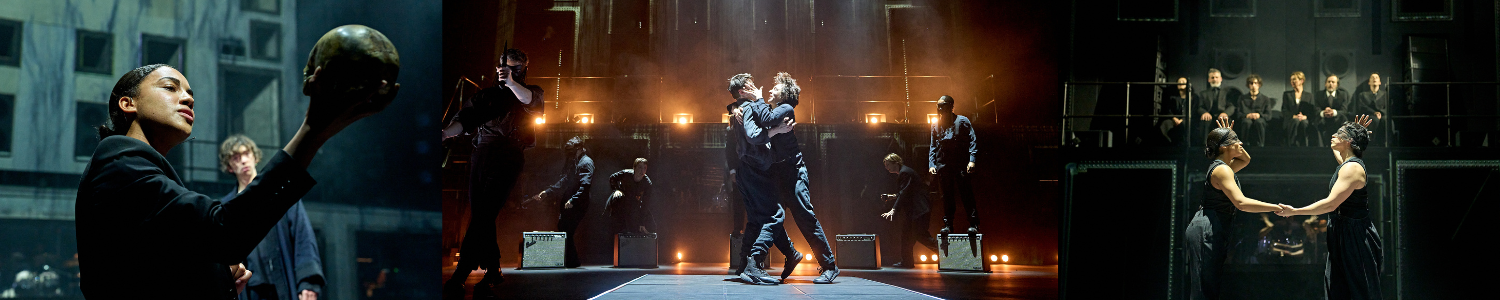
Culture writer Ellen Campbell praises the RSC’s production Hamlet Hail to the Thief for its masterful fusion of Shakespeare’s classic tragedy with Radiohead’s critically acclaimed album
Hamlet Hail to the Thief is a profound production that elides Shakespeare’s play with Radiohead’s 2003 album Hail to the Thief. The play ‘fuses language, music and dance in a way that offers us an exhilarating and unique reinvention of Shakespeare’s masterpiece.’ [1] My friends and I were sat on the edge of our seats during the whole performance. The raw talent of the actors left me speechless, and the music was unforgettable. The next day, I was fortunate to attend a Q&A with cast and crew members of Hamlet Hail to the Thief.
In attendance at the Q&A was the talented Tom Knowles, who is associate musical director. Knowles explained how the play’s sound was created through a process of workshops; this included fragmentation of songs, harmonies and duets – even reversing songs, changing the tempo and splitting tracks. Knowles shares how the music is at the foreground of establishing tone in the play. Rather than simply playing a soundtrack, the actors are compelled into movement work and are prompted to engage with the music. Knowles coins the sound of the production as “messy, weird and magic.”
Both Shakespeare and Radiohead are art forms with perhaps opposing audiences, and yet the performance combines both to create a masterpiece
Hamlet Hail to the Thief encourages raw music and text to act as one entity. Both Shakespeare and Radiohead are art forms with perhaps opposing audiences, and yet the performance combines both to create a masterpiece. By aligning the poetic and the political, an entirely new genre of musical theatre is crafted. Claudia Harrison (UoB alumni) plays Hamlet’s mother Gertrude, and she spoke eloquently about the play’s depiction of femininity. Harrison discusses how Shakespearean female characters are often passive and lack autonomy. She stated that these women often “have things happen to them,” rather than making things happen for themselves, and their stage presence consists of “crying and periods of silence.”
However, in this production, the female characters are valiant and brave, filling previous silences with their thought and input. Their thought is rife with rage and frustration, in turn communicating their emotions without saying a word. This implies that the women are not silenced, but rather they have the power to use these moments of silence to express their emotion and build a connection with the audience.
Furthermore, Horatio is wonderfully played by non-binary actor Alby Baldwin. In the Q&A, associate director Francesca Murray-Fuentes recalled a conversation with Baldwin in which they were eager to bring aspects of their non-binary identity to the character of Horatio. Murray-Fuentes stated that “Queerness exists everywhere, so why not in our play?” This choice to have a non-binary main character has significant impact for a contemporary audience, as many LGBTQIA+ community members do not see their identities represented in Shakespeare. Additionally, this acceptance of Horatio connotes the changing dynamic of theatrical spaces, Murray-Fuentes says; “Having these socio-political conversations is arguably our duty as a theatre-makers.”
the female characters are valiant and brave, filling previous silences with their thought
During the Q&A, members of the cast and production team also made enlightening comments regarding the political weight of Hamlet Hail to the Thief. Notably, Murray-Fuentes illustrates how different adaptations of Hamlet often communicate varying themes relevant in contemporary society. Shakespeare’s work is rife with novel themes and his plots often resist a singular reading, therefore different theatrical productions of Hamlet will often prioritise different themes. For instance, some versions of Hamlet focus on the concept of masculinity or gender, while others focus on grief and loss.
Additionally, the timing of theatre productions is often charged with political weight. I felt especially moved during the play when Horatio recites the final lines of the play; surrounded by corpses, he questions ‘how these things came about’. Horatio encourages us to remember these ‘carnal, bloody and unnatural acts; of accidental judgments [and] casual slaughters.’ This closing line invites the audience to consider the socio-political context when contemporising Hamlet, and the remaining relevance of themes such as loss, war and grief, even 400 years following the play’s original publication.
To conclude, Hamlet Hail to the Thief is a bold performance with striking contemporary relevance. The imaginative production, unforgettable orchestration and pure talent is extraordinary. Hamlet Hail to the Thief is a must-see performance, for Shakespeare and Radiohead fans alike.
Rating: 5/5
[1] Daniel Evans and Tamara Harvey, Hamlet Hail to the Thief Official Programme, Royal Shakespeare Company
Comments