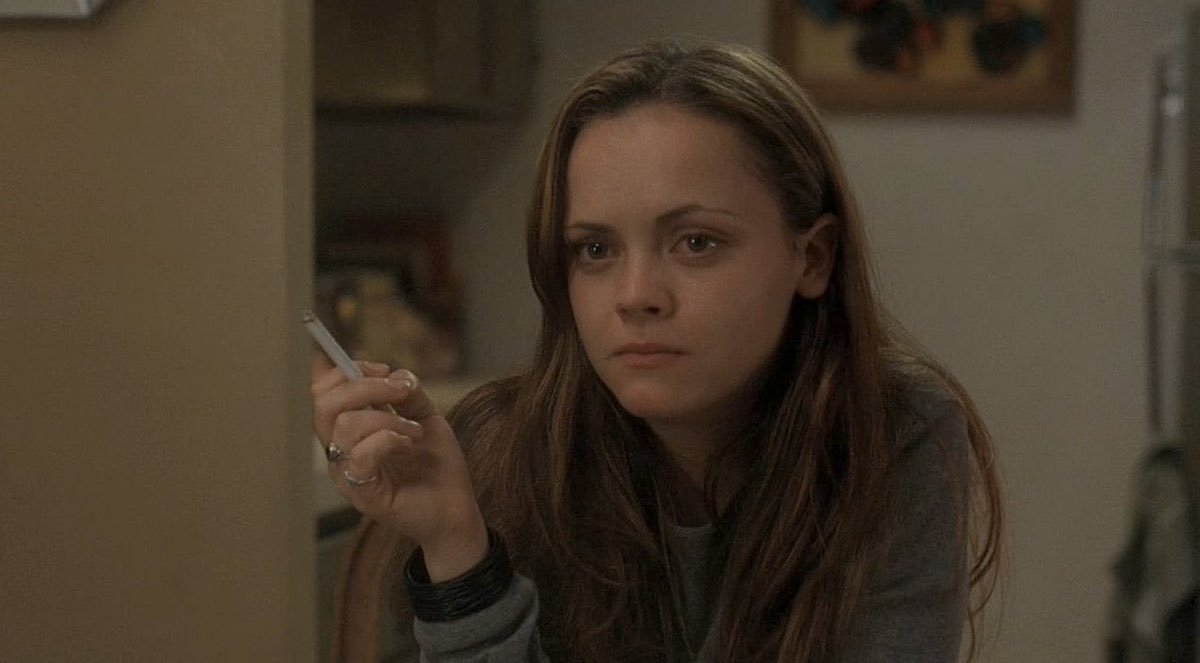
Film & TV Writer Cassandra Fong looks back on the 2001 film Prozac Nation, praising Christina Ricci’s striking portrayal of Elizabeth Wurtzel

Content warning: mental illness
In Prozac Nation, the 2001 adaptation of Elizabeth Wurtzel’s controversial and confessional memoir, director Erik Skjoldbjærg crafts a bleak, atmospheric study of depression, identity, and disconnection. But at the centre of this emotionally dense film is Christina Ricci, delivering a career-defining performance that is both intellectually sharp and devastatingly vulnerable. It’s her nuanced, layered portrayal that transforms the film from a straightforward adaptation into a profoundly affecting character study.
What’s most striking about Ricci’s performance is her refusal to make Elizabeth easy to digest.
Ricci plays Elizabeth Wurtzel, a brilliant but emotionally volatile Harvard freshman whose inner turmoil threatens to unravel her promising academic and professional future. On paper, Elizabeth is prickly, difficult, at times even self-destructive. In the hands of a lesser performer, she might come off as cold or performatively troubled. But Ricci brings to the role a deep emotional intelligence that refuses to flatten the character into stereotype.
What’s most striking about Ricci’s performance is her refusal to make Elizabeth easy to digest. She plays her not as a victim or a tragic figure, but as a real young woman in crisis, someone smart enough to understand the mechanics of her pain but unable to control it. Her performance is filled with contradictions that feel painfully authentic: Elizabeth lashes out even when she craves intimacy, mocks the very people trying to help her, and intellectualizes her emotions as a form of self-protection. Ricci captures all of this with remarkable precision.
From the opening scenes, Ricci’s physicality and subtle emotional cues establish a character walking a psychological tightrope. Her Elizabeth is anxious, quick-tongued, constantly shifting between rage and dissociation. But beneath all the volatility, there’s a deep, aching sadness that never feels far from the surface. Ricci allows us to see the toll of Elizabeth’s inner life on her body and spirit not through overt displays of anguish, but through the quiet, persistent weight she carries in her posture, her gaze, her voice.
Ricci allows us to see the toll of Elizabeth’s inner life on her body and spirit
The voiceover narration, largely drawn from Wurtzel’s original prose, is where Ricci’s intelligence shines brightest. She delivers the memoir’s incisive, often painfully self-aware reflections not with melodrama, but with a cool detachment that adds to the haunting effect. These inner monologues give us direct access to Elizabeth’s mind, but it’s Ricci’s performance that bridges the space between thought and behavior. She gives the film its psychological realism by showing how someone can articulate the problem and still be helpless to solve it.
Her dynamic with the supporting cast further underscores the complexity of the role. Jessica Lange, playing Elizabeth’s erratic and emotionally dependent mother, brings a matching intensity to their scenes together. But Ricci never lets the relationship become one-dimensional. There’s a clear undercurrent of pain, history, and even guilt between them, and Ricci channels all of that into every interaction. Her confrontations with Lange feel emotionally lived-in: fraught with resentment, yes, but also marked by a desperate need for maternal love.
Ricci also shows range in her chemistry with Elizabeth’s friends and lovers, including Jason Biggs and Michelle Williams. In those moments, she allows slivers of charm and warmth to emerge, only to pull back into isolation as Elizabeth’s illness overwhelms her. These fluctuations are not dramatic plot points; they’re organic responses to a life being quietly undone by a condition few people around her understand.
In a cultural moment when mental health was still largely stigmatized in media, Prozac Nation offered a rare and serious depiction of clinical depression in young adulthood.
The film itself occasionally stumbles under the weight of its subject matter. Its episodic structure, reliance on internal monologue, and grim tone may feel uneven or emotionally exhausting. But Ricci provides the throughline, a unifying emotional force that grounds the film in something deeply human. Her performance is the reason the film works at all, elevating what could have been a clinical exploration of mental illness into something poetic, raw, and relatable.
It’s worth noting, too, that Ricci was not just the film’s star but also its executive producer. Her commitment to the material is evident in every frame. This is not a showy performance designed to win awards; it’s a portrayal crafted from empathy, insight, and a clear respect for the subject matter. Ricci doesn’t just play Elizabeth, she seems to understand her, inside and out.
In a cultural moment when mental health was still largely stigmatised in media, Prozac Nation offered a rare and serious depiction of clinical depression in young adulthood. And Christina Ricci’s performance remains its greatest strength: a deeply intelligent, emotionally searing portrayal that gives voice to an experience that, for many, had long gone unheard. Her work here is not only a high point in her career, it’s a reminder of the power of smart, fearless acting to bring difficult truths to the screen with honesty and grace.
More from Redbrick Film:
Redbrick Rewind: The Bling Ring
Comments