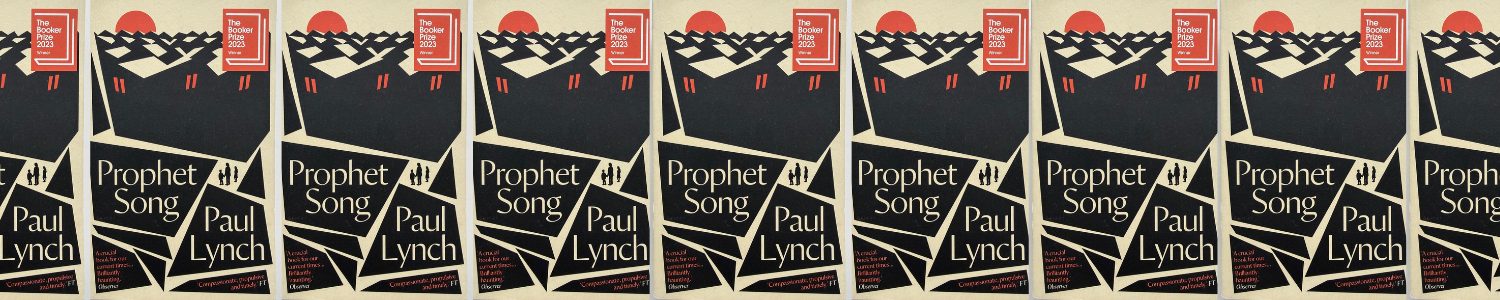
Culture Writer William Meadwell reviews Paul Lynch’s Prophet Song, praising its depiction and exploration of a fictional fascist regime set in Dublin
Prophet Song by Paul Lynch, published in 2023 and winner of the Booker Prize, is a novel that envisions contemporary Dublin held in the chokehold of a fascist regime, known simply as ‘the party’. The narrative follows scientist Eilish Stack as she and her family navigate the suppression of opposition, militarism, and subordination of individual interests that develop over the course of the book.
A masterful examination of what a far-right regime would look like in a western European city
The narrative opens with Eilish’s husband, Larry, a teacher and trade unionist, getting called upon by the GNSB, the party’s new secret police. This initiates a sinister series of events – first, Eilish starts seeing gradually increasing support for the party in her daily life. Larry then participates in a march against the party that gets squashed by the police, and all Eilish can do is watch it unfold on the TV. Larry and many others in the rally do not return home, and this occurs amidst many other disappearances, all opponents or dissidents of the party. As one would expect, this has a lasting impact on the young family, Eilish left to raise four children on her own.
Lynch’s novel is a testament to the lengths a mother would go to protect her family, revealing the tenacity of the human spirit when faced with the dark cruelty that same spirit is capable of. It’s particularly relevant in the contemporary geopolitical landscape, as we stare down the barrel of more guns that threaten countries with years of social and economic regression. Lynch has said that the book was inspired by the Syrian regime that emerged in the early 2010s, a regime that was only recently brought down in 2024. This regime wrought terror and brutality on its people, severing international relations and suppressing opposition where it saw fit. In 2026, Lynch’s book could have been based on several other governments who all seem to want to emulate the early acts of the fictional party that has crippled Dublin in Prophet Song. The book can easily be interpreted as a pertinent warning against the reality that many countries are sleepwalking towards. It is chilling when fiction doesn’t look much like a story.
The tenacity of the human spirit when faced with the dark cruelty
On a stylistic level, Lynch executed this perfectly. This story is teeming with events that destroy the reader and yet the author forces you to keep trudging along with Eilish and her family to the end of the world. The continuous prose that lacks speech marks can seem disorienting at first, but this structural choice paired with sweeping metaphors brilliantly represents the crushing force of the regime, constantly suppressing and burdening those living under it. The setting and tone of the later chapters read like the most depressing dystopias out there – the last chapter feeling like it was ripped straight out of Cormac McCarthy’s The Road, a stark contrast to the Dublin that chapter one opens with.
Paul Lynch’s Prophet Song is a masterful examination of what a far-right regime would look like in a western European city, bringing the horror of 1930s fascism into the modern era. In Eilish Stack, Lynch has created a beacon of hope to believe in, a light that shines radiantly in the depressing and muted dystopia in which the tale is set. This narrative will crush you, but it does so with a macabre grace that shocks and saddens.
Enjoyed this review? Read more from Redbrick Culture below:
Comments