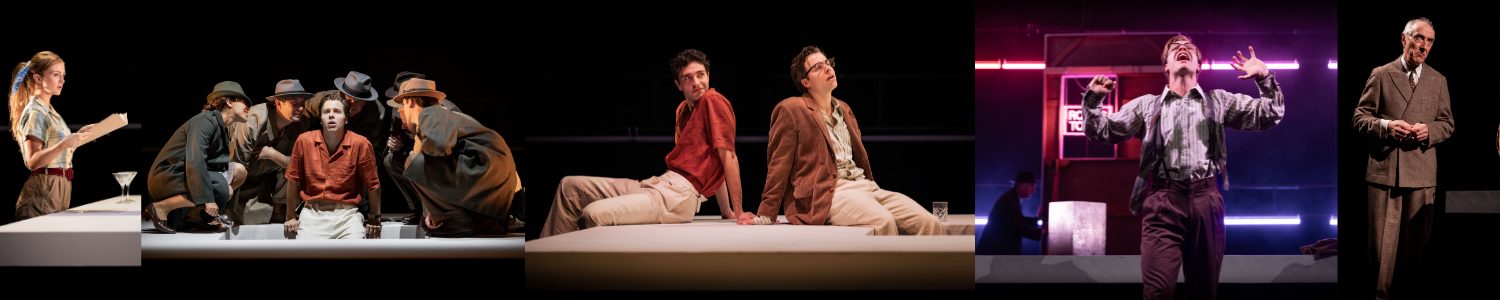
Culture Writer Caitlin Rock reviews The Talented Mr. Ripley, praising strong cast performances and an innovative creative team
‘Have you ever had the feeling that you’re being watched, or followed?’ Tom Ripley (Ed McVey) asks us as the play begins, easing us into the profound metatheatre we are about to watch. The fourth wall is broken so many times that when a stage manager asks the actors to leave the stage due to a technical malfunction, I question whether this is part of the play. It is not, but neither does it hinder our enjoyment as we are snapped right back into the enthralling world.
Profound metatheatre
This production of The Talented Mr. Ripley is an adaptation of Patricia Highsmith’s 1955 novel of the same name; a new take on a story that has been adapted into both film and TV form. New York fraudster Tom Ripley is offered a free trip to Europe in exchange for coaxing Dickie Greenleaf (Bruce Herbelin-Earle), the son of a wealthy stranger, home from a secluded Italian village. As Tom’s connection with and deception of Dickie rises, so too do the stakes.
The staging is the first thing you notice when you walk into the theatre. For a play predominantly set in Italy, the choice of a single raised podium in the centre of the stage seems confusingly simple. However, lighting and sound are expertly utilised to completely transform the stage into whatever space the director wants us to see. This set comes to be one of the most effective storytelling tools in the whole play. A hole within the podium – invisible to those in the stalls – means characters can appear and disappear at a moment’s notice. Dead characters can rise up out of the ground and remind us that they are never really gone.
Aside from transformative staging, what made Mr Ripley so compelling and watchable, for me, was definitively the actors. With such a small cast, it is important that each cast member carries their weight. That was undeniably achieved here. There wasn’t a single character on stage that felt out of place. Leda stood out amongst the minor cast members, playing seven distinctly different roles (most notably Emily Greenleaf). From accent to costume to gait, everything about how she completely inhabited each new character could have fooled me into thinking the ten-person cast was profoundly bigger.
Herbelin-Earle’s Dickie Greenleaf commanded the stage, gliding around with a perfect mix of effeminacy and arrogance. Clear inspiration was taken from Jude Law’s Dickie (The Talented Mr Ripley, 1999), but never in a way that made it feel like Herbelin-Earle wasn’t bringing something fresh to the role. Casting Director Marc Frankum hit the nail on the head with Herbelin-Earle, whose height adds something that I didn’t know was missing from Jude’s Dickie, making him more imposing, and able to tower over Tom and Marge (Maise Smith) in scenes of conflict; a visual representation of who holds the power.
Fooled me into thinking the ten-person cast was profoundly bigger
The combination of the performances by the two leading men was gripping. A spine-chilling awkwardness colours their early interactions, creating the basis for the two to grow closer and more entwined culminating in moments of homoeroticism that are only possible because of the chemistry and tension that has been building since they first met. McVey’s subtle changes in demeanour as he becomes more immersed in Dickie’s inner world are so minute that they almost go unnoticed until we are slapped in the face with just how different he has started to act.
This level of innovation should have been expected from such a psychological play, but I kept finding myself shocked by new and experimental ways that were found to explore Tom’s mind. Tom’s friend Cleo calls the story ‘Shakespearean’, and the influence is certainly notable in Ripley’s frantic soliloquies that read in part like a scene from Hamlet, and in part like bad spoken word poetry. In some moments, he merely lists off words such as ‘lonely’, which lacks effect when overused and in comparison to the more creative ways the fourth wall is broken. For example, when trench-coat and fedora clad figures come on stage to critique Ripley’s performance of himself, tricking us into thinking that Ripley was the one performing, and not McVey.
Overall, The Talented Mr Ripley is an immensely engaging play full of talented people on and off stage. The story is beautifully constructed and creatively presented. Whilst I can’t speak to its faithfulness to the book, fans of the film can expect to be kept on their toes as plot points differ, whilst the heart of the story remains the same.
‘Have you ever had the feeling that you’re being watched, or followed?’ By the time Tom repeats this line for the final time, he seems to be pointing right at me, making me an accomplice. And after watching such a delectable play, I accept that role willingly.
Rating 4.5/5
Enjoyed this review? Read more from Redbrick Culture below:
Comments