Film & TV Writer Elizabeth Gough ranks the best and worst plot lines in the iconic Christmas film Love Actually
Spoiler warning!
After the success of Four Weddings and a Funeral (1994), the collaborations between writer Richard Curtis and actor Hugh Grant dominated romantic comedies for about a decade. This all culminates in 2003 with Love Actually (2003). Perhaps the most sentimental film of all time, this romcom combines Christmas with the concept of love. At its best, Love Actually is genuinely funny or heartbreaking; at its worst, it is saccharine or frustratingly daft.
Taking the form of an ensemble movie, some stories are inevitably better than others. Some are genuinely masterful, some are good enough within the wider context of the film, and some are offensively bad. Despite its many flaws, Love Actually has become a Christmas classic. Even when the soppiness of ‘Love actually is all around’, Curtis brings enough irony and self-depreciation into the script for it to still feel authentic. For me, Love Actually is a guilty pleasure that I am happy to scrutinise.
#9 Colin and the American girls

Not only is it blatantly sexist, but it is tonally incongruent with the rest of the film.
Misogynistic and unfunny, this story features Death in Paradise actor Kris Marshall, playing Colin, an insufferably cocky loser. He is convinced that if he goes to the United States, girls will fall in love with him simply because he is English. In any sane story, upon arriving in Wisconsin, he would receive the same luck – that being none – that he found back in Britain. Unfortunately, in a poor attempt at comedy, the plot gratifies his wishes.
Not only is it blatantly sexist, but it is tonally incongruent with the rest of the film. In this interview with Hugh Grant, he aptly claims that Love Actually is about pain. While this is true for most of the stories, it is a shame that Colin could not have experienced this thematic thread in his story. While most characters have to change for the better in some way, the worst one has the luxury of staying stagnant. I guarantee that cutting this subplot would have only benefited this movie.
#8 Juliet, Peter and Mark

I am not confident that this could be filmed today.
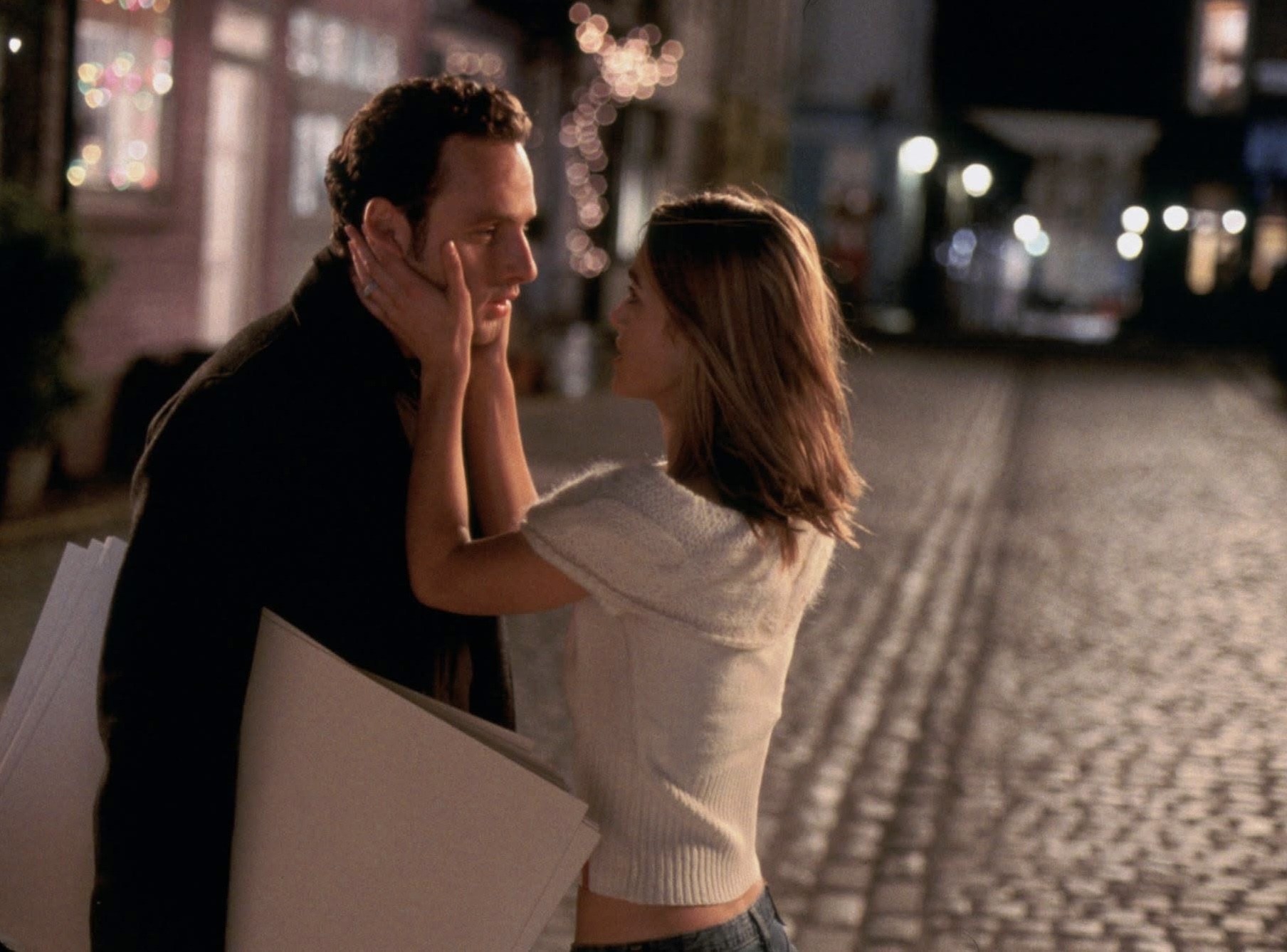
Yes, this includes the most iconic moment of Love Actually. But no, it does not make any sense.
The Walking Dead star Andrew Lincoln plays Mark, who is (not so) secretly in love with Juliet (played by Keira Knightley, shortly after starring in The Pirates of the Caribbean), the wife of his best friend Peter (Chiwetel Ejiofor, 12 Years a Slave).
Rather than being normal in any capacity, Mark is continually rude to Juliet, leading her to believe he hates her. At the same time, he keeps videos of her from her wedding, which are so zoomed in that his best friend is not even visible. He then proceeds to knock on their door with massive signs to confess his love to her.
While the intention is almost nice – being honest about his feelings, without any intention of acting upon them – he did just act upon them. He has now taken one of his own secrets and passed it on to Juliet to keep from Peter. It is also bonkers that he thinks Juliet is ‘perfect’ to begin with, seeing as he hardly spoke to her.
Another off-putting aspect of this is the age gaps between the actors: Keira Knightley was 17 at the time, while Chiwetel Ejiofor was 26, and Andrew Lincoln was 30. I am not confident that this could be filmed today.
#7 Jamie and Aurélia

I genuinely love this story – as implausible as it is.
While Jaime (Colin Firth, The King’s Speech) is at Juliet and Peter’s wedding, his girlfriend cheats on him with his brother – ouch. Alone, he retreats to his French cottage with only his Portuguese housekeeper, Aurélia (Lúcia Moniz). Despite their language barrier, they begin to fall in love. When Jaime returns to Britain, he starts learning Portuguese. In true romcom fashion, he returns to France and proposes to her in frankly broken Portuguese; she responds in likewise broken English.
I genuinely love this story – as implausible as it is. The way the audience can see that they are talking about the same things through the subtitles makes the audience believe in their connection. However, proposing in their first conversation is crazy. I hope they wait a while before they actually get married.
#6 John and Judy

Delightful awkwardness.
Arguably, many of Love Actually’s funniest and most charming moments stem from this story. Lord of the Rings star Martin Freeman plays John, who meets and falls in love with Judy (played by Gavin and Stacey’s Joanna Page) while working as professional stand-ins for sex scenes. Akin to the horrible Colin subplot, this is the only other story in the film that does not have any pain. Instead, it has awkwardness. Delightful awkwardness. Much of the comedy stems from the couple’s shyness about approaching their love life while being completely comfortable naked and simulating sex.
This story functions well within the context of an ensemble film, where its funny moments can shine without the relationship needing many complications. To an extent, the (possibly ironic) wholesomeness of this story makes it stand out in Love Actually while making it the least interesting to discuss.
#5 Sarah and Karl

The joyful dance that Sarah does in her stairwell after realising that Karl is going to stay the night is so infectious.
This story features Sarah (played by Laura Linney, star of The Truman Show) finally managing to connect with her long-term office crush, Karl (Rodrigo Santoro). The joyful dance that Sarah does in her stairwell after realising that Karl is going to stay the night is so infectious. Unfortunately for them, phone calls from Sarah’s mentally ill brother interrupt them and their relationship. Their last interaction on screen is Karl simply saying ‘Merry Christmas’ to Sarah at the office.
The way this plot builds so that the audience is rooting for Sarah, only for her hopes to be immediately crushed within about two minutes, is simply cruel screenwriting from Curtis. I choose to believe they reconnect after the film takes place.
#4 David and Natalie

Though bizarre, this narrative works for me.
If Love Actually was not already filled with so many preposterous plots, this would be the most implausible. However, we are talking about Love Actually.
This story features Hugh Grant as David, the Prime Minister. Unlike many of his other roles from this period, Grant’s character actually has a job, although he spends little time in the film governing the country. Instead, he is in love with a member of Downing Street’s household staff, Natalie (Martine McCutcheon). David impulsively stands up to the President of the United States for Natalie. Of course, a Hugh Grant character cannot be too chivalrous, so because he feels uncomfortable about his feelings for her, David then moves her to a different position.
However, after reading her Christmas card, he takes action. He knocks on every door of the street she lives on to confess his love. They kiss backstage at the children’s Christmas concert/Nativity (do not ask why); the backcloth is raised, revealing them to everyone.
Though bizarre, this narrative works for me. I think Grant remained in romcoms for so long because he is clearly great at building rapport with many different actors, as well as blinking lots while stuttering to the person he loves.
Unfortunately, being a film from the 2000s, the strange insistence that Natalie is fat is so frustratingly bewildering and unnecessary. Still, the remarks are infrequent enough for it not to ruin it for me.
#3 Karen, Harry and Mia

For Karen, either staying or leaving will make her life ‘foolish’.
This plot line features two Harry Potter and Sense and Sensibility actors, Emma Thompson and Alan Rickman, as the married couple, Karen and Harry. Over the course of the film, we see that at his office, Harry is being seduced by Mia (Heike Makatsch).
Harry’s attempts to buy a necklace for his mistress are momentarily foiled in a glorious cameo by Mr Bean himself, Rowan Atkinson. Karen finds the necklace ahead of Christmas, and in crushing dramatic irony, she assumes it’s a present for her. After all of her excitement, she opens the present to find that Harry has given her a Joni Mitchell CD, thereby confirming that he is having an affair.
Adding to the devastation, Karen has to put on a brave face for the children. She gives herself a brief moment to pull herself together in her room before leaving the house with the family so the children can perform in the nativity.
Curtis cleverly leaves the story unresolved. For Karen, either staying or leaving will make her life ‘foolish’. Earlier, she compared herself to her brother, David; where he saves the country, she makes a lobster head for one of her children. Her status as wife and mother is where most of her achievements lie, meaning that her husband’s affair not only disrupts her marriage, but her identity and life, too.
The greatest drawback to this story for me is the characterisation (or lack thereof) of Mia. She is presented as an almost malicious force in Harry and Mia’s marriage as she seduces Harry. However, the audience is given no indication why she is interested in Harry in the first place. Is it opportunism, as he is her boss? Or is it genuine love?
#2 Daniel and Sam

There is no way I can fathom anyone having any complaints about this wholesome, funny and ridiculous subplot.
Shortly after his wife has died, Daniel (Liam Neeson) is worried about his stepson, Sam (Thomas Brodie-Sangster), especially since he hardly leaves his room. Daniel eventually manages to get Sam to confide in him, only to reveal that the main issue troubling Sam is that he is in love with a girl from his school. Daniel’s supportiveness and how he takes Sam’s feelings seriously from start to end are delightful. He shows genuine enthusiasm towards Sam’s plan to get Joanna’s attention by playing the drums at the Christmas concert. That same evening, however, Joanna was flying back to America. This all culminates in Sam managing to get past security at the airport (with thanks to a second cameo from Rowan Atkinson) to say goodbye to her.
There is no way I can fathom anyone having any complaints about this wholesome, funny and ridiculous subplot.
#1 Billy Mack and Joe

Nighy’s performance here was genuinely deserving of the BAFTA he received.
For me, the funniest plot in Love Actually is undoubtedly this one. Bill Nighy plays a Rock and Roll legend, now desperate to reach Christmas number-one single for his self-admittedly poor Christmas version of ‘Love is all Around’ by The Troggs. Maybe as a result of promising to perform it naked if it tops the charts, he succeeds. After reaching the success that he wanted, notably being invited to Elton John’s party, he realises that he would rather spend Christmas with someone he loves. Without a family, he turns to his manager Joe (Gregor Fisher), whom he had previously mocked and perhaps resented.
Nighy’s performance here was genuinely deserving of the BAFTA he received. He delivers crude dialogue with impeccable charisma. Lines such as ‘don’t buy drugs, become a popstar, and they give you them for free’ add a much-needed cynicism to the almost nauseating sentimentality of Love Actually. That is not to say that this plotline is devoid of feeling. In fact, it is because Billy is such a cynic that his concession to the concept of love at the end of the film has significance. The way that Nighy stumbles through this confession of love in a guarded way with so much embarrassment makes the final message of the story appear less mawkish, when it is, in reality, the most sentimental ending of all.
Conclusion
After examining each story in Love Actually, I have realised that they all made even less sense than I thought they did. And that is not to say my expectations were high. Still, with (almost) all of them being somewhere between delightful and heartbreaking, it is impossible to suggest that the ludicrousness detracts from the movie. Instead, it adds more charm.
More from Redbrick Film & TV:
What makes a Christmas film special?
Feature: Five Unconventional Christmas Films
The Girlbosses of Christmas: Liberal Feminism in Christmas Films
Comments