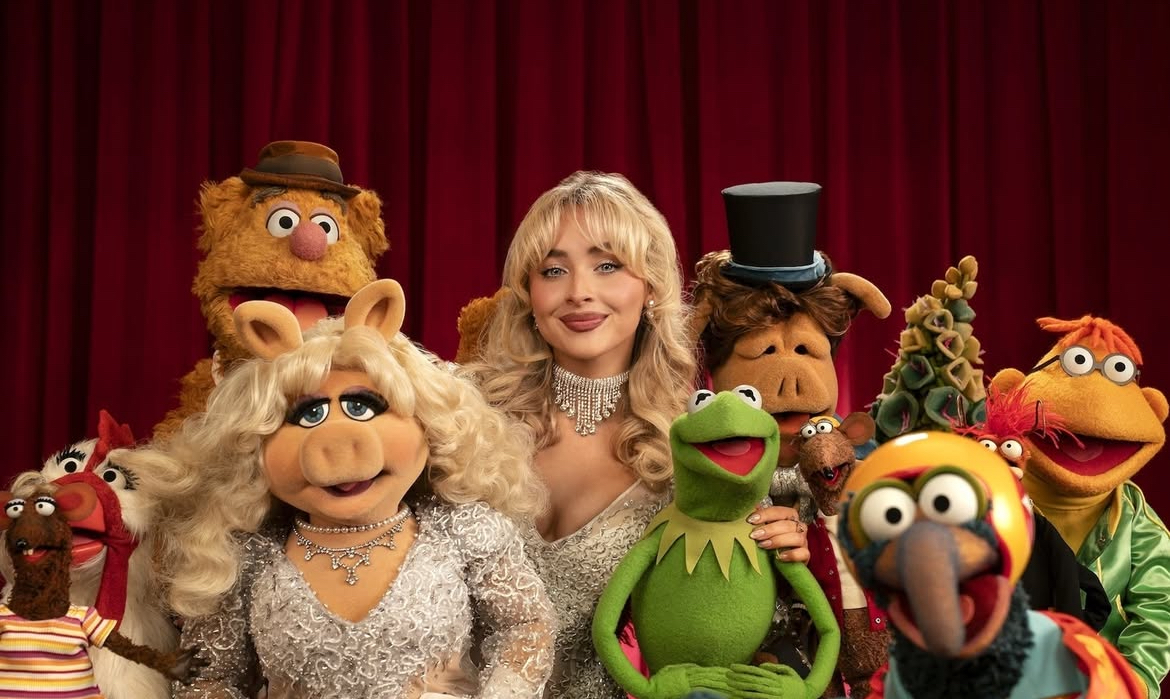
Film & TV Writer Esme Chen argues that the Muppets revival uses nostalgia as a business model, while also suggesting that Sabrina Carpenter is portrayed through a stereotypical and palatable form of femininity
Life was, in fact, a happy song when Disney announced their revival of The Muppet Show in 2026, featuring Sabrina Carpenter, but like many, it’s impossible not to ask why Disney have done this now, after their impromptu, no big deal, 45-year (I mean, how did we survive?) hiatus, especially after they remove the Muppets 4D experience at Walt Disney World Florida, (which I am still incredibly salty about!) so why now?
Unfortunately, this now becomes a criticism of how contemporary media repackages nostalgia through celebrity culture (seen through one of the most popular pop faces of our generation, Sabrina Carpenter) to negotiate tensions between the illusion of reinvention and corporate branding and gendered performance.
Nostalgia becomes a business model, something which is not emotional but is now engineered
The revival isn’t random – the Muppets have become part of Disney’s strategy of recycling original, loved characters through strategic celebrity alignment. Unfortunately, the Muppets need someone like Sabrina Carpenter to make it feel current and not recycled material, but also, because it’s cheaper and safer for Disney to revive something audiences already know and love. Nostalgia becomes a business model, something which is not emotional but is now engineered. There is mass appeal, older audiences who see the muppets on a nostalgic basis, younger audiences who see them as ‘retro’ or ‘quirky’, and teenagers/young adults who grew up with the film instalments.
It’s Sabrina Carpenter who functions as a marketing bridge and signal. Not only does she bring her fanbase (and a very dedicated one at that) to the Muppets, but she also tells audiences that the Muppets are actually current and popular. This is where the problem arises. There is nothing new about the show, for it completely mirrors the old Muppet Show: musical performance, celebrity guest, comedy – and so, the revival demonstrates how contemporary media prioritises the circulation of familiar nostalgic content, rather than genuine experimentation, which is becoming increasingly rare and difficult for numerous reasons, one of those being big conglomerates like Disney.
She has a carefully managed image (think of her appearance, humour, or even media presence) which is inherently tied to her desirability and relatability.
Sabrina Carpenter, as we all know, is one of the most popular pop faces in Western culture at the moment. But for this argument, I will be using her not as a person, but a constructed identity – because that is what her persona is. She has a carefully managed image (think of her appearance, humour, or even media presence) which is inherently tied to her desirability and relatability. Her pop image is designed to be consumed on access platforms. But what a contrast to the World of the Muppets. Extremely chaotic, absurd, historically male-dominated, and deliberately disrupted – so where does Sabrina fit into all of this?
There is definitely a question of how she fits, and what exactly is the balance producers are trying to strike – polished, controlled, over-exuberant femininity vs archaic, chaotic, and a messy performance. So, how exactly is Sabrina Carpenter represented? Unfortunately, she slips into that stereotypical gendered notion of comedy, where the male figures are funny and comedic, whilst the woman is left to be composed, controlled, and beautiful. It is definitely important to consider if she is allowed to be chaotic, look ridiculous, or be loud and messy, or if she should be kept as increasingly feminine and perfect? I would argue it’s the latter.
Whilst maintaining the comedy (most abhorrent to me through her performance of the hit single ‘Manchild’), she is definitely seen as more of an object and a small collaborator to the comedy, rather than a subject (somebody who drives the action and creates humour unapologetically).
Sabrina’s whole persona aligns with corporate expectations of femininity and exactly what Disney wants, which is limiting to the extent to which she can fully participate in the Muppet’s chaotic and subversive humour.
As previously discussed with the Muppets’ brand revival, Sabrina Carpenter fits perfectly into the Walt Disney Company’s idealised version of femininity – something which is polished, marketable, and palatable. Her personality fits into this perfectly. She is modern, but safe, attractive, but not disruptive, and expressive, but not controlled. Sabrina’s whole persona aligns with corporate expectations of femininity and exactly what Disney wants, which is limiting to the extent to which she can fully participate in the Muppet’s chaotic and subversive humour.
In due course, the episode is still extremely enjoyable. There is something to be said for seeing your favourite characters on screen again (I am, however, still waiting for Bean Bunny’s reprisal), and all in all, it is an extremely fun watch, and I am more excited to see what The Muppets have in store for us next.
More from Redbrick Film & TV:
Film Review: Diamanti / Diamonds
Comments