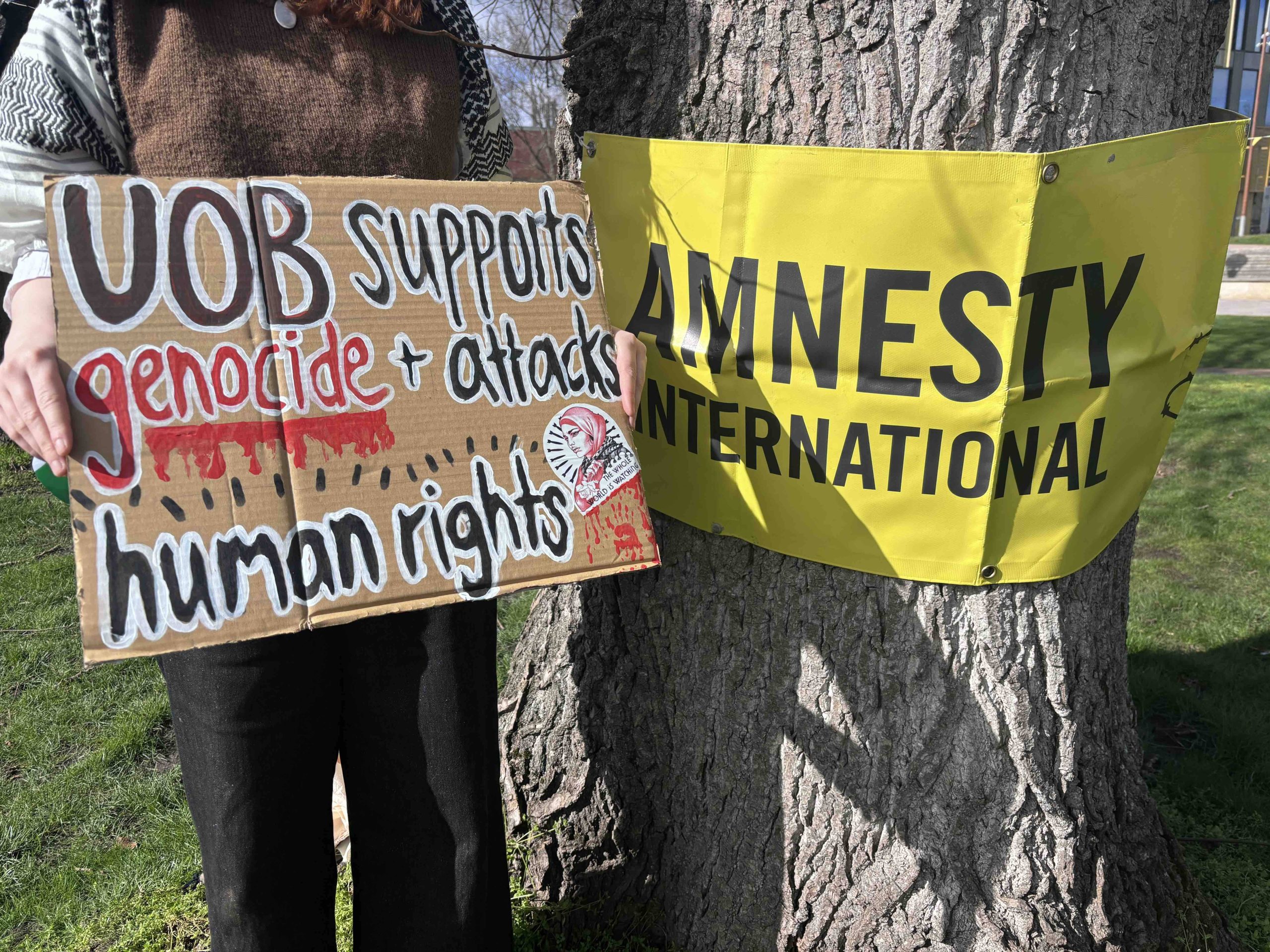
Digital Editor Anisah Qazi reports on the University of Birmingham’s protest polices in light of Amnesty International’s upcoming report on the crackdown of students’ free speech at UK universities
On Wednesday 11th March students gathered on the grass of University Square. On the grass stood a speaker system, three stalls and bunting waving the distinctive yellow logo of a candle wrapped in barbed wire. The banners draping the tables declared in bold, ‘Apartheid off Campus’ and ‘UoB Silences Dissent’.
On the same day similar ‘teach-outs’ took place on campuses across the country, as part of a nation-wide campaign by Amnesty International.

With campus security hovering nearby, Nina Truscott, the president of UoB Amnesty Society, began speaking into the mic. The report is set to expose the suppression of free speech at UK universities…
‘This is not a protest, but a day of action, a teach-out… we are here because we believe in students’ rights to freedom of speech, freedom of assembly.’
‘We encourage students not to be scared, to stand up for what they believe in without fear of repercussion. This event is supported and instigated by Amnesty International to encourage students to use their voices to uphold justice.’
These teach-outs were intended to coincide with the release of the full report by Amnesty International, a non-governmental organisation that protects the right to free speech globally. Due to pushback from UK universities, the release of the report has been delayed for an undetermined amount of time.
Redbrick interviewed the compiler of the report for details on its contents.
According to her, the report is set to expose an increase in the suppression of free speech at UK universities, evidencing that this has been institutionalised through University and Government policies working in tandem. The University of Birmingham is explicitly identified, alongside other universities, as the report critiques its actions since 2023 regarding the freedom of speech and assembly on campus.
The University have commented that, ‘At the time of responding, the Amnesty International report referred to has not been published and therefore cannot be commented on.’ The University of Birmingham is explicitly identified
The University of Birmingham’s actions fall in line with UK law and government policies. The University of Birmingham’s and the Guild’s current internal policies around protest together require the following:
- All protests on campus require authorisation by the University.
- Applications for approval must be made at least 21 working days prior to the event.
- All external speakers must also be submitted for review 21 working days prior to the event.
Speaking to committee members of Amnesty Society and Feminist Society who spoke at the event, both argue that their free speech is hampered by the University’s long bureaucratic processes for organising protests and external speakers, which they say function as a hinderance to holding events.
This experience was echoed by speakers from local Birmingham City University and Aston University Amnesty societies, who expressed the same frustrations with their university policies, which had made them unable to hold a Defend Dissent event at their campuses.
Suppression of free speech on campuses… triggered by university and government responses to Pro-Palestinian protests…
Amnesty’s report is paired with its broader campaign against student censorship. As part of the campaign, Amnesty are calling for universities to agree to the Defend Dissent Charter which calls for universities to agree to the following summarised demands:
- Guarantee freedom of expression and assembly.
- Replace excessive notice periods for protests with simpler procedures.
- End misuse of disciplinary actions to punish activism.
- End intrusive monitoring and data sharing of protests with third parties including Prevent and police.
- Avoid discrimination by addressing racialised targeting of protest attendees.
- Adopt definitions of Islamophobia and Anti-Semitism which are consistent with international law and do not undermine freedom of expression.
- Publish data on protest-related disciplinary actions.
- Establish a complaints mechanism for staff and students who feel their rights to freedom of expression have been violated.
- Establish appropriate support services for students whose right to exercise freedoms are at risk, including international students.
- Take action to protect freedom of expression when it is threatened by external bodies.
Amnesty’s report is set to identify the suppression of free speech on campuses as having been triggered by university and government responses to the Pro-Palestinian protests on campuses across the country since 2023. It also highlights that Government Prevent policies and university policies target in particular the freedom of expression of Muslim students. Amnesty International has previously called for Prevent duty to be ‘scrapped’ , citing UN recommendations to abolish the policy over concerns of racism and human rights violations.

Speaking at the event, the current Guild President Antiona Listrat detailed the threats of disciplinary actions against her following pro-Palestinian protests at the University of Birmingham.
‘They [the University] told me I had used offensive language and threatening behaviour… they said the offensive phrase was that I was chanting “stop killing babies” and the harassing behaviour was me clapping my hands.’
Antonia argues that ‘it is illegal’ under UN law to require permission to hold protests. …you have to choose between being a good student and getting your degree, and dissenting’
The University have replied saying that ‘Along with all other legal and regulatory obligations, the University of Birmingham takes its freedom of speech responsibilities very seriously and has a longstanding commitment to freedom of speech and academic freedom. Our Code of Practice on Freedom of Speech is proportionate, appropriate, and lawful, and has been referred to as such by the High Court. Our approach is impartial of any particular viewpoint, and we have a long track record of facilitating debates, events and activities on campus, including peaceful protests, on a range of issues. The University of Birmingham has never, and would never, disadvantage any member of our community because of their religion or the views they lawfully hold or express.’
Another student, having themselves been threatened with potential disciplinary action commented,
‘It feels like you have to choose between being a good student and getting your degree and dissenting. As if they can’t come hand in hand. If you do anything against us, we’ll take away your degree.
Their attempt of making an example out of Antonia has really scared people out of protesting.’

[Societies in attendance] argue that their free speech is hampered by the University’s long bureaucratic processes for organising protests and external speakers…
The UoB Amnesty Society, sure that any application made would be denied, secured no authorisation for their event. A day ahead of their event following monitoring of their Instagram account the University sent the committee a cautionary email, in which potential for disciplinary action was threatened.
The Guild of Students have commented that it ‘requires student groups to use the processes available in order to ensure the safe running of all events and activities on campus. To confirm the Guild did not receive an event proposal for this activity.’
Speaking at the event, Monisha, the Amnesty Society president at Aston University where 24% of the student body are international students, told us that additional fears of deportation following disciplinary action compromise international students’ engagement in defending or expressing their right to free speech.
So far, the Defend Dissent Charter has been implemented by several universities including SOAS, the University of Edinburgh and Newcastle.
The Amnesty Society at Birmingham have opened a student petition which will be put to the Guild and The University of Birmingham, asking them to implement the Charter.

Looking for more? Try out these from Redbrick News:
Refugee status becomes temporary in UK asylum policy change
Government announces Birmingham – Manchester rail link plan
Comments