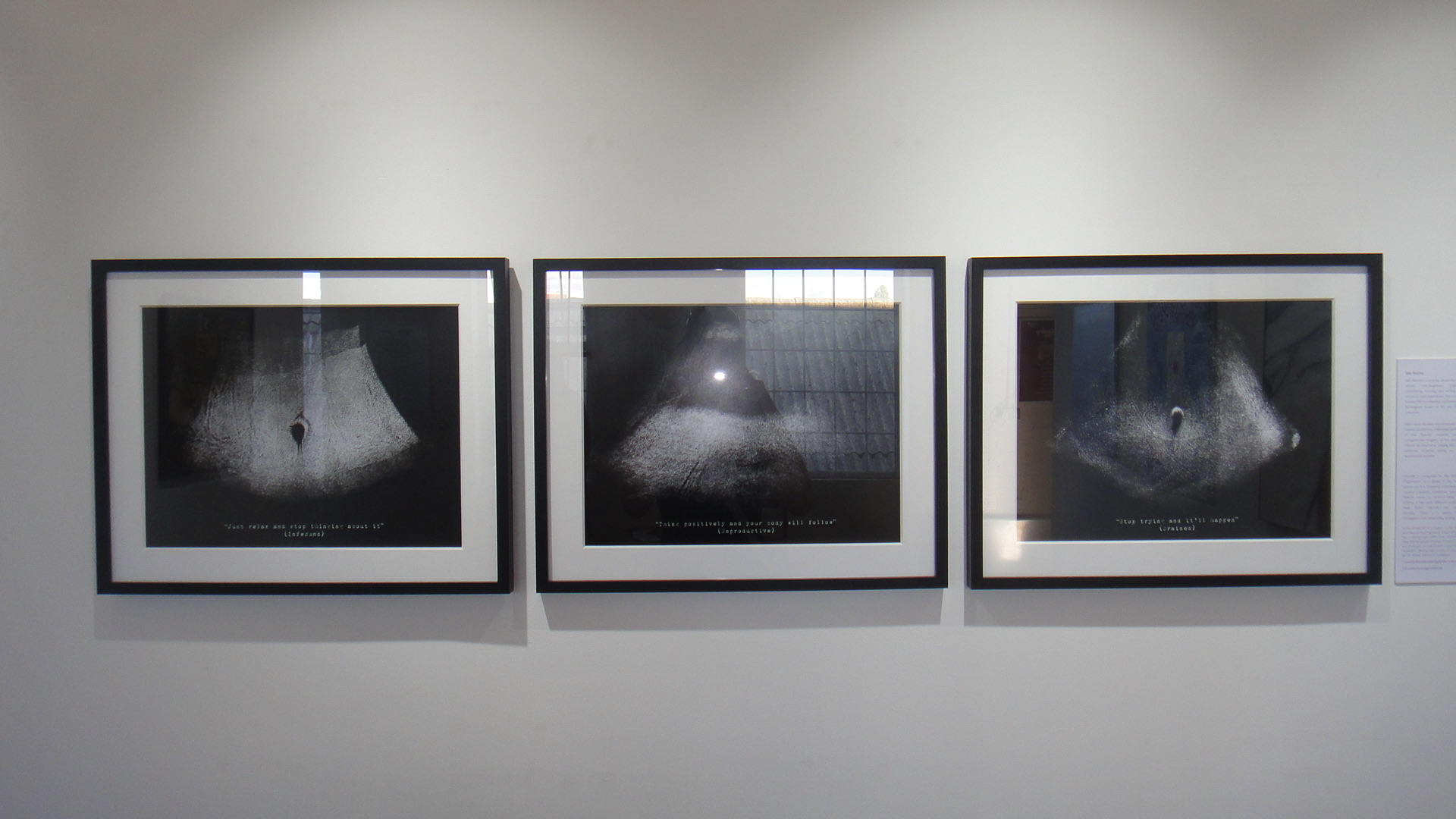
Jen Sawitzki and Tamara Greatrix met with curator Sophie Mason and artist Larissa Shaw to gain exclusive insight into Mason’s recent exhibition ‘Bleeding Out’ which campaigns for endometriosis awareness.
Redbrick met with curator Sophie Mason to get an exclusive insight into her recent exhibition, Bleeding Out. The multimedia portfolio comprised of artworks from seven Birmingham-based artists, focusing on personal experiences of injustice and mistreatment of women and marginalised people in the healthcare system in the UK. Her purpose of the exhibition was to ‘give artists in the area a chance to shine,’ but also to tell people going through health conditions who feel ignored that they are not alone.
Personal experiences of injustice and mistreatment of women and marginalised people in the healthcare system…
To make submissions to the exhibition more accessible to those from a non-art background, Sophie worked closely with Cysters. The charity is dedicated to ‘breaking down the systemic barriers that create menstrual, mental, maternal, and menopausal health inequalities’, and much of their grassroots work focuses on nurturing their community. And that was exactly what Cysters did when members were brought together at the Warehouse Cafe, just on the other side of Digbeth to the exhibition. Armed with felt-tips and magazines, their contribution to Sophie’s exhibition was a touching mix of collages and personal essays touching upon their often-facetious mistreatment by doctors.

Sophie told us that if she could say one thing to healthcare professionals, it would be to ‘start viewing their patients as people and view them holistically not just as a series of body parts but with a life outside of the hospital.’ ‘I wanted it to be site specific to Birmingham […] it’s important because we have the women’s hospital here.’
During our visit to Bleeding Out, we were lucky enough to meet Larissa Shaw, who spoke to us about her experiences as an NHS patient and PhD student. Larissa attends Birmingham City University and University of Birmingham, and her artwork form a part of her PhD which reframes witches as a credible source of information, alternative to the stigma around them that has been present throughout history. Larissa shared that she ‘didn’t ever think [she would] do a PhD. I’m from a council estate in Walsall.’
Her struggles in the healthcare system inspired her to create the piece…
Throughout her studies, she has worked with other people who have endometriosis and worked in response to archival information, trying to centre their experiences. Endometriosis is very close to home for Larissa, as she herself is diagnosed with the condition. She shared how her struggles in the healthcare system inspired her to create the piece, ‘I’ve seen 50 different doctors for endometriosis, and I’ve seen one who listened to me.’
Although it may seem farfetched initially, this particular moment highlighted the correlation between her PhD’s topic and her participation in the exhibition for us. As is common knowledge, history tends to repeat itself. So is a woman having to ‘prepare [evidence] for a doctors appointment as one does for court’ (as one of us put it) not just another version of women being deemed hysterical?

Larissa’s piece depicts a hospital waiting room. The embroidered hospital gown, discarded atop a hospital chair, instantly captured the desperation and anxiety of a waiting room. The gown had splotches of Larissa’s own blood, showing brutality at the hands of the NHS. Speaking with her, we discussed how the flaws within our healthcare system – and particularly women’s care – have been continuously diminished throughout history. And particularly how nothing has really changed.
Only a few moments after meeting the pair, we had to ask, ‘Is that a real hospital chair?’ to which Larissa replied, ‘Yeah, it’s pretty visceral, isn’t it?’ We laughed at the familiarity of it, which every person who has been through the NHS system knows too well, but we also recognised that one object should not carry so much shared experience of injustice.
Flaws within our healthcare system – and particularly women’s care – have been continuously diminished…
‘Having these different things layered on top of one another is a palimpsest’ Larissa said. Opening a can of worms, we ensuingly asked what that word meant. Cambridge Dictionary defines it as a ‘text or document in which writing has been removed and covered or replaced by new writing’. This, Shaw told us, was a nod to a few things. Firstly, a now-retracted study that chose to study endometriosis’ correlation to attractiveness – demonstrating exactly what interests were at heart for doctors interested in women’s healthcare. And secondly, how research into women’s bodies was literally rewritten at one point in time; how paper shortages caused books and manuscripts about the female body to literally be overwritten and erased.
Her work did the opposite – printing out the attractiveness study for all to see on her palimpsested hospital gown, alongside her own experiences at Birmingham Women’s Hospital. ‘My body is evidence these things are happening’: these personal accounts with faint black text layered over represents the historical documents written by women that were written over, simply to save paper.

The feeling of it sears through your body…
The rose was one image we lingered on. Larissa explained that its meaning is multi-faceted. She sees it as representative as the first time she felt pain during sex, and how ‘something so intimate results in something that causes so much pain.’ She sees the rose as symbolic of the vagina, ‘the petals feels so soft and you caress them with your fingers […] then you get greedy and grab hold of the thorns by mistake and the feeling of it sears through your body.’ Not only that, but Larissa wanted to show the deep-rooted misogyny that has been present throughout history, ‘it’s emblematic of the Renaissance time when women’s bodies were censored by petals, and the petals and rosebuds were symbolic of fertility.’ The oversimplification of women’s bodies is something that resonated with both of us, not just the lack of resources spent on women’s care and research into something as complex as our hormonal cycles, or even the view of the vagina as something beautiful and flowerlike. But also, how the flowers – and women – are discarded once they start to wilt, losing their looks, fertility, and ability to provide fulfilling sex frequently enough for their partners.
Something so intimate results in… so much pain
‘I spoke to a doctor once about [sex] being something that I’m actively avoiding now because it causes me so much pain and he told me to have a glass of wine.’ A term that we continually returned to in our discussion was ‘medical gaslighting’ and the ‘anxiety’ that comes along with that. Larissa even mentioned feeling ‘mental’ and ‘treated as a child’ as if you are lying. ‘Doctors will prescribe you mental shit that is never gonna work […] there’s a massive power imbalance’ as though the pain is in your head. She continued, ‘If I’m having these issues, it’s showing systemic issues for people way more marginalised than me’.
‘I appreciate there is a chronic lack of resources, funding and staffing,’ which prevents many doctors from giving the treatment they would like to, but ‘basic human compassion goes a long way,’ Sophie told us.
I spoke to a doctor once about [the pain]… he told me to have a glass of wine…
Many of the other artists seemed to share this sentiment. Yasmeen Fathima Thantrey’s piece was something neither of us had ever seen anything like before. She mapped and printed her own MRI scan onto a bathing suit the same as her dress size, to make a critique about how doctors often pin medical issues onto weight even if it is unrelated.
Despite her telling multiple doctors multiple times that the pain she felt was from her IUD, she was consistently told the pain was weight-related, and that it would improve if she were to lose it. It was only found out via CT scan that the pain she had been complaining about was due to a displaced coil that had implanted into her uterus.

This story is unfortunately all too common and is only being worsened by shadow bans that are preventing women from being able to research what could be causing them pain, as was Thantrey’s case. ‘When I think about how many [endometriosis content creators] I follow versus how many I see on my feed, I do think a lot of it is being censored,’ said Sophie. We discussed in depth our own experiences of ‘shadow banning’ and the rise of women’s sexual education being considered pornographic and subsequently banned under the new Online Safety Act media laws, a topic also touched on by artist Leah Hickey.

Considering that endometriosis affects 1 in 10 women of reproductive age, the description of women as ‘dirt underneath your fingernails’ is – unfortunately – aptly fitting. Whether the ‘you’ in question is a doctor wanting to give you the pill and send you on your way, or a politician who could not care less about the information and community online health forums provide, Hickey’s calligraphy epitomises the way those with uteruses are treated.
Bleeding Out was a ten-day art exhibition hosted by Seventh Circle Artwork and Aesthetics in Digbeth. Entrance was free, and it was attended in numbers by politicians, trainee doctors, students and journalists alike.
Enjoyed this article? Read more from Redbrick Culture here:
Musical Review: The 25th Annual Putnam County Spelling Bee
Comments