Life&Style writer Isabel Whitt talks about the genius of Claudia Winkleman.
There are television presenters, and there is Claudia Winkleman: a woman who has somehow turned a fringe, a partiality for kohl eyeliner, and an air of conspiratorial mischief into one of the most formidable careers in British broadcasting. Fresh from the velvet-cloaked, 9.6 million-strong success of Series 4 of The Traitors, she now arrives, perhaps inevitably, at television’s most exposed frontier: her own chat show. A fringe, a partiality for kohl eyeliner, and an air of conspiratorial mischief.
It is the culmination of a rise that was anything but overnight. Winkleman began, improbably, as a travel writer before becoming a familiar presence on the televisual margins: holiday programmes, daytime shows, the sort of formats that fill schedules rather than define them. In these early years, she already clever, quick and faintly eccentric, but not yet the gravitational force she would become. Her ascent gathered pace with Strictly Come Dancing, first on its companion show It Takes Two, and then, decisively, as a main host. From there, transcended mere presenterdom to becoming a draw in her own right.
Financially, the transformation has been equally striking. Winkleman now ranks among Britain’s highest-earning television personalities, with an estimated net worth hovering around £9-9.4 million, a figure built not only on BBC salaries, but also endorsements, production ventures, and a portfolio of prime-time successes. It is, in its way, the clearest measure of her appeal, audiences do not simply watch her shows; they follow across them. She evolved from presenter into a figure many viewers now consider a ‘national treasure’
And follow they do. On Strictly, she evolved from presenter into a figure many viewers now consider a ‘national treasure,’ presiding over sequins and samba with a warmth that renders the most painful of routines to communal triumphs. With The Traitors, she pivoted again, this time into something darker and more theatrical: a gothic ringmaster gliding through a Scottish castle, as much storyteller as game-maker. Here she demonstrated an instinctive comprehension that television is not only about narrative, but about atmosphere and the quiet calibration of suspense.
Then there is The Piano, perhaps the purest expression of her adaptability. Filmed in the most public of spaces; British railway stations, it becomes, under her lead, a theatre of intimacy. She seamlessly draws on moments of vulnerability and connection from strangers, creating television that feels simultaneously expansive and deeply personal. It is here again, where her defining quality is unmistakable: she makes people feel safe enough to reveal themselves, and in doing so, makes viewers invest. Winkleman possesses a form of warmth that resists manufacture and media-trained blandness.
This ultimately, is her genius. Winkleman possesses a form of warmth that resists manufacture and media-trained blandness. She facilitates, never dominates. Rather than imposing herself, she creates conditions that allow others to shine, enabling conversations to unfold despite the cameras rather than because of them. It is a rare skill, and one that goes some way to explaining her longevity.
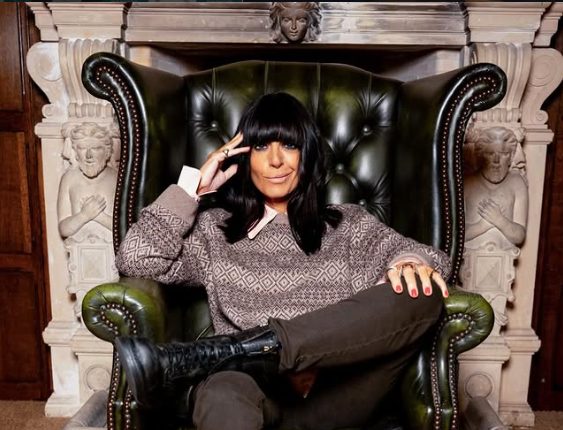
Her look, too: the iconic fringe, heavy eyeliner, the nude lip, has become shorthand for that presence. She has often joked that it built her career, as a visual signature in an industry that prizes uniformity. But the fringe is only the packaging. The substance lies in a precise blend of self-deprecation, intelligence and emotional acuity, allowing her to move effortlessly between silliness and sincerity. Success, like a good fringe, is less about perfection than about knowing exactly how to frame the face beneath it.
Which brings us, inevitably to the chat show: a risk, perhaps, for the BBC and Winkleman herself. If Strictly offered choreography and sparkles, and The Traitors narrative and tension, this format is more exposed, more dependent on her alone. It demands on both charm and control. Early reviews suggest a degree of chaos: too many guests, too many competing conversational threads, but these feel less like fatal flaws than early adjustments. Winkleman has never been about the precision; she is atmosphere.
And perhaps that is the point. She does not need to outdo the established titans of the genre – Jonathon Ross, Graham Norton, Alan Carr. She need only to be unmistakingly herself: warm, generous, mischievous and quietly in command. If Claudia Winkleman has proven anything, it is this: success, like a good fringe, is less about perfection than about knowing exactly how to frame the face beneath it.
Enjoyed this? Read more from Life&Style:
Spring Has Sprung: How to Welcome the New Season
Comments