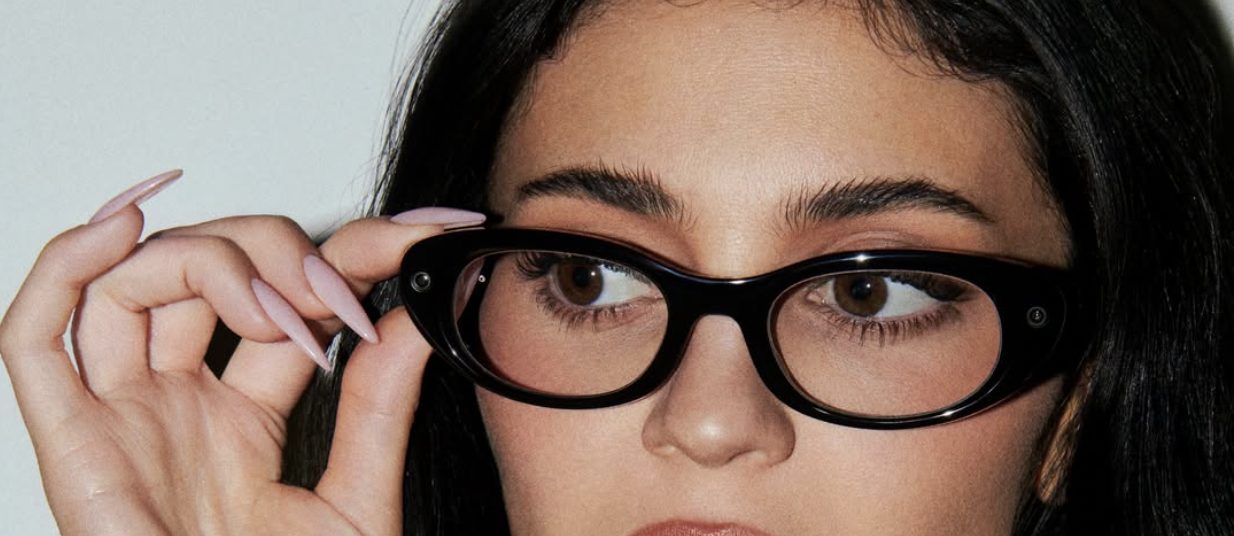
Virginia Hastings investigates Jenner’s recent collaboration with Meta, questioning why many have decided to draw the line at this partnership as opposed to other surveillance technology.
When Kylie Jenner’s Meta glasses launched, I didn’t think anything of it. A pair of smart glasses that let you capture your day hand-free felt harmless. A gadget for holidays, nights out and memories you want to keep. At £359, they are not positioned as an inaccessible tech-bro toy, but rather something you would buy for yourself.
Then the stories started coming out. People filmed mid-conversation without knowing it. Strangers caught on camera and posted online without ever agreeing to it. That’s when I started questioning what I’d accepted so easily. The glasses hadn’t changed, what I thought they were for had. That shift in my thinking is happening to a lot of people too, and it’s bigger than one celebrity endorsement. Jenner hasn’t just launched a product; she helped make an existing form of surveillance feel like fashion. The camera isn’t newly acceptable so much as newly invisible, and that means the people standing near a wearer are now adjusting their behaviour for a watcher they can’t even confirm is there.
…people standing near a wearer are now adjusting their behaviour for a watcher they can’t even confirm is there.
But what caused this seemingly odd collaboration between tech giant Meta and socialite Jenner? Google Glass failed a decade ago partly because it looked like a surveillance device; its clunky lens made the wearer look instantly suspicious. Jenner’s version solves that problem. She didn’t build new technology; she built new packaging. A cat-eye frame and voice lines recorded in her own accent do what no privacy law or public debate ever managed: make people assume good intentions by default. I and many other people didn’t question the glasses when they launched because nothing about them was designed to make me.
The small gem set into the corner of the right lens, right next to the camera, is reportedly designed to evoke the flash of a paparazzi camera, something Jenner has dealt with her whole life. It’s a strange choice, a piece of jewellery drawing attention to the exact spot doing the recording, turning the camera into decoration instead of hiding it. Meta has been open about this strategy. Its VP of industrial design said this launch was the company’s first serious attempt to become a name in fashion, not just tech.
Once the glamour has done its job, the real problem starts. Surveillance was never about who’s holding the camera. It’s about what happens to the footage once it exists: who owns it, who studies it, who profits from it. Whatever the person wearing the glasses intended to capture, be it a joke or a cute sunset, is unimportant. None of that matters the second the footage leaves the device. Whatever system processes it afterwards doesn’t know or care what the wearer intended. It can still match your face to a name, tag your location and log who you were with and when. None of that requires malice. It just requires the footage to exist somewhere Meta, or anyone with access to it, can reach.
Surveillance was never about who’s holding the camera. It’s about what happens to the footage once it exists: who owns it, who studies it, who profits from it.
That uncertainty isn’t just the wearer’s problem; it becomes everyone else’s too. I too couldn’t tell the difference, not until I’d heard enough stories to know better. Other people standing next to these glasses at a bar or a bus, may not have heard those stories, and so they can’t tell either. People already do this instinctively on nights out: scanning strangers for hidden cameras or staying camera ready even when no lens is visible, just in case footage turns up online regardless. Some have even linked this to the common observation that barely anyone properly dances at bars or clubs anymore. People are changing how they behave in public because they might be on camera, not because they definitely are. Jenner didn’t create that effect on purpose. But she made the glasses that let it spread faster and made them fashionable enough that almost no one questions them.
The obvious pushback is that none of this is new. We’ve had Ring doorbells, Snapchat’s camera glasses, Uber tracking your journey, Google Glass over a decade ago. So why the outrage now? Partly, because it’s Kylie Jenner. Some people just don’t like her, and this gives them a reason. But that’s a distraction from the actual shift: the technology isn’t new. What’s new is that it no longer looks like something worth questioning. It’s worth being honest that this isn’t really a story about consent, or even about Meta. It’s a story about camouflage and how quickly a controversial object stops being interrogated once it’s been made to look desirable. The same people criticising the glasses this week will, without a second thought, share their Spotify Wrapped in December, happily handing over a year’s worth of personal data for a shareable graphic. That’s not a contradiction so much as a confirmation: we were never objecting to the data collection. We were objecting to how it looked.
The same people criticising the glasses this week will…happily [hand] over a year’s worth of personal data for a shareable graphic.
None of this means we should stop talking about it. If anything, it’s exactly why we should keep talking about it, whether this is the first time you’ve thought about what’s recording you or the hundredth. I keep coming back to the gem on the lens, dressed up as a paparazzi flash. Jenner spent her whole career on the other side of that flash, photographed without asking. Now she’s selling the rest of us the tool to do the same thing to someone else, styled well enough that nobody stops to notice. I still think the glasses look genuinely cool, and that’s precisely the problem: cool is doing the work that scrutiny used to do. The next viral product won’t look like surveillance either. It will look like something you want.
If you liked this, read more from Redbrick Comment:
Student Safety in Selly Oak: Who is Responsible?
Comments