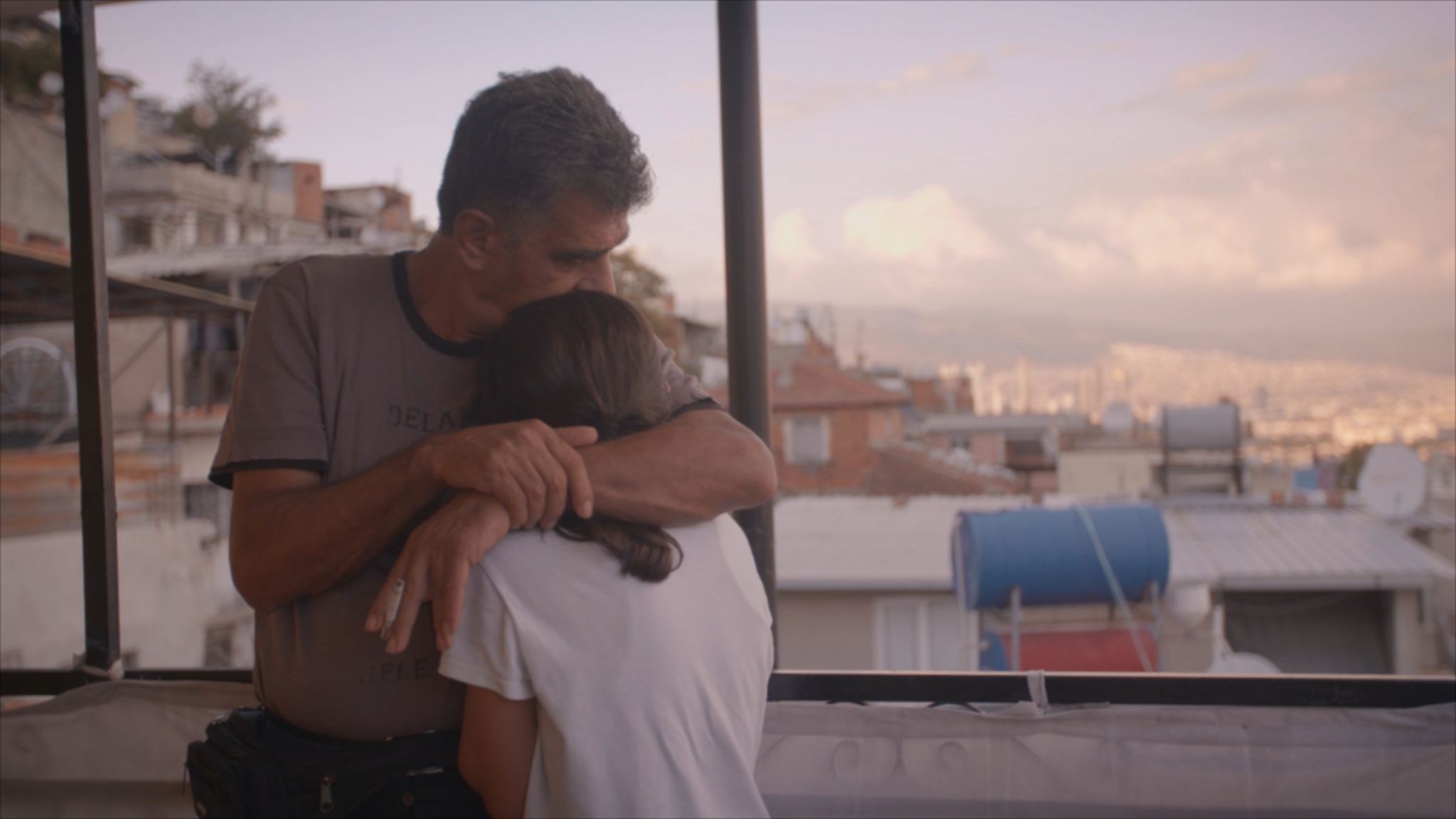
Editor-in-Chief Tamara Greatrix talks to Itab Azzam and Jack MacInnes about their documentary ‘One in a Million.’
Content Warning: physical abuse and mention of global conflicts.
While many of us spent our formative years navigating Brexit, COVID-19 lockdowns and Zoom lessons, Syrian refugee Israa’s childhood was shaped by war, displacement and sacrifices for safety.
In an exclusive interview, I spoke to the directors of One in a Million, Itab Azzam and Jack MacInnes, about their process. Filmed between 2015 and 2025, the documentary details young refugee Israa and her family’s experiences fleeing Syria. The film then follows the family as they move to Germany, up to Israa’s marriage and a visit to Syria at the unexpected fall of the Assad regime.
The past decade has been a turbulent time to grow up in the United Kingdom. Brexit (2016) brought economic uncertainty due to higher post-referendum import costs and the loss of opportunities like the Erasmus scheme. The Coronavirus pandemic (2020) disrupted education and had major impacts on young people’s social skills and cognitive skills. Yet, for Israa, growing up during this period meant something far more challenging. She was living on the front line of the Syrian war, in Aleppo.
MacInnes first moved to Syria with Azzam, who is Syrian, in 2010, describing it as “an incredibly beautiful, but complex place.” Following the escalation of the Syrian Civil War in 2011, the pair were eventually forced to leave. Having witnessed friends and loved ones displaced by the conflict, they were heavily inspired by personal experience in deciding to create the film. MacInnes spoke candidly about the social and political landscape that shaped the past ten years of filming, including “Brexit, COVID-19, the Israel-Gaza conflict,” the rights and wrongs of migration, and comparisons between Western and Syrian culture.
The couple travelled to Izmir in Turkey to witness the Syrian refugee crisis first-hand, witnessing the smugglers as they met with refugees, promising them a better future. Syria is located opposite Greek islands, and MacInnes and Azzam described how they did the journey many times; that was until they eventually met Israa and her father and just ‘fell in love with her.’ They decided almost instantly upon meeting her that they needed to document her story. Azzam and MacInnes wanted to be a voice for people who “aren’t spectacular” but who they felt were still “worthy of documentation and are heroic in stories in their own right.”
The directors recognised that in Western media, refugees are treated as either a “hostile invasion” or “charity cases” and wanted to rewrite the narrative, ensuring what they describe as ‘the spirit of Syria’ wasn’t lost in online discourse. They wanted to make what journalists were reporting about into “something human,” not something far detached from reality. They wanted people to see what was happening with their own eyes.
Their original plan was to film Israa’s journey to Germany, but they soon realised this would prevent them from showing Israa’s full story in pursuit of a happy ending. They felt that filming for ten years would showcase reality, without their own editorial input interfering. The pair described Israa as “incredibly full of life and positive, despite living in such a dangerous position. She continued through her life “with a hope for what her future might be.”
MacInnes explained that showing the final edit of the film to the family was one of the most significant and stressful moments of the film-making process, a testament to their desire to do the family’s story justice. He described the ‘huge burden’ that was lifted from his shoulders when they reacted so positively, and emphasised how privileged he and Azzam felt that the family had opened their doors and trusted them over the years.
The family’s reactions to the film were equally touching; Israa and her father cried through the entire film, while her mother was “happy to tell her story.” The directors also shared how watching the film had prompted Israa to reflect on how far she had come, particularly moved by revisiting memories of “selling cigarettes on the streets of Turkey.” Azzam added that Israa “loved seeing herself and her love story,” as well as her return to Syria.
The film also allowed Israa to witness something she had never experienced privately, as her father apologised in an interview for his past physical abuse. Reflecting on the impact of the filmmaking process, and decision to interview the family members individually, MacIness expressed: “We hope that the film has been, you know, by talking to us, they’ve been able to sort of talk to each other. And that they, that’s a sort of way for them to reconcile.” The directors said Israa now maintains a good relationship with her father, and that welcoming a grandchild brought them closer than ever.
Yet some of the most meaningful moments of the filmmaking process were the ones where the cameras weren’t rolling. Azzam described feeling “tortured by all the things [she] wished she’d captured.” One specific memory was Israa’s traditional Syrian wedding. While the footage could not be featured in the film because it would be religiously unacceptable, due to women removing their headscarves, it is a memory both Azzam and Israa hold close.
Having documented Israa’s transformation from a young girl fleeing war to a married woman and mother, Azzam and MacInnes hope that One in a Million will encourage audiences to reconsider their preconceptions of immigration. Now 22, Israa is pursuing training with the German government to become a councillor, and has learned English. She finally has the freedom she longed for her entire life.
Azzam and MacInnes hope that One in a Million will encourage people to become more educated on immigration and recognise the 118 million displaced people in the world as humans with their own stories, lives and goals. MacInnes said he hopes people will be unable to leave the film with their “prejudices intact.”
One in a Million is showing across Birmingham; catch it at The Mockingbird Theatre this week and next. You can buy tickets and check showtimes here.
If you enjoyed A Decade in the Making: Interviewing the Directors Behind One in a Million, read more from Redbrick Film & TV here:
Re-watching an Autumn Classic: In Defence of Emily Gilmore
Pluribus: A fight against Artificial Intelligence
Comments