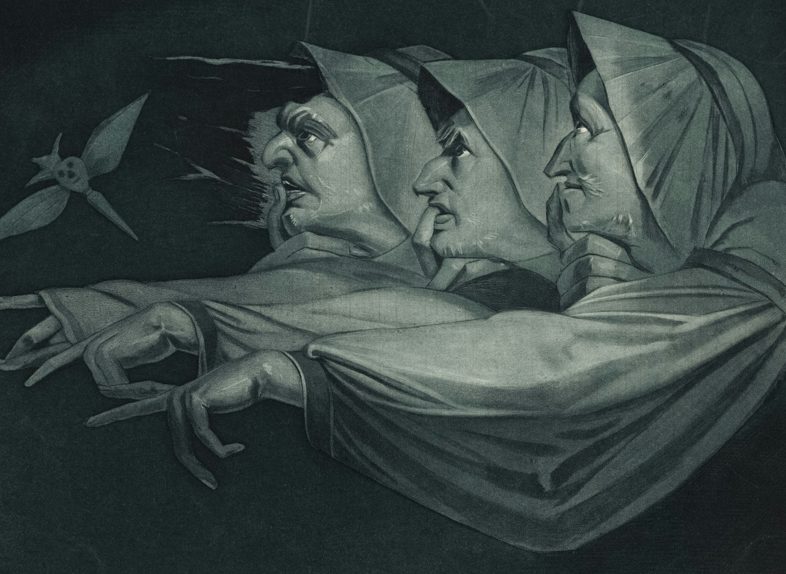
Culture Editor Katherine Bhaskar reviews the Guild Drama production ‘The Witch of Edmonton’.
Underground, you find yourself in a nauseating white maze. Corridor after corridor, swivelling left, swerving right – the Birmingham Guild’s eerie basement traps you in an endless maze of white-painted walls and wooden doors. Outside, the skies should be dark by now. Yet here you are, lost and fatigued in a century-old, possibly haunted building. Closing your eyes, you take a deep breath to clear the fog of confusion. Focusing your mind on conjuring a path to your destination, it was to no avail. Slowly allowing light into your eyes again, surely they must be playing tricks on you. Curiously, this strange new setting buries tall scrawny trees in the ground, as well as splatters of cold candle wax on the surface. Tense air wafts around the room. Blankets of the night hung pagan symbols of the elements: earth, air, fire, water, spirit.
You are in the parish of Edmonton: a village tucked in the outskirts of London.
Like a forbidden page torn out of history
Ahead, lies a visibly grouchy old woman draped in tattered clothing. Passionately, she is muttering to herself (about goodness knows what!) while gathering some firewood. You hide behind the rows of the audience to observe this lady and her eccentricities. Not long after, three people interrupted the lowbrow Shakespearean monologue unfolding before you. Their noses arrogantly pointed high, and eyes condescendingly squinted down upon the poor elderly lady hunched below. An argument simmered, then rapidly came to a boil. Paralysed on the seat, you are unable to move – unable to deescalate the fighting. Both sides bared sharp fangs at each other, but at the climax of it all, the man attacked and spat out Elizabeth Sawyer’s infamous label: ‘The Witch of Edmonton’.
Like burning flames, the audience must surely be enraged at how the townspeople not only treated Sawyer so cruelly, but also how society in the seventeenth century normalised violence towards minority groups.
However, before we draw any conclusions, the act has yet to come to an end.
Something feels awry. Rather than settling down, the atmosphere continues to thicken. Stronger and stronger, the ostracised woman’s spite of her own village grew. Its pungent scent caught the attention of a dog, whose shadow stretched and towered over the mortal woman. Consumed by both fear and hate over society’s evils, she breaks a nearby branch, slits her finger and signs a blood contract of revenge with the devil. We have stepped into the territory of folklore. Territory of the morally grey.

I could not believe that this was Esme Chen’s, student of the University of Birmingham, first time directing a drama production. As soon as I stepped into the venue, it transported me into a realm of the supernatural: pagan-themed stage props mentioned in the anecdote; dim-yellow lighting like a forbidden page torn out of history; and a brilliant cast which wore the skin of the original characters. What I loved most of all is the clever portrayal of Dog. As Thomas Amaee’s silhouette (and the beastly hand-crafted mask he wore) acts behind the curtain, this separates the otherworldly figure from the tangible. Moreover, by enlarging this projection, it characterises the devil as a formidable power shrouded in mystery.
If I could be a little critical, I will say that there is still room for some improvement. Due to the limits of being a student director, Chen had to be resourceful with the small space she was provided. Because of the tight seating arrangement, parts of the stage were completely hidden from view – causing the audience to miss key moments of the performance.
Regardless, it is no fortuity that director Chen was able to execute the play so well. Chen humbly shares to the audience that those close to her would know of her immense love towards folklore, and how it played a significant role in her upbringing.
Analysis of ‘The Witch of Edmonton’
In Esme Chen’s adaptation of ‘The Witch of Edmonton’, her play follows the events leading up to Elizabeth Sawyer’s judgement. And not forgetting, the comedy of her naive foil character, Young Cuddy Banks. Despite residing in an era of witch hunts, both of them are all too familiar with the devil. Yet, lived through entirely different fates.
Dressed up in authentic folklore, ‘The Witch of Edmonton’ seamlessly hides social critiques of seventeenth-century customs within its story. Over the course of the play, it becomes clear that the writers Rowley, Dekker and Ford, intend to frame society as the true devil who converts women into witches. Dog is the manifestation of the people’s corrupt nature, a symbol prevailing throughout the story. Defining and ostracising Sawyer as a hunchbacked, decrepit, old woman, Sawyer was made into a witch – becoming a prophecy that fulfilled itself. In the end, her life played out as a metaphor about the consequences of neglecting marginalised groups within a community.
“For my research as an actor, the more you find out about her, the more you realise she was a very normal woman who became something that others made her.” ~ Jac Daggers, who played Elizabeth Sawyer.
Moreover, the writers and Esme Chen subtly cued in a second theme of disapproval towards seventeenth-century societal design. That is, double standards towards men and women within a patriarchy. Despite both’s status as a minority in Edmonton, Elizabeth Sawyer and Young Cuddy Banks’ interaction with Dog is starkly different.
Women were demonised and punished
The woman was poor, elderly and physically deformed – violently shunned and beaten by the villagers. The boy was likewise mocked as a lower-class fool, but in contrast, remains accepted by the community. The two’s relationship with the devil thus diverged paths. One was driven by a desire for revenge against those who harm her. Events spiral down, and her soul is damned. Ultimately, Sawyer was abandoned by Dog and set for execution. Another, he treats the devil as a friendly pet. In the final act, Cuddy Banks survives the play unscathed – banishing Dog with none other than kindness and setting boundaries.
Director Chen divides the stage in half for her production, contrasting the dual perspectives. By framing the story this way, double standards of seventeenth-century patriarchy appear so blatant. While men’s flaws are excused as harmless folly, women were demonised and punished.
“In seventeenth-century England, when the witch trials were going on, every woman somehow could be identified as a witch.”… “The witch is such a flexible term: maybe that’s a monstrous figure, positive figure, or the mother maiden crone.” ~ Esme Chen, director of ‘The Witch of Edmonton’.
However, the audience should be informed that ‘The Witch of Edmonton’ is based on true events. Historically, Elizabeth Sawyer was indeed accused, interrogated, convicted, and executed. Yet, her story was first narrated in 1621 as a tale by Henry Goodcole – source material for this very theatre production. Emotions, thoughts, and experiences presented on stage may not be accurate to what the real Sawyer truly felt. After all, history is defined by those who narrate it. Whether towards Sawyer or others of her time, it would be unfair to make definitive judgements on the basis of assumptions.
Today, we might ask whether these flaws of seventeenth-century society resemble life in 2026. Are there similar patterns of judgement, exclusion, or unfair privileges in contemporary times?
“I would say, I don’t think the treatment of minority communities today is honestly any better than back then.” ~ Noah Peach, who played Young Cuddy Banks
It is true that society has not reached perfect equality. To that extent, I agree with the perspective of Peach. Even so, being an optimist to a fault, I believe that modern society is progressing towards a positive direction. Today, we live in a globalised world that celebrates our differences, creates opportunities for under-represented groups, and welcomes emerging identities. Although, it is still possible that villagers in the play simply found a scapegoat to cope with their own fears. In any case, the ‘The Witch of Edmonton’ shares a universal lesson that stretches to today. Even if one is dissatisfied by their individual circumstances, nobody should take out their frustrations upon others, as they may also be going through difficulties. Perhaps, if the townspeople accepted Sawyer into their community, showed her kindness and love as a human being, she may not have turned against her own kind. Living a fuller life thereafter.
“I feel like every modern woman has an innate characteristic of the witch that she can identify with.” ~ Esme Chen, director of ‘The Witch of Edmonton’.
To conclude, Director Esme Chen shared that the production was not perfect all the way through – facing many challenges. I was none the wiser. Chen’s adaptation of ‘The Witch of Edmonton’ showed me years of love seasoned in this cauldron. The result was a spellbinding play: it reveals taboo truths of seventeenth-century society, and envelops the audience in an enigmatic world of folklore.

Rating: 4/5
Enjoyed this review? Let’s keep you entertained:
Redbrick Visits: Bleeding Out Exhibition
Comments