What has caused French students nationwide to protest, and what does Comment Editor, Writer, and France resident Ed Bettles have to say about it?
First starting in mid-September in major cities such as Paris, Marseille and Bordeaux, the protests of secondary school and university students have been spreading like wildfire across France. The movement has garnered support on an unprecedented scale, with up to 480,000 people being reported to have participated in the National Day of Mobilisation, and the number of arrests on a single day reaching 1949, surpassing the record set by the gilet jaunes (yellow jackets) movement in 2018. Many schools and universities, including my own in Aix-en-Provence, have been forced to remain closed throughout this period due to the disruption and threat of demonstrations, vandalism and blockades on school property and in lecture halls. Now, as I am writing in mid-October this mobilisation lycéenne is showing no signs of slowing or backing down until a satisfactory agreement with the government can be reached, but what has caused this public outcry?
The lack of funding and resources in secondary schools and universities
Students across France are deploring, first and foremost, the lack of funding and resources invested in the education system, manifesting in the dilapidated conditions of school buildings, teacher shortages and absences, overcrowded classrooms, and long school days with long free periods in between classes. It’s the general feeling that students can’t be expected to learn in these unsuitable conditions, however there are still many who criticise and dismiss their demands as childish, trivial or unrealistic. It’s easy for outsiders, watching the reports from behind screens or abroad, to think this way because, yes, the change they’re calling for is immense, but so is the magnitude of the problem.
Students can’t be expected to learn in these unsuitable conditions, however there are still many who criticise and dismiss their demands as childish…
Moreover, many are using the violence, rioting and looting that broke out across France during the national mobilisation on October 17th as an excuse to discredit protesters’ demands. For example, President Emmanuel Macron publicly highlighted that substantial government costs would have to be invested in reparations that could have been invested in the education system. Admittedly, this is disappointing and counterproductive – hundreds of millions of euros were looted from local businesses and irreparable damage was done to public property, like the tourism office in Lyon which was burned down. Nonetheless, to dishonour the very valid concerns of the peaceful majority, based on the actions of the minority, capitalising off of the protests to loot and riot, would be a gross injustice.
Student poverty
From an English student’s point of view, it’s easy to be deceived by the appearance of cheap student living. In France, student accommodation and on-site restaurants are managed by an organisation called CROUS. CROUS offers very affordable (around €200-€300 or £170-250 per month) albeit simple housing, but the problem is that its places are very limited (equivalent to less than 10% of France’s student population). Therefore, in practice, CROUS is only available to international students and a small percentage of domestic students, who qualify, from low-income backgrounds. The reality, for the majority of students, is needing private accommodation (around €700-€800 or £590-£675 per month) but without the financial aid of maintenance loans we’re privy to in the UK.
CROUS restaurants are also renowned for offering a very substantial €1 meal, including a main meal (often pasta or chips), and two sides (ranging from salads to yoghurts to pastries). Many students rely on this system (and often other external food aid), but the CROUS restaurants are chronically overworked, overwhelmed by demand and under-funded for next-to-no profit. Despite there being no current plans to abolish the €1 meal, the likelihood of the restaurants collapsing under pressure is becoming an ever-growing concern for students already struggling with the cost of living.
Increased costs to international students
On top of the risk of increased costs posed to all students, many are standing in solidarity with international students against the ironically named Bienvenue en France (Welcome to France) decree passed in May, which imposes tuition fees 16 times higher for non-EU students. Many accuse this policy as being socially selective and xenophobic, reducing access to higher education, especially for those from French-speaking Africa and the Maghreb – a recurring sentiment which leads nicely into the next point.
Parcoursup and inequality within the university admission process
In the same way that we use UCAS in the UK, in France students must use the platform Parcoursup to apply for university and other higher education institutions. However, after a reform in 2018, Parcoursup stopped anonymously ranking students and admitting the top percentile, ensuring objectivity and, in theory, equality amongst students. Instead, now the criterion for admission varies between institutions, is often not clearly explained, and centred around cover letters, teacher recommendations and the reputation of your school. As a result, many (quite naturally) feel that this reform exacerbates the problems and inequalities in the system rather than solving them, making the admission process less accessible, more stressful and a betrayal of their right to education.
Police violence and the repression of student freedoms
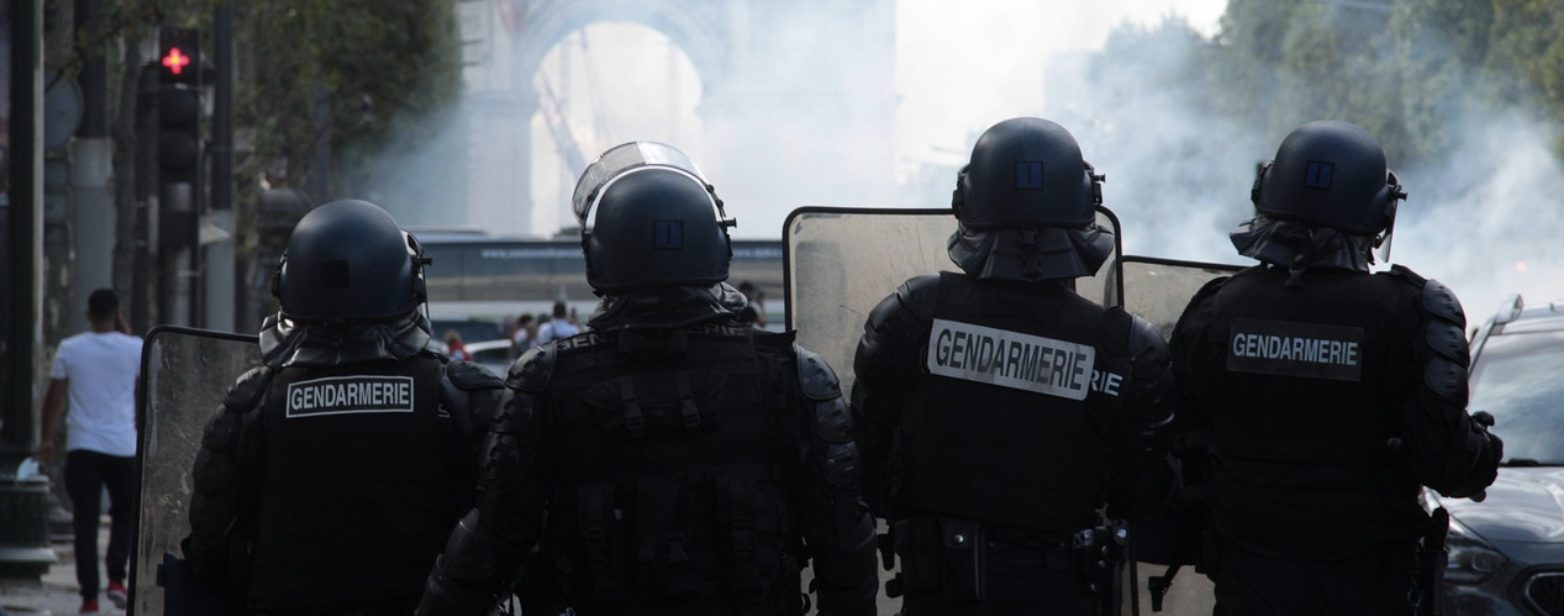
The interventions and tactics used by the police and CRS (Compagnies Républicaines de Sécurité) in the (mostly) peaceful protests and demonstrations have also played a significant part in amplifying the outrage, determination and defensive position of students. It should also not be forgotten that by nature, many of these protestors are minors. In many cities, crowds have been met with tear gas, riot shields and batons, leading many to deplore the ironic contrast between the lack of consideration given to student voices and the harsh repressive forces used to silence them. One viral protest sign read: “15 CRS pour 1 élève, mais 1 prof pour 30” (15 riot police for 1 student, but 1 teacher for 30 students) highlighting the police’s disproportionate response to the protests and that, ironically, if the government invested such extensive resources in the first place, there would be no protests to quell. Another reads: “Trop jeune pour être écouté, assez grand pour être gaze” (Too young to be listened to, old enough to be tear gassed). In two other notable instances, a 16-year-old was blinded by a police bullet, and another 15-year-old lost their hand to a stun grenade. Although the government reports to have launched inquiries into cases of potential police misconduct such as this, for the most part, they continue to defend the police’s use of force as a necessary and proportional reaction to combat the protests. As such the police’s ongoing presence continues to cause concern and unrest.
15 riot police for 1 student, but 1 teacher for 30 students
Another notable cause of public contention is the police’s use of Snapchat to infiltrate group chats with highschoolers and collect information on protest plans and attendees. The officer, who adopted the alias ‘Mamadou’, sent the message that has since become a mocking slogan of the movement: “Bismillah c’est les ténèbres… on vas tout casser” (Bismillah it’s the darkness… we’re going to break everything) accompanied with Algerian flag emojis. This language reveals a shocking and disappointing truth about the state of the French police. Firstly, the use of a traditionally Arabic name, along with the Arabic word ‘bismillah’ (traditionally used to begin a Muslim prayer and used incorrectly in this context) and the Algerian flag emojis, all suggest an attempt to imitate a stereotyped Maghrebi, Muslim persona, to appeal to their racist, perceived demographic of the protestors. Secondly, ‘on vas tout casser’ (using a grammatically incorrect conjugation of the verb ‘aller’ meaning ‘to go’) not only speaks to the assumption that young people, and members of the movement, are less intelligent, but also presupposes and even incites violence and what was otherwise planned to be a peaceful demonstration.
The use of a traditionally Arabic name…Algerian flag emojis, all suggest an attempt to imitate a stereotype[]…to appeal to their racist, perceived demographic of the protestors
From what I’ve witnessed during my time in Aix-en-Provence so far and the experiences of my peers in other universities across France, there seems to be no obvious end-in-sight for this mobilisation lycéene and the disruption it’s causing. Despite Prime Minister Sébastien Lecornu ordering ministers to tackle the students’ demands before the end of October, it is extremely unlikely that satisfactory educational reform will be achieved or afforded within their already strained budget if it is possible at all! In fact, with France’s presidential election soon approaching in 2027, some students are vowing to continue protesting until President Macron’s removal from office. If anything, it is likely that with these elections more protests will emerge as Marine Le Pen and Jean-Luc Mélenchon battle for office and the tensions between the far-right and left wing in France reach boiling point. To that I say bon courage à tous et à toutes!
If you enjoyed this article, why not read these articles from Redbrick Comment?
Surveillance, Meta Glasses & Kylie Jenner
What is the point of International Women’s Day anymore?
The US Midterms: What’s Next for Trump?
Comments